By Kotaku | Created at 2026-10-09 14:46:37 | Updated at 2026-10-09 16:27:43
2 hours ago
By Kotaku | Created at 2026-10-09 14:46:37 | Updated at 2026-10-09 16:27:43
2 hours ago
“A lot of people are saying that it’s time the games industry was unionized,” said Tim Schafer. “They say people who make games are overworked, underpaid, and taken advantage of. What do you think?”
An audience of hundreds of game developers began to awkwardly chortle and groan in response to this question, posed by Schafer at the 2019 Game Developers Choice Awards (GDCA) in San Francisco, California. He continued, “I am not anti-union, but I don’t really think we need ’em, guys. I mean we’re doing fine, right? We’re all great here, and in this show, and no one here is union—oh, God.”
The spotlight on Schafer suddenly went out, leaving him in darkness. The audience laughed, this time heartily. “That’s right, except for the lighting crew, I forgot they’re all union. Okay, you guys-“
Schafer kept speaking, but his words became undistinguishable as his mic was tuned to make him sound like a squeaky cartoon character who’d gobbled up too much helium. More laughs from the audience as Schafer continued speaking, seeming to apologize to the audio people as well. As he continued, the video screen behind him changed from the GDCA logo to a black screen with the words, in all-caps, scrolling by over and over: UNION! UNION! UNION! The audience began to cheer.
Schafer’s mic went back to normal: “I hear you, I hear you, this is a union show, and we’re better for it. Fine, all right? Thank you. Thank you Local 16. I guess there are unions all around us, and we somehow live to tell the story.”
Over seven years later, Schafer’s own long-standing studio, Double Fine Productions, still doesn’t have a union. It almost did, earlier this year, when a majority of eligible employees filed a petition with the National Labor Relations Board to start one. But the petition was withdrawn just two weeks later, leaving those employees union-less just a month before its then-parent company, Microsoft, enacted a devastating, Xbox-wide reorganization plan.
Microsoft cut Double Fine loose from the stability of first-party studio membership to pursue its own destiny, adrift financially with its games and IPs, yes, but limited financial runway. 23 people were laid off shortly after, including all eight of the union organizers who’d signed their names on the union petition withdrawal letter to the studio.
“I don’t want to sound like I’m trying to influence anybody,” Schafer told me in September. “I would say in general I’m pro-union and I think the games industry treats people terribly, and I can see where the need for protection comes from. I mean the game industry in a lot of places crunches people, burns them out, then lays them off, and it’s like…any time a union activity starts, I feel like the industry has been asking for it by the way they treat employees.”
Significant parts of the game industry have unionized, including Sega of America, and multiple massive teams within Microsoft/Xbox, including Zenimax and Blizzard. So why didn’t it work at Double Fine? The answer depends on who you ask. I spoke to 15 current and former Double Fine employees on all sides of the union fight, reviewed Slack messages from throughout the brief but explosive two-week-long union campaign, and spoke to Tim Schafer in person at PAX West to hear his perspective on what happened.
Six months later, the only thing that’s not in dispute is that labor organizing at one of the video game industry’s most progressive studios has stalled, and in the wake of the failed effort are feelings of grief, confusion, and betrayal.
The indie darling
Founded by Schafer in 2000, the Psychonauts developer has been known for years for its warm, creative, and progressive internal culture. Much of that has been shown off publicly through the Double Fine Adventure! and PsychOdyssey documentaries by 2 Player Productions, which are extraordinarily rare both in their transparency, as well as the mainstream attention they attracted for an indie studio. These series catalogue Double Fine from 2012 to 2021, chronicling the development of both Broken Age and Psychonauts 2, including the studio’s acquisition by Microsoft in 2019.
But no documentary catches everything, and certainly not organizing efforts, which are traditionally conducted in secret. The seed for unionization at Double Fine was actually planted years ago, at GDC 2018, when Game Workers Unite passed out fliers and spoke openly about the benefits of unions. The energy escalated significantly after Schafer’s 2019 GDC speech, and grew even more when Microsoft acquired the studio later that year. Among other reasons for organizing, at the time, was that a number of employees felt a need to protect themselves and their colleagues from unwanted interference by the new parent company.
Others, though, had concerns about working at Double Fine specifically, especially after a meeting that took place in fall of 2019. The meeting is recorded, partially, in the documentary PsychOdyssey, and multiple sources referred to it as the “Bad Meeting.” This team meeting was initially convened by Schafer to discuss concerns raised in Slack by programmer Amy Price that Double Fine would have to crunch to make set deadlines on Psychonauts 2.
What’s shown in the documentary of the meeting is certainly tense and uncomfortable, but according to multiple people who were there, the full context of the meeting felt even more hostile. They say a number of people seemed to “dogpile” on Price, repeatedly shooting down her concerns and even beginning to frame their disagreement in ways that felt, to observers, like personal attacks. They say that some, not depicted in the documentary, tried to defend her. One person I spoke to described the meeting as a “witch trial.”
[Then-senior producer Kevin Johnson claimed on Twitter in 2021 that Psychonauts 2 was made with “no crunch,” but multiple sources I spoke to asserted that this experience was not universal across the entire studio.]
Several people I spoke to told me that this meeting was emblematic of what they believed to be a larger power imbalance at the studio, where those with less influence and social cache had no safe way to raise serious concerns. That meeting was a catalyst, cementing for some that employees needed a better way to air grievances. A union seemed like a good option.
However, Double Fine employees’ first attempt to organize didn’t get very far. Employees involved were still in very early talks when, at one union-related meeting of interested coworkers, conversation grew heated between one initially supportive-seeming person and some of the others. One individual who was present claims that this person’s rhetoric escalated, the meeting grew heated, and at least one other person was left in tears. According to those familiar with the aftermath, the emotional impact of that meeting left several then-organizers feeling hurt and uninterested in continuing action at the time. While it’s possible that efforts would have picked back up again, the COVID-19 pandemic’s onset in 2020 sent everyone home from the studio and in-person gatherings, curbing further organizing talks.
Culture clash
Organizing talks began anew around 2024. At first, it was just a small group discussing what it would look like to revisit the idea. But in late 2025, Schafer announced that all new hires were now required to be in the Bay Area, and existing Bay Area–based employees were encouraged to come into the office twice a week. Though not a mandate on paper, some people told me they felt there was an unspoken pressure to start showing up after years of reordering their lives around remote work. Some were frustrated with this, and that grievance sparked union interest once again.
As discussions continued, other reasons to unionize were raised, many the same as before. Microsoft’s ownership came up often, organizers told me. People cited fears around the encroachment of generative AI, or that the parent company would eventually shut Double Fine down as it had multiple other studios before, or that it would conduct potential mass layoffs. Some people who had largely positive experiences at Double Fine simply saw unions as an inherent good that could help protect what they already had—and to be clear, many of those I spoke to had glowing things to say about Double Fine’s work culture, praising the studio’s collective ability to work through problems and support one another, particularly through Double Fine’s many financial ups and downs.
But again, some joined the union effort citing concerns about Double Fine specifically. Across my conversations with multiple sources, I heard a handful of stories regarding issues at work such as sexual harassment, alcoholism, and bullying that sources claim went unresolved for far too long, at times for months, after being reported. [Schafer responded to this in our interview: “I reacted immediately. I mean those were like instant.”]
“As an organizer on the committee, you hear about a lot of things happening to your colleagues that shouldn’t happen anywhere to anyone, even if you don’t experience those things firsthand,” one organizer told me.
Then there was Schafer himself. Founder of Double Fine and studio head since its inception, Schafer cut a larger-than-life figure both externally and internally. He was beloved by fans and well-liked as a boss within Double Fine, including by most of the union supporters. He routinely did public appearances and interviews in which his casual, charismatic attitude drew in attention and love for Double Fine. Those I spoke to largely agreed that he was an excellent spokesperson for the studio.
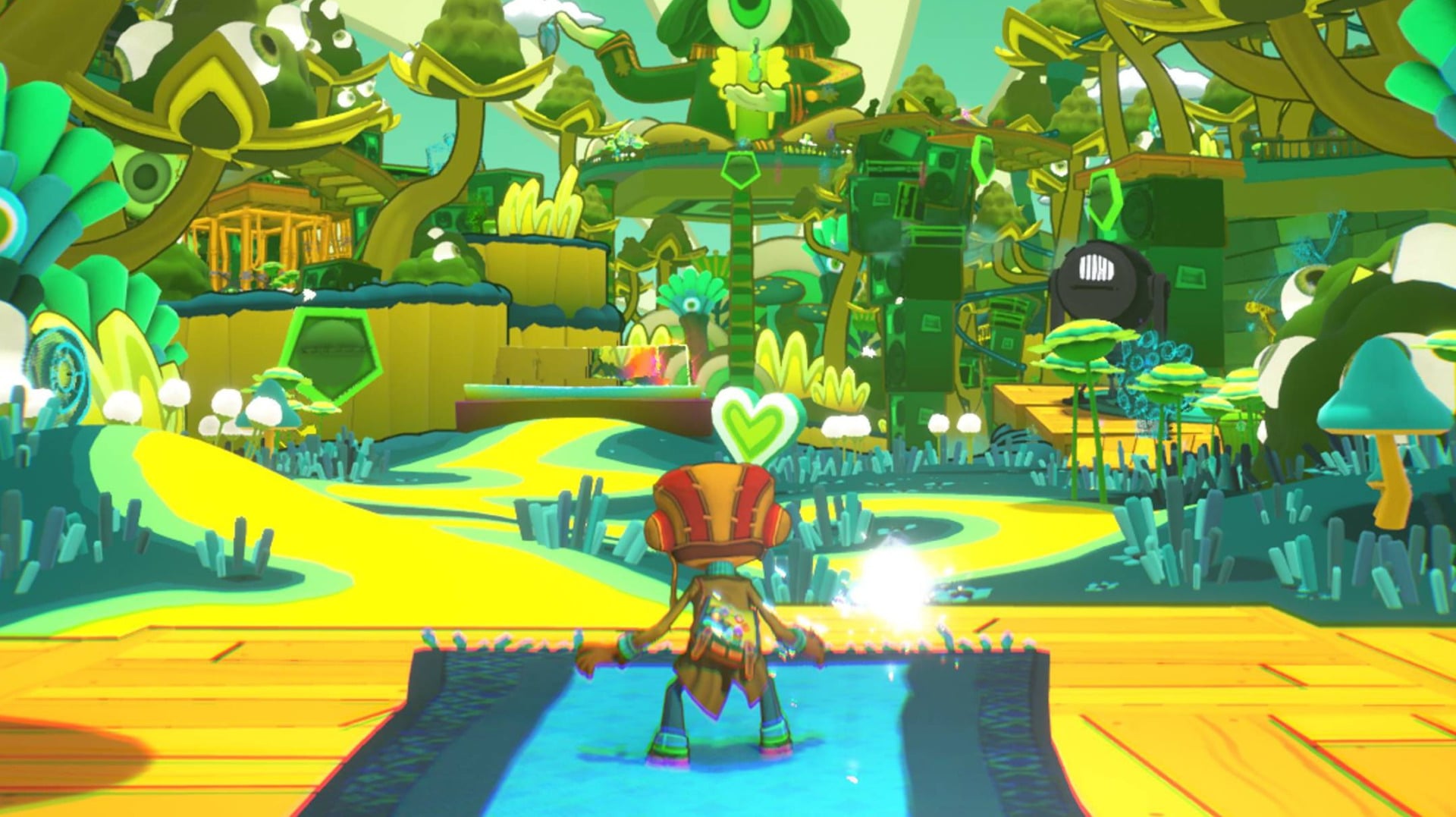 © Double Fine
I was also told by many that Schafer’s opinion carried great weight at Double Fine not just as a boss, but as a publicly-visible, well-liked social leader of a very tight-knit studio, a beloved colleague who often played board games and hung out outside of work with his reports. Over and over, I heard people express fear that their ability to succeed or fail at Double Fine was intrinsically linked with not just how Schafer felt about them personally, but by extension how senior members of the studio who were themselves close with Schafer felt about them. To some who joined the studio after the days of games like 2009’s Brutal Legend, this potential social stigma hanging over them felt unfair and uncomfortable.
“One of the things that is truly exceptional about [Double Fine] is that there are many people who work at the studio who have been there a really long time, like over 20 years,” one employee told me. “And those people generally feel very close to Tim, and they generally feel protected by Tim in a way that other people who don’t have their experience might not. That if something bad were to happen to the company, like, for example, if Microsoft were to end our contract and cut us loose, they would still have a job. Because they’ve been there.”
Schafer responded to these concerns at length in our interview, but here’s a portion of what he had to say on this:
“It’s up to me to work on it, so everyone feels comfortable talking to me. I’ve tried to take more of the new people out to lunch than I have had time to do before. I feel like the fact that they’re still there, hopefully they realize that we value them, and they’re important to us. I mean, that’s the trick. Why would someone feel like they couldn’t talk to me? It’s always going to be a big problem for me to figure out, because I try to be really open to everybody and welcome them. And it’s like, there’s people that I’ve worked with for 25 years who are very important to me, obviously. And I feel like I have the right to those relationships with those people. The right to say, I have trust with this person who’s worked on ten games and never let me down.”
Union organizers recognized that the power Schafer held over studio culture and opinion could be make-or-break for a burgeoning union effort. As another organizer told me:
“There are [other] workplaces where the boss is an asshole, everyone hates him, hell yeah we’re gonna unionize. But everyone [at Double Fine] just knew, implicitly…if we could get [Schafer’s] approval, we’d be set. If it was something where he’s like, ‘Well technically I’m supposed to be neutral, but I wouldn’t be upset if you all unionized,’ that would be…it’s happening. That’s victory. If, on the other hand, he said, ‘What the hell are you talking about? I don’t like that at all,’ we’d be screwed.”
Organizers suggested speaking to some of the more senior members of the studio who were closer to Schafer to gain a bit more understanding of where he might stand on the idea, but this proved challenging. Those people who were closer to Schafer also tended to be managers, and thus ineligible to be in the union. Speaking with them was risky, and CWA representatives advised caution. Friendly as Double Fine could be, it would only take one person mentioning the union to someone higher up at Double Fine or even Microsoft to out their efforts before they were ready, which could be catastrophic. And this would also be dangerous for the managers they might speak with: if a manager got involved in the union efforts, then was not eligible for the union, there was always a chance they could face retaliation from Microsoft or other management while lacking the protection a union would offer in such a situation.
Even more challenging was determining who even was eligible for the union in the first place. Decisions about eligibility are typically worked out between the workers and management after the union has gone public, but burgeoning unions still need to make educated guesses on eligibility beforehand so they know who might be safe to speak to. But that process is becoming more and more difficult, especially in tech. U.S. labor law was written at a time when lines between bosses and workers were far clearer: bosses were not in unions, and regular employees were. Modern-day, white-collar work is fuzzier, video game development even more so, and Double Fine perhaps even more so than most studios.
As organizers came to realize, a sizable portion of Double Fine’s staff had been “managers” by some definition, at some point. Maybe they only managed one person, or maybe they had been in charge of a project that was eventually finished or canceled. Some were currently in leadership roles on projects that conferred some decision-making power, but had no direct reports. A few people were HR-adjacent, but not officially HR. What’s more, a lot of Double Fine’s most senior staff had moved overseas during the pandemic. While their roles remained unchanged, they were legally classified as contractors, who are legally ineligible for such a union.
Organizers say that their CWA contacts told them this confusion was not unusual in the games industry. It was a serious, ongoing problem with labor law that numerous games studios were actively dealing with.
“The game industry is chaotic, where people get suddenly promoted when someone leaves, people get promoted just because they did a really good job with something, stuff like that,” said one former employee. “There’s a cultural effect of that, which is just that over time, more and more people feel like they’re part of studio leadership and identify as studio leadership. They feel like they have a stake.”
While organizers tried to untangle the eligibility question, slowly but surely, the group of certain eligible supporters grew. CWA recommends workers build to roughly 80 percent (or close to it) support before going public: while a simple majority is all that’s needed to win a union at a workplace, having a supermajority helps proof against the impact of any potential union-busting campaigns. By the time Double Fine’s union went public, they had support from roughly 75 percent of employees they believed to be eligible. The full list of people believed to be eligible, however, consisted of just under half of Double Fine’s total employees.
Labor neutrality neutrality
Double Fine’s union drive came at an unusual time for both the studio and CWA. Back in 2022, Microsoft announced a “labor-neutrality agreement” with CWA ahead of Microsoft’s acquisition of Activision Blizzard, pledging to “take a neutral approach when employees covered by the agreement express interest in joining a union” and setting up an internal system to allow employees to easily vote to form a union and receive Microsoft’s recognition in the event of a simple majority without having to go through a long, drawn-out process with the NLRB. It also published a set of principles for how it would approach employee organization.
This agreement was originally announced specifically for Activision Blizzard employees, representing an attempt to pacify concerns about labor rights and smooth the path for Microsoft to close its acquisition. Later, ZeniMax staff were included as well, seemingly opening the possibility for other Xbox subsidiaries to be covered. However, the agreement officially expired in 2025, and at the time Double Fine’s organizers were preparing to go public, it hadn’t been renewed. Organizers were told by their CWA representatives that CWA and Microsoft were in active negotiations over a renewal, but were also told that negotiations had stalled, with seemingly no resolution in sight. Microsoft/Xbox declined to comment to Kotaku for this piece.
Because of that, Double Fine workers were encouraged to petition anyway, and organizers were told that CWA reached out to Microsoft lawyers to ask for a temporary commitment to neutrality for Double Fine workers. However, organizers believed that this outreach would have the knock-on effect of tipping off Microsoft that Double Fine was about to unionize. Assuming that Microsoft lawyers would inform Double Fine management, organizers at Double Fine felt they had to announce a few weeks sooner than they may have wanted to, and went forward with their petition on May 7, 2026.
The union was not announced publicly, but rather with a vision statement posted internally to the company’s Slack, signed with the names of all the union supporters, most of whom had also signed union authorization cards. The estimated number of eligible people at that time was in the 40s, and 32 people signed the petition.
 © Double Fine Action Union
“The video games industry is always changing, and we appreciate all the ways in which studio leadership has had our backs in the face of that chaos,” read the petition. “Through unionization and collective bargaining, we can do things that leadership alone cannot, with a transparent and democratic process that advocates for workers in all disciplines: Creative, technical, production, and operations.
“We believe this is the next logical step to making Double Fine the best it can be in all respects: a workplace where we can build careers we are truly proud of; a unique creative studio with a loving, global fanbase; a beacon within our industry, showing the world that games are made by human beings; and finally, a place where everyone looks out for one another.
“We are stronger together, and that is how we intend to build our union.”
In Slack, the first threaded reply message didn’t come until 18 minutes later, from a senior, ineligible employee. It read as follows:
“Is this something that will be voted upon by all of the employees at Double Fine? This seems to be coming out of nowhere and I’ve heard nothing about this. Were there meetings that excluded employees and therefore voices and opinions out of the discussion?”
Frequently asked questions
In the hours that followed, a thread began to develop under the announcement message as employees who had been unaware of the union up to this point began to react. Many of them seemed surprised, but genuinely curious, and union organizers replied to some of the questions with more information about how the process would work, and why some of their colleagues were ineligible.
However, over the course of the thread, the tone began to shift, with more openly concerned and even negative voices speaking up. Several self-admittedly ineligible people expressed discomfort with having not been told about the union in advance, suggesting that all employees should have a say in the decision, even ineligible ones. Multiple others, again mostly (but not entirely) ineligible, stated that they supported unions generally, but a few also argued that unionizing wasn’t right for Double Fine due to its unusual make-up.
One person wrote: “[I]f anything this is going to break the link of trust with management and what made DF special in the first place. I’m not part of this union…so I was not aware of it and my opinion doesn’t really matter, but I don’t agree with this. It just makes me sad that it had to come to this. DF is not that kind of place.”
On Monday, May 11, the studio had its first all-hands meeting since the union announcement at 11:30 a.m, but it was anything but usual. Schafer got up in front of the company and read a prepared statement—something the very casual, charismatic Schafer rarely did—explaining that a union petition had been filed and that Double Fine managers needed to remain neutral. Many I spoke to who were there recalled Schafer being emotional as he read. His voice was shaking. He seemed “rattled” and “scared.” As soon as he finished reading, Schafer left the room. Shortly after the meeting, he sent around a “Unionization Frequently Asked Questions” document to staff.
In speaking to people from across Double Fine, it’s become clear that the experiences of its employees over the following two weeks varied wildly depending on where they stood on the union: supportive or unsupportive, eligible or ineligible. From union supporters and organizers, I heard numerous descriptions of surprising, unsettling, and even what some felt were emotionally manipulative interactions with coworkers who were in opposition to the union both on Slack and in the office, which led to them feeling attacked by their peers.
This included managers. Legally, the only union-related prohibition for managers was that they could not give employees their opinions on unions or encourage them one way or another. But several union supporters said they directly heard managers express concerns that they were no longer allowed to speak to their employees about anything, and a few people told me their own managers or senior members of their teams stopped speaking to them entirely, even about the games they were working on. “They helped enforce this narrative where you couldn’t talk to people when nothing about neutrality required that to happen,” said one union supporter. “Supporters who were confused saw that, and bought into it.”
Other union-supportive employees told me they received the cold shoulder from people they didn’t work closely with, but had previously been friendly with. There were accusations of strongly anti-union employees trying to scare off prospective members, sharing hypothetical or even at times outright false information about the impacts a union would have at Double Fine, or making what sources asserted were false accusations about the organizers themselves and their tactics.
Many union supporters pointed at a couple of employees in particular as the source of much of the discord, and specifically one person came up over and over: the same employee from the meeting that ended the 2019 union effort. This person, they said, had a significant amount of social influence internally at Double Fine, and was eligible for the union, but was using that influence to immediately and proactively try to turn their colleagues against the idea of a union. One person recalled hearing them worrying out loud in the office in front of others that Double Fine would never be able to have another Amnesia Fortnight (its popular internal game jam) again if there was a union. Multiple people said they witnessed them yelling at another employee about the union in the office, bringing them to tears. [This employee did not respond to my request to speak for this article.]
Because Double Fine has so many remote workers who wanted to weigh in, a Slack channel was created specifically for union discussion. Only non-managers were allowed in. A large number of these posts, screencaptures of which were shared with Kotaku, expressed concern and fear that the union was inherently excluding a large group of employees. A notable portion of this conversation was driven by the same anti-union employee who was so vocal in the office. Among other things, this employee posted snippets of the National Labor Relations Act and interpreted them for their peers, at times incorrectly. At one point, they posted a segment from a Q&A about whether or not employees could be terminated under a union contract, saying, “Good luck everyone!” In another message, they claimed the union effort had created “an unsafe working environment” and said that some of their peers had shown “that they are not safe to be around,” seemingly just because of their stance on unions.
 © Double Fine
Union organizers attempted to step in and correct misinformation at several points. But they felt under attack by their colleagues, particularly as more and more people began to adopt these same talking points. When some people called for a town hall that would allow people to query the organizers, that same employee volunteered to spearhead it. Organizers declined. Some still recalled “The Bad Meeting” from years before, and they didn’t want to repeat the experience, especially with someone who they felt was actively hostile to their cause moderating the event.
The CWA had also coached organizers on not getting caught up in fielding a laundry list of arguments or criticisms. Rather, they were advised to continue addressing colleagues one-on-one over calls, focusing on answering genuine concerns from individuals, and avoiding leaving a workplace paper trail that could result in future retaliation against them or those they spoke with. And those I spoke to said they did try to reach out to everyone who expressed concerns—many just didn’t respond, or only wanted to speak in a group setting. “We didn’t want there to be a whole drawn-out debate about unions on the company Slack,” said one organizer.
But while the organizers tried to figure out how to respond to what they said was a surprising and unexpected wave of opposition, mostly from those who were ineligible, many of the messages in Slack were growing increasingly personal. One person, who acknowledged they were left out of discussions due to “confusion” around their eligibility, said “Emotionally, I feel like I lost my job last Thursday. That’s how I feel. I am in mourning, but I see others in celebration, and I can’t twist myself into enough knots to see and understand the path to celebration.”
Others spoke of feeling outright betrayed by the union effort. “I have never been scared about losing my job until that letter came out,” wrote the same employee who had been leading much of the anti-union discussion in a Slack message. “It has created both uncertainty of Double Fine’s future, and an unsafe working environment for a lot of people at DF.
“…TBH seeing some of the names on that list is incredibly heartbreaking…I’m going to retreat now and hopefully pull some of the knives out of my back.”
In and out
In addition to organizers and eligible pro-union employees, I also spoke to those who were ineligible, on the fence, or actively opposed. Some ineligible employees I spoke to told me they were genuinely confused and hurt by the union effort’s seeming unwillingness to address just how many individuals were left out. One told me that while they understood why they were legally ineligible, they still felt excluded from a community they had been a part of for years. They were also frustrated at their inability to get answers from organizers as to how manager determinations and eligibility would work, particularly given the company’s regular Amnesia Fortnight events where anyone in the company could temporarily become a project lead on a game. They described organizers as “weirdly evasive” in answering direct questions and insisting on one-on-one conversations with their colleagues, and said they felt uncomfortable with their refusal to engage in a big group discussion, which they say is how the studio had historically collectively tackled difficult issues.
“We are a tiny studio, very tight knit,” they said. “And the organizers didn’t really have answers for any specific/direct questions, nor did they seem to have considered the impact unionizing would have on some of the best developers at the studio. There were people who didn’t seem to be bothered by that outcome, or maybe they felt the union was more important to them, which was their choice, but generally nobody wanted to leave anyone out of the conversation here, and unionizing meant a very clear divide between ‘managers’ whenever it applied, and non-managers. Like…what kind of support could the effort get when it cut out the people who literally built this place? We have absolute legends here who deserve a seat at the table when it comes to any future, and that’s not just Tim.”
Another ineligible individual I spoke to told me that personally, they were pro-union, and went into the situation with an open mind. However, the events that unfolded in the hours and days that followed the announcement soured them on the idea. They told me they attended a meeting with other employees about the union, eligible and ineligible non-managers. “It was one of the only times I felt there was an open and real discussion about the union,” they said.
“I was shaken by some of the things that were told to me by people whom I consider to be some of the most trustworthy in the company. I left that discussion with questions that felt like they needed answers. I wanted to know why certain people [who] had been considered ineligible were in fact absolutely eligible. I wanted to know why certain eligible people were saying they had been given incorrect information by the people who had approached them about signing. There were other red flags as well, things that seemed off about the whole thing, but I really don’t think it’s for me to share as they are personal stories.”
For the most part, those I spoke to who ended up opposed to the union told me their main concern was around eligibility: the large number of people left out, the current nebulousness of who would be in or out, and what a dividing line between union and non-union employees might do to the company, its culture, and its many benefits. They emphasized that this was especially concerning given Double Fine’s long history of open communication and solving problems as a large group—what would happen if suddenly, half the studio couldn’t be a part of that process? They also didn’t understand why organizers couldn’t satisfactorily answer what they saw as basic questions about how the union would work, and why they seemed to want to avoid public discussions in favor of one-on-ones, which they saw as potentially manipulative.
However, some other ineligible employees who were uninvolved with the effort told me they were personally appalled by how quickly the tide turned on the union. One ineligible manager told me that “the conversations just made me feel astounded at the immense dysfunction I was seeing,” which was compounded when they attended a meeting with Microsoft for managers weeks after the union petition was rescinded “where I got to hear the other managers vent about how they didn’t know how to talk to people anymore and how they didn’t feel like they could be critical of performance, lest they anger the union.”
Both they and two other ineligible sources I spoke to agreed that while the eligibility issue was a problem, this wasn’t about being excluded or included. It was just a real, legal situation. If you weren’t in the U.S., or you had power over other employees, you couldn’t be in the union.
“Pro-union people in general tried to stick to just talking about procedures and process, trying very hard not to organize a union in a company-controlled, company-monitored channel, as that clearly could count as trying to organize a union on company time and on company grounds,” one ineligible employee told me, explaining what they observed in Slack.
“Anti-union people seem[ed] to have absolutely no boundaries. They would post multiple pages as Slack comments gushing about Tim and how much Double Fine meant to them and how hurt they were about the union attempt. This was done by employees that were both eligible and ineligible for the union. They would often also demand specific answers from pro-union people even though those could not reply freely.
“…Seeing how quickly people who supported unions in other companies turned against their colleagues who are pro-union made me think that a union was very much needed at Double Fine, because it was clear that those anti-union people in no way would have the back of their colleagues if anything bad happened and it became an us-versus-them situation.”
Stronger together
In the second week after the union was announced, one by one, some who had signed authorization cards began to retract them. Some did so quietly. Others announced their withdrawal in Slack and apologized to their colleagues. Many cited the reactions from their colleagues and the overall negative atmosphere as a reason for the retraction.
At least two claimed they’d been given misleading information before signing, saying they were unaware of the sheer number of ineligible people there would be. [Organizers I spoke to told me they did not intentionally mislead anyone, but said they understood that discussion of how many people total across the organization supported them could have been made clearer pre-announcement.]
“For over a year, we listened to and supported our colleagues, even cried with them about their experiences. Now to be told we had misled them was bewildering,” one organizer told me. Another said they ran a “by the book” campaign by CWA standards, and noted that all their messaging had been positive.
“There was no point at any of the OC [organizing committee] meetings that I attended for over a year where we were like, ‘Oh yeah, we’re really gonna get ‘em,’ or ‘We’re really going to fuck this [place] up.’” they said. “Why would we do that? We have a studio we like working at. I can’t get over the willingness [of those who were anti-union] to believe the worst of your coworkers’ intentions, that’s one of the hardest things to swallow for me.”
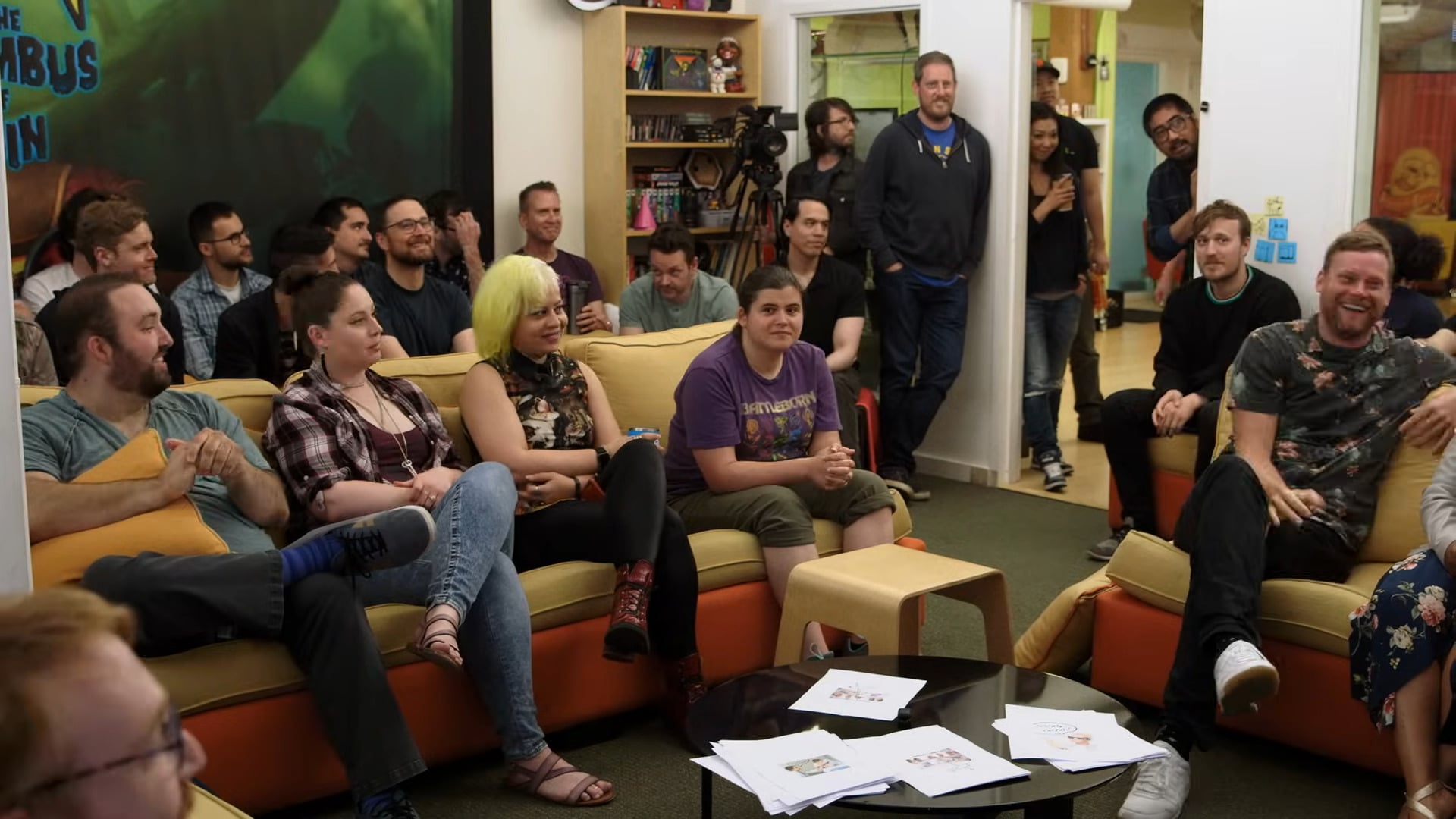 © 2 Player Productions, Double Fine
Initially, the union organizers wanted to craft a new statement and ask their remaining supporters to sign on, hoping to still have a majority with which to continue forward. But even with a majority, the loss of so much support would result in a weak, ineffective union. The effort had been dealt a fatal blow.
On May 20, two weeks after the union’s initial announcement and filing with the NLRB, the organizing committee withdrew its petition for a union, and posted an announcement of such in Slack:
“When it became open knowledge that a majority of union-eligible workers decided to see more rights and protections through organizing our union together, that was met with negative reactions and then pressure quickly rose. We care about our coworkers more than anything, that’s why we organized.
“We want people to have the time and space to decompress and allow for more productive conversations in the future. With that in mind, we are pulling our petition with the National Labor Relations Board.”
The message was signed by eight of the then-current organizing committee members, and concluded with an invitation to a Q&A session later that week for anyone who wanted to know more about unions. One month later, all eight of those organizers would be laid off.
It was also a shocking setback for the CWA’s labor organizing efforts that have been so successful in other parts of the game industry, including at Microsoft, where multiple unions across Activision Blizzard and Zenimax have now both organized and won contracts. “CWA staff and workers engaged in the organizing campaign used a time-tested organizing model that supports workers to win successful union drives,” a spokesperson said when asked about what went wrong. “We do not, however, comment on the internal dynamics of specific organizing campaigns. When workers are retaliated against for engaging in concerted, protected activity, they are able to file Unfair Labor Practice charges per the National Labor Relations Act.”
Double Fine, independent again
On June 10, just weeks after the petition was withdrawn, Xbox CEO Asha Sharma published an email to the company claiming that Xbox would need to undergo a “reset,” that it had spent too much on studios it was not equipped to maintain, and that the company would need to face some harsh realities, and soon.
A week later, reports began to surface that Double Fine was at risk, facing closure if it couldn’t be successfully spun off independently. Three weeks after that, it was announced that Xbox would lay off 3,200 people in the coming year—1,600 of them immediately, the rest later— and was undergoing a massive restructuring that would see Double Fine and three other studios go independent.
While all of this was happening, tensions over the union drive remained. For supporters, the once-warm and jovial vibe of the studio had grown cold, and no one seemed to know how to fix it. Three people told me they continued to be ostracized by some of their peers who would no longer, or would barely, speak with them.
Others disagreed with the idea that the fallout was that severe.
“I’m surprised to hear the supporters felt attacked, all the discussions were impassioned but also very respectful!” one ineligible employee who told me they stayed mostly out of the union discussions said.
“…I guess I don’t really consider the very valid questions some people wanted to have answers for before deciding as attacking anyone. Maybe they expected immediate, unanimous support and were surprised that people didn’t just get along to go along? I don’t know. That’s speculation on my part. I genuinely thought that, while it was obvious people had different opinions on the what and how of it all, that it was clear everyone who spoke publicly collectively cared deeply about the studio.”
The spin-off from Microsoft precipitated new fears. Would there be layoffs? Would Double Fine get to keep ownership of its games? Would the studio even have enough runway to survive for long without Microsoft’s backing? The answer to these questions came rather quickly. On July 28, 23 people were laid off from Double Fine amid the split. These layoffs took place after Double Fine’s departure from Xbox, and Schafer was the final deciding voice as to who stayed and who went. Among those 23 were all eight organizing committee members who had signed the letter to the studio announcing the petition withdrawal. The majority of the rest, though not all, had been vocally or, in a few cases, privately supportive of the union, even if they’d been ineligible to join it. In total, the layoffs comprised roughly one-fourth of Double Fine.
“People felt like [the union] was dividing the company, that there would be people who would be in the union and people who would not,” said one organizer. “Old-timers wanted to know why they needed this if they couldn’t be a part of it, said it was putting them in a weird position. The majority of the company can’t be a part of the union, that feels weird. There was this response, this division, ‘the union is dividing us,’ and my take is, well, there already is a division…that division was made really fucking clear when people got laid off.”
When I asked Schafer directly about this accusation, here’s what he said:
“I mean, that’s definitely not the reason. Like, we didn’t target people for layoffs…we’ve done how to save people from [the] beginning. Of like, who we most desperately need to make these games. We’ve never retaliated against anyone for anything. We’ve had union activists in the company for 15 years. Posting freely in our Slack, and it’s always been fine. I mean, we still have union activists in the company who can post about it now. So I don’t think we’ve ever shown a tendency to retaliate against people. It’s just like, the people we saved, you know, we do favor things like seniority when you’re protecting people from layoffs. And I think that probably influences the patterns of it, you know?”
Most of those I spoke to who were laid off in that wave told me that the severance package felt unusually generous. They suspected this was the result of Schafer negotiating with Microsoft, and were grateful to him for doing so, though Schafer elaborated a bit more on that process in my interview as well. One union-supportive person pointed out the irony that, had the union been successful and layoffs had taken place, the group would have been able to negotiate with Microsoft for severance like the other unions were doing. However, that same person acknowledged that a union may not have been able to secure as good a deal as Schafer had.
 © Double Fine
Still, others remained deeply critical of Double Fine management. Several told me they wished that top leadership, Schafer or HR, would have stepped in to at least cool the rhetoric on Slack and in the office even if they couldn’t speak about unions specifically. And as one person told me:
“Management absolutely mishandled the situation…The manager training was weeks late and landed after the brunt of the drama. The lack of direct communication made an already clique-y culture even worse. And studio leadership overall was not only extremely influenced by their proximity to Tim, but there was a large amount of ignorance towards the role of a union or how they work.”
In the weeks and months since the petition withdrawal, those at Double Fine who had openly or even privately supported the union tell me they have laid low, afraid of further retribution or ostracization. “It feels like they want you to leave,” one person said. “And it’s working. I’m looking for other jobs.” Unfortunately, as they and others pointed out to me, the games industry job market is so bad that jobs are in short supply.
That decision could still be made for them if Double Fine cannot find a way to support itself. The studio has just completed its crowdfunded Amnesia Fortnight, which successfully raised $678,942 of a $400,000 goal to greenlight the winning game, Plot Armor. In theory, a successful release of Plot Armor would buy Double Fine some time for bigger projects that take longer to develop. Without that, though, Schafer told me that Double Fine’s runway from the split with Xbox is “a matter of months.”
I spoke with Schafer for around an hour at PAX West in September about what happened before, during, and after this two-week period. Again, you can read the full transcript of our interview here, which includes his responses to questions about how involved Microsoft was, how he reacted to what happened, and how he feels about this two-week period now, months later, amid the rest of the chaos his studio has undergone. But here I’ll share his response to my final question, where I asked if he would have done anything differently regarding the Double Fine union if he could go back and do it again:
“We were all just doing the best we can. I don’t know. I mostly stayed out of it. I had to stay out of it. I couldn’t have changed a lot of stuff I did, mostly, my hand was forced with everything that happened. I would have to have gone back a year previous and worked on bringing more people to feel in, from the outside in, in the company. Maybe once it started, everything I did was kind of prescribed.
“I think it’s been a very trying year. And I think we did the best we could, and can do, considering we’re still alive and we still have a lot of people who are very happy at the company. And I think we did pretty well. But we’re not perfect, and I’m sorry there are people out there who have had a bad experience.”
With so many of the organizers gone and the internal tone being what it is, it seems unlikely that a Double Fine union will reemerge any time soon. But in spite of everything, of those organizers I spoke with, not one regretted having tried to form the union.
“We need unions, more than ever,” one organizer concluded. “In order to start pushing back on some of the terrible things that are happening in our world, labor is a driving force in how these organizations, these companies, the government, works. They need us, our labor, to make their billions. Anybody, if you’re reading this, you should unionize. If you are seeing people being mistreated in your office and nothing’s being done, you should unionize. Remote work being discontinued, unionize, AI being adopted, unionize. If you hate the Trump administration, unionize. I think about the EA workers now who are owned by Jared Kushner and Saudi oil, you should unionize, nothing good will come of these people owning your work. They will bleed you and spit you out. Unions are the bare minimum that we have to fight against stuff. We can be a collective force when shit hits the fan.
“Some people didn’t feel they needed a union at Double Fine. But other people did. And if you are for unions, if you are for labor rights, maybe, hey, you don’t feel like you need it, great. Then what’s the harm in that happening? What do you think is going to happen to you? And if you do think something is going to happen to you, what? Why? What that tells me is you know that things are not right, but you are too afraid to stand up and fight for your fellow co-workers.”