 By Miltary.com | Created at 2026-08-14 13:55:58 | Updated at 2026-08-14 16:41:54
2 hours ago
By Miltary.com | Created at 2026-08-14 13:55:58 | Updated at 2026-08-14 16:41:54
2 hours ago
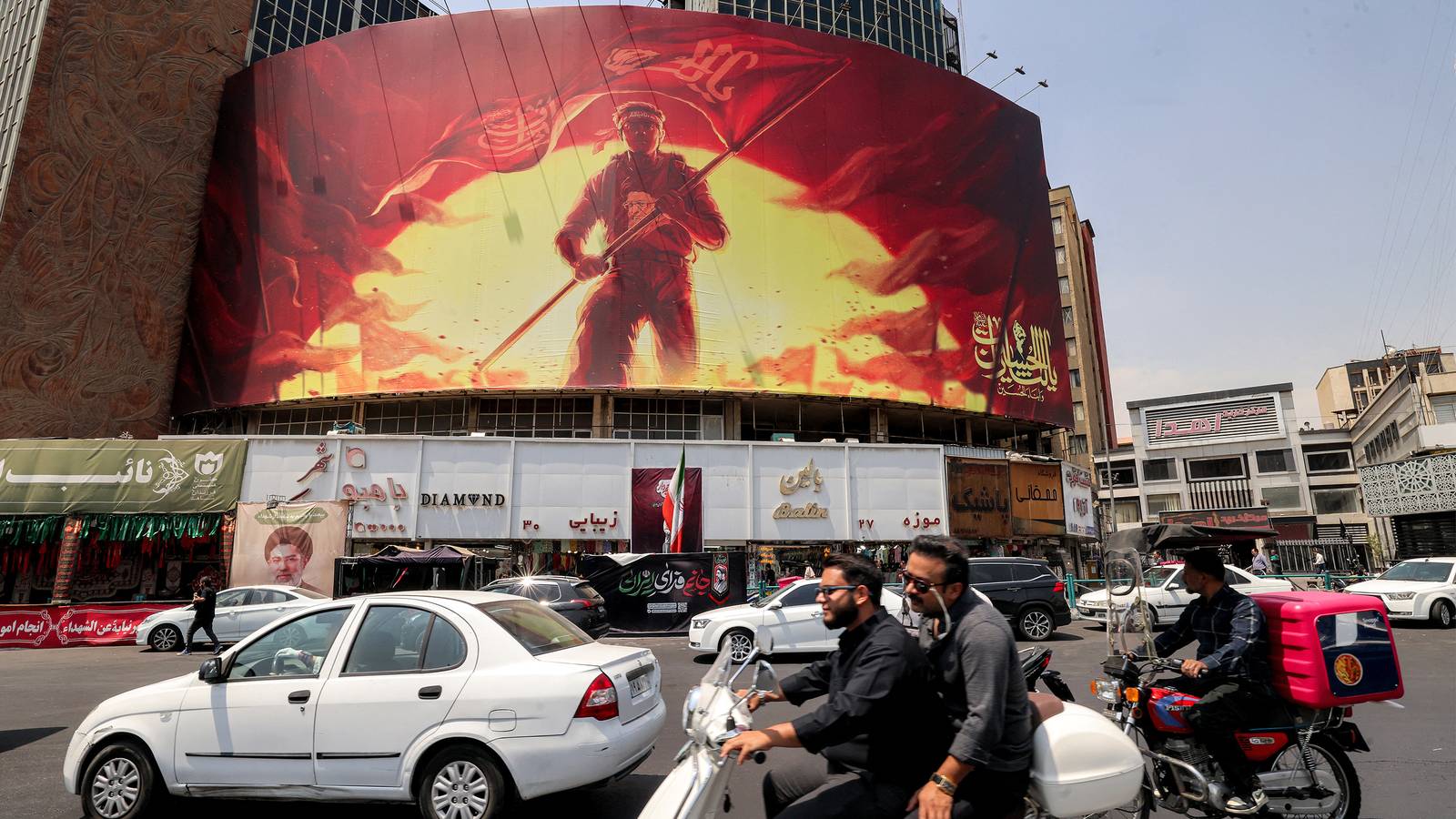 Motorists drive past a political billboard at Valiasr Square in central Tehran on Aug. 8, 2026. Hopes for an imminent US-Iran deal to end the blockage of the Strait of Hormuz added to optimism that oil and gas, along with other key products, would again start flowing freely after more than five months of war. But oil prices turned higher ahead of the weekend in the absence of any confirmation of an accord, amid reports that Iran was planning to block
 Originally published by Bloomberg News
In a little over a decade since starting her business in Tehran, Nazanine has weathered U.S. sanctions, successive currency collapses and two wars. This is the first time she’s had to use credit to buy groceries.
Since the U.S. and Israel began bombing Iran in late February, the 56-year-old has been forced to lay off staff and forgo any non-essential spending to cope with surging costs. Living alone makes it easier but, sometimes, she still falls short.
“There are days when I don’t have any money,” Nazanine said, asking that her last name and the details of her company be withheld due to the sensitivity of speaking with foreign media. “It really helps to buy my weekly shopping in installments.”
The conflict is transforming the spending habits of Iranians, whose purchasing power has evaporated under nearly-80% inflation and a currency that’s lost almost 30% of its value this year. Decades of sanctions, corruption and poor management strangled the economy well before the war, but U.S.-Israeli strikes have deepened the hardship, destroyed key infrastructure and killed thousands of civilians.
Almost six months since the start of the war, U.S. President Donald Trump is betting that intensifying economic pressure on the Islamic Republic will succeed where military force has failed. He has maintained a months-long naval blockade on Iran’s busiest sea ports, as the two countries remain deadlocked over control of the Strait of Hormuz.
Iran has managed to navigate economic isolation for years, but economists warn that the conflict may drag it into one of the worst economic crises in the history of the nation of 90 million people.
Across Iran’s capital, shop windows are covered in signs advertising interest-free credit and buy-now-pay-later plans. Popular for years for durable goods like furniture or kitchen appliances, their use has surged since the war as retailers extended the option to basic necessities, including food, according to state media reports and almost a dozen people Bloomberg spoke to in the country. Most asked to remain anonymous for fear of reprisals.
Vulnerable and poor Iranians already make up some 70% of the population, estimates Hadi Kahalzadeh, a non-resident fellow at the Washington-based Quincy Institute.
“Buying food and everyday necessities in installments is one of the clearest signs that inflation has moved from a macroeconomic problem into the structure of daily life,” he said.
This poses a challenge for Iran as it pushes back against Trump’s threats and demands. Two months before U.S. and Israeli strikes began, a slump in the rial triggered violent nationwide protests that evolved into a major challenge to the Islamic Republic’s leadership. Thousands were killed in the ensuing crackdown and the judiciary has continued to punish protesters, executing 27 people linked to the unrest since March, according to the United Nations’ top human rights official.
The International Monetary Fund said in April that it expected Iran’s economy to shrink 6.1% this year, the fastest pace since the mid-90s, with inflation at a record 70% — steep even for a country with one of the world’s highest rates. The Iranian government estimates the first six weeks of the war caused $270 billion worth of damage to the economy.
Nazanine, the business owner in Tehran, says eye-watering price rises are putting huge pressure on families but supermarkets remain, as yet, well stocked. During this year’s month of Muharram, one of the holiest in the Shia Muslim calendar, she saw no sign of shortages, with people distributing large amounts of free food throughout the city as part of traditional nazry offerings.
Sanctions and worsening international isolation have forced Iran to steel its economy against external threats, pivoting to Asia as the U.S. and the E.U. sought to ban imports of its oil and it was cut-off from international banks.
“Over time, Iranian firms and the government have found alternative markets, intermediaries, payment mechanisms, and transport routes,” said Mohammad Reza Farzanegan, economics professor at Philipps-Universität. “Oil exports, for example, have increasingly been redirected toward China.”
Iran has said shipments continue to defy efforts by the U.S. to throttle them, but export levels are a fraction of what they were before Trump returned to office.
The surge in payment plans and credit in what’s traditionally been one of the Middle East’s biggest cash-based economies is itself a sign of the country adapting to a fresh cycle of economic hardship.
Mahmoud, who runs a small business selling audio and video equipment in Tehran, said installments and credit have been vital for retailers to retain customers. He too uses them frequently to buy essential goods.
“The interest built into installment plans pretty much offsets inflationary expectations,” Mahmoud, who didn’t want to be identified by his full name when speaking to foreign media, said. “Sellers feel more confident selling at current market prices, which keeps cash flow moving.”
Iran remains one of the most industrialized economies in the Middle East, its gross domestic product per capita roughly on par with that of Egypt, Morocco and Tunisia.
The economy has been at the heart of a fierce political debate, mostly waged by hardliners, over whether Iranian officials should keep engaging with the U.S. when, they say, all efforts to negotiate with Trump have resulted in Iran being bombed.
High profile hardline clerics like Ayatollah Ali Arafi, who stood as interim Supreme Leader after Ayatollah Ali Khamenei was killed by the U.S.-Israeli strikes that started the war, have explicitly told officials not to restart diplomacy.
“Do not continue the negotiations,” Arafi said last month, according to the semi-official Tasnim news agency. “Officials should not, on the pretext of economic problems and fear of the costs of war and striking infrastructure, continue the path of negotiations with infidels any further.”
Kahalzadeh believes Iran is likely to redirect resources to military efforts and effectively shift the burden onto the population. The very mechanisms that help bypass external pressure — such as state control, informal trade or reduced imports — undermine the economy and household welfare.
“These measures help avoid immediate collapse, but they also leave us with high inflation, unemployment and poverty,” Kahalzadeh said, likening the overall impact to a “resilience trap.”
At the start of the century, Iran was the Middle East’s biggest economy. Now, it trails many of its neighbors like Saudi Arabia or the United Arab Emirates. GDP per capita has declined in nominal terms.
Majid Reza Hariri, a businessman and head of the Tehran-based Iran-China chamber of commerce, warned that the U.S. blockade is more harmful than the war. Land and rail routes can never offset maritime trade that Iran relies on and has been losing, he said in an interview published Monday in the semi-official KhabarOnline.
Officials mustn’t allow the economy to acclimate to the blockade like it has done with sanctions, he said.
For all of its resilience, Iran risks being tilted into a full wartime economy for the first time since it was invaded by Iraq, in 1980.
A prolonged naval blockade would likely result in “serious shortages of food, fuel, medicine, industrial inputs or foreign exchange,” Farzanegan said, with expanded rationing and price controls probable.
___
©2026 Bloomberg L.P. Visit bloomberg.com. Distributed by Tribune Content Agency, LLC.