By The Rio Times | Created at 2026-08-04 05:50:18 | Updated at 2026-08-05 22:39:30
1 day ago
By The Rio Times | Created at 2026-08-04 05:50:18 | Updated at 2026-08-05 22:39:30
1 day ago
Key Facts
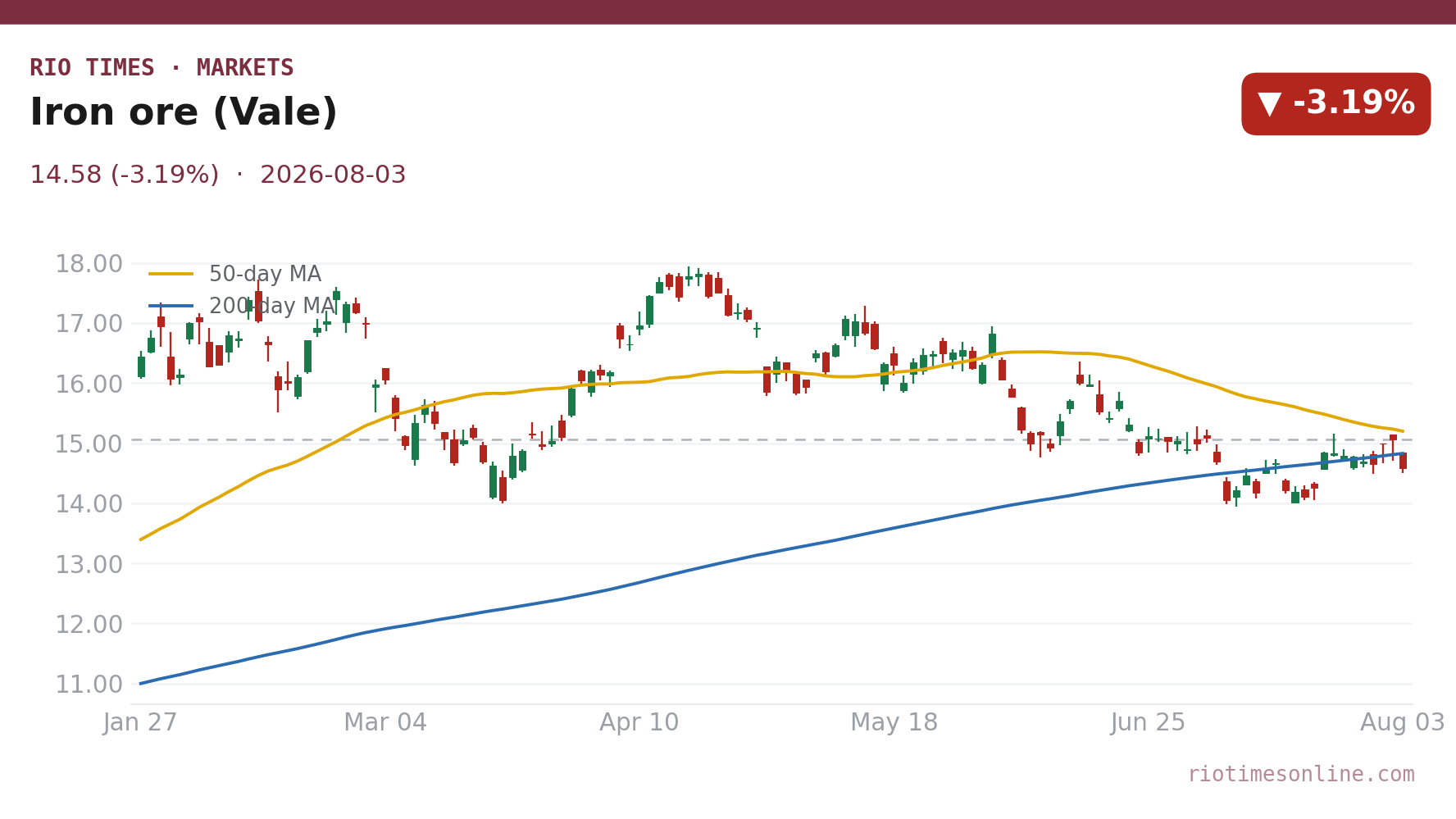
- Vale’s New York-listed ADR fell 3.19% to US$14.58, serving as the primary equity proxy for seaborne iron ore prices into China.
- China’s steel mills are weighing modest government stimulus signals against persistently weak construction orders that cap near-term demand for the raw material.
- Brazil’s CSN Mineração shares edged up 0.17 per cent to R$5.73, showing marginal domestic resilience even as global miners traded lower.
- Rio Tinto’s US-listed stock slipped 0.98 per cent to US$95.90, reflecting broader caution among the Australian majors feeding the same Chinese customer base.
- Iron ore is the primary ingredient for steelmaking, linking the fortunes of Brazil’s Vale directly to construction and infrastructure spending across China.
- No spot iron ore price is quoted on the Rio Times feed, so foreign investors track Vale, Rio Tinto and CSN Mineração as real-time proxy instruments for the commodity.
Today’s Focus
Iron ore proxies held steady-to-firmer on Tuesday as China’s steel complex digested a fresh round of modest government stimulus signals. Vale’s American Depositary Receipt, the most liquid iron ore equity proxy for global investors, traded at US$14.58. The ADR gives foreign buyers direct dollar‑denominated exposure to Brazil’s largest miner, which ships the bulk of its ore to Chinese blast furnaces.
The move reflected a market caught between hope and hard reality. Beijing has been drip‑feeding support measures aimed at infrastructure and manufacturing, but construction orders—the biggest source of steel rebar demand—remain soft. That tension prevented Vale’s shares from building on any early momentum while still keeping them above the previous session’s close.
Brazil’s CSN Mineração provided the session’s bright spot, adding 0.17 per cent to finish at R$5.73 on the São Paulo exchange. Rio Tinto, Vale’s Australian rival and fellow China supplier, fell 0.98 per cent to US$95.90 as traders booked profits following a modest recent uptick. The divergence showed that investors are differentiating between Latin American and Australian iron ore exposures, though both ultimately answer to the same Chinese customer.
Foreign investors watching from outside Brazil have no iron ore spot price on the Rio Times feed. Instead they follow the equity proxies: Vale in New York, CSN Mineração in reais, and global miners like Rio Tinto. Those instruments translated a weak session in the physical ore market into a broadly negative equity picture.
What matters today. Iron ore proxies fell because weak Chinese construction demand outweighed modest stimulus chatter, with Vale’s ADR down 3.19% to US$14.58.

01 The session in one read
Iron ore equity proxies fell on Monday as traders weighed Chinese stimulus headlines against the stubbornly weak construction data that ultimately determines how much ore China’s mills consume. Vale’s New York‑listed ADR changed hands at US$14.58, down 3.19% from its prior close.
The ADR serves as the most direct, liquid proxy available to foreign investors who cannot see a live spot iron ore price—Vale’s revenue is overwhelmingly tied to the fines and pellets shipped from its Brazilian mines to Chinese steelmakers. That proxy told a story of a market willing to hold position but not yet to chase.
Assessment — China property caution caps rally MEDIUM
The steady outcome suggests iron ore markets are in a holding pattern, absorbing Beijing’s willingness to support growth without yet seeing that support flow into actual steel orders. Vale’s ADR at US$14.58 lacks a catalyst to push higher while China’s property completions and new housing starts remain depressed. The variable to watch is any official announcement from China’s housing ministry on presale delivery guarantees, which would directly translate into rebar demand, steel mill margins and ultimately the loading schedules at Vale’s Brazilian ports.
02 The board
Three equity instruments capture the iron ore complex for Rio Times readers, each quoted in its native currency. Vale’s US‑dollar ADR at US$14.58 anchors the board, representing the world’s second‑largest seaborne iron ore exporter. In São Paulo, CSN Mineração gained 0.17 per cent to close at R$5.73, a rare positive print among the major proxies.
The move in CSN Mineração, a smaller but pure‑play Brazilian iron ore miner, suggests domestic investors saw slightly better value after a recent drift lower—or perhaps judged that Brazil’s competitive freight advantage to Chinese ports relative to Australian rivals would matter more in a stimulus‑driven uptick. Rio Tinto, the London and New York‑traded Australian giant, fell 0.98 per cent to US$95.90, giving back a portion of earlier gains as traders reassessed the timing of any China demand recovery.
| Iron ore (Vale) | US$14.58 | -3.19% |
| CSN Mineração | R$5.73 | +0.17% |
| Rio Tinto | US$95.90 | -0.98% |
Source: EODHD close, 2026-08-03. Where a commodity has no spot feed, an exchange-traded tracker or leading producer is shown as a labelled proxy.
Live Market IntelligenceThe live market boardInside: market breadth, the sector heatmap, currencies & rates, the Latin America scoreboard and the full instrument board.Rio Times · Live Market Intelligence
Latin America — Cross-Market Board
Regional
Aug 4, 2026 · 02:46
Ibovespa · benchmark
178,000.24 +0.00%
+33.86% over 12 months
Market breadth · 4 names
25% advancing
1 ▲ advancing3 declining ▼
Currencies, rates & key inputs
Latin America scoreboard
IndexLastTodayStrength
IbovespaBrazil 178,000.24 +0.00%
S&P/BMV IPCMexico 66,700.17 -0.35%
S&P IPSAChile 11,049.58 +0.30%
S&P MERVALArgentina 3,274,443 -0.51%
MSCI COLCAPColombia 2,384.67 -0.31%
BVL S&P PerúPeru 57,378.30 —
Full instrument board
| IBOV | 178,000.24 | +0.00% | +33.86% | 177,999.00 | — | — | — |
| IPSA | 11,049.58 | +0.30% | — | 11,016.85 | 11,063 | 10,970 | 1,513,213,483 |
| IPC MEX | 66,700.17 | -0.35% | +17.74% | 66,935.53 | — | — | — |
| MERVAL | 3,274,443 | -0.51% | +43.16% | 3,304,918 | — | — | — |
| COLCAP | 2,384.67 | -0.31% | — | 9.04 | 9.05 | 9.02 | 4,133 |
| BVL PERÚ | 57,378.30 | — | — | — | — | — | — |
| USD/BRL | 5.09 | +0.29% | -8.10% | 5.07 | 5.09 | 5.09 | — |
| EUR/BRL | 5.86 | +0.08% | -8.65% | 5.85 | 5.86 | 5.85 | — |
| USD/MXN | 17.30 | -0.22% | -8.30% | 17.34 | 17.33 | 17.29 | — |
| USD/CLP | 925.12 | -0.04% | -2.30% | 925.48 | 925.12 | 925.12 | — |
| USD/COP | 3,231 | +0.88% | -21.62% | 3,203 | 3,231 | 3,230 | — |
| USD/PEN | 3.38 | -0.40% | -2.52% | 3.39 | 3.39 | 3.37 | — |
| USD/ARS | 1,494 | +0.54% | +10.56% | 1,486 | 1,494 | 1,494 | — |
| USD/UYU | 40.27 | +0.17% | +3.16% | 40.20 | 40.27 | 40.27 | — |
| USD/PYG | 5,936 | +0.08% | -18.27% | 5,931 | 5,936 | 5,936 | — |
| USD/BOB | 12.07 | -0.25% | +82.02% | 12.10 | 12.07 | 12.07 | — |
| USD/DOP | 58.13 | +1.72% | -1.73% | 57.15 | 58.13 | 57.96 | — |
| USD/CRC | 448.42 | +0.00% | -7.62% | 448.40 | 448.42 | 448.42 | — |
Largest moves today
USD/DOP 58.13 +1.72%
USD/COP 3,231 +0.88%
USD/ARS 1,494 +0.54%
MERVAL 3,274,443 -0.51%
USD/PEN 3.38 -0.40%
IPC MEX 66,700.17 -0.35%
COLCAP 2,384.67 -0.31%
IPSA 11,049.58 +0.30%
The session read
The Ibovespa was little changed 0.00%, with breadth negative — 1 of 4 names higher. IPSA led, while MERVAL lagged.
V
◆ Live Company Intelligence
Vale
NYSE: VALEVALE3Basic MaterialsOther Industrial Metals & Mining65,805 employees
$64.09B
Market cap
Analyst target $16.87
Wall Street view
3.9Moderate Buy/ 5
14 Buy12 Hold0 Sell
Avg. price target $16.87 · +14% vs 200-day
Valuation & profitability
Market cap$64.09B
Revenue (TTM)$214.86B
P / E ratio22.8
Profit margin0.0%
Return on equity6.8%
Price & risk
52-wk low
$9.0452-wk high
$17.94
Beta (volatility)0.73
200-day average$14.81
Revenue trend · 6y
20202025
Latest $38.23B
Ownership
Institutions21.6%
Shares outstanding4.26B
Top holderCapital World Investors
Institutional holders5+ funds
Dividend
No regular dividend — earnings reinvested for growth.
What Vale does. Vale S.A., together with its subsidiaries, produces iron ore and nickel in Brazil, Asia, the Middle East, North Africa, Europe, the Americas, and Oceania. The company operates in two segments, Iron Ore Solutions and Vale Base Metals. It extracts, produces, and distributes iron ore, iron ore pellets, briquettes, nickel, copper, other ferrous…
03 What moved it
The session’s decline came from two opposing forces. Chinese authorities signalled continued support for infrastructure investment, with provincial governments accelerating bond issuance for transport and grid projects—a signal that steel demand has a policy backstop. That prevented Vale and CSN from sliding.
Offsetting the stimulus narrative was the physical reality inside China: construction companies report thinner order books, and steel service centres hold elevated rebar inventories relative to the pace of domestic sales. Until those secondary trades translate into primary blast‑furnace demand, iron ore equity proxies are stuck waiting.
04 The Latin American read
For Latin America, iron ore is far more than a single company’s stock price. Brazil’s export revenue, its trade surplus with China, and the fiscal health of mineral‑rich states like Minas Gerais and Pará all tie back to the same fundamental question: how much ore can Vale ship at a price that supports royalties, jobs and tax receipts.
Vale’s ADR at US$14.58 gives a US‑dollar read on that entire chain. The Rio Tinto figure of US$95.90 reminds Latin American exporters that competition from Australia’s Pilbara region remains intense, particularly on freight costs to northern Chinese ports. CSN Mineração’s modest gain to R$5.73 shows that Brazilian onshore investors read the same stimulus signals but apply a local lens, factoring in a weaker Brazilian real that makes dollar‑denominated ore revenues more valuable in São Paulo terms.
05 The names to watch
Vale is the dominant name for any foreign investor seeking Latin American iron ore exposure—its New York ADR provides instant, dollar‑settled access. CSN Mineração offers a pure‑play Brazilian alternative, listed in reais on the B3 exchange, with a narrower focus on the domestic mining and export chain.
Rio Tinto, while an Australian company, competes for exactly the same Chinese customers Vale serves, making its US‑listed stock a useful cross‑check. When Rio Tinto and Vale diverge sharply, it often signals a change in relative freight competitiveness or a shift in Chinese buyers’ preference for higher‑grade Brazilian ore over Australian fines.
06 The outlook
The iron ore equity complex enters the rest of August with a clear-if-narrow path: further Chinese policy measures could spark a rally in Vale and CSN, while any disappointment in construction data could tip proxies back toward recent lows. Vale at US$14.58 sits near the middle of a range that has frustrated both bulls and bears, and the lack of a decisive spot commodity price visible on most terminals means equity proxies will carry an outsized signalling burden for the market.
07 What to watch
- China property presale delivery data: Any official guarantee of completion for stalled housing projects would boost rebar demand and directly lift Vale and CSN Mineração shares.
- Freight spread between Brazil and Australia to China: Widening or narrowing freight costs change Vale’s competitiveness against Rio Tinto, visible in their relative share price moves.
- Brazilian real exchange rate: A weaker real inflates the reais value of Vale’s and CSN’s dollar‑priced ore revenues, often lifting their São Paulo‑listed shares.
- Steel mill profit margins in Tangshan: Margins are the best real‑time indicator of whether Chinese mills can afford high‑grade Brazilian ore or will switch to cheaper Australian fines.
Frequently Asked Questions
Why can’t I see an iron ore spot price on the Rio Times feed?
Iron ore does not trade on a single liquid futures exchange with a public feed. Instead, the market follows equity proxies like Vale’s New York ADR to track price direction.
What does Vale’s ADR tell me about iron ore?
Vale is the world’s second‑largest seaborne iron ore exporter and China is its biggest customer. The ADR price at US$14.58 reflects investor bets on ore demand, supply and freight costs.
Why did Rio Tinto fall while CSN Mineração rose?
Rio Tinto slipped 0.98 per cent to US$95.90, while CSN added 0.17 per cent to R$5.73, likely reflecting different investor bases and currency effects rather than a fundamental shift in iron ore trade flows.
How does China’s economy affect iron ore proxies?
China produces more than half the world’s steel. Construction and infrastructure spending there directly determines how much iron ore Vale, Rio Tinto and CSN can sell, and at what price.
This article was produced by The Rio Times’ automated newsroom system. How we use AI · Report an error
LatAm Markets: Live Signals → — real-time movers, turnover leaders and FX across Latin America.
The Rio Times · Power Map
See who really holds power in Latin America
Click to open the Power Map →