By The Straits Times | Created at 2026-08-01 21:16:33 | Updated at 2026-08-02 23:12:24
1 day ago
By The Straits Times | Created at 2026-08-01 21:16:33 | Updated at 2026-08-02 23:12:24
1 day ago
SYDNEY – A steep drop in Australian home prices fuelled by the federal government’s move to curb tax breaks for investors has prompted analysts to question whether one of the world’s most spectacular property booms could finally be ending.
Over the past 30 years, prices in Sydney, Australia’s most populous city, have surged by over 730 per cent, with the median price rising from A$215,000 – or less than six times the median income – to about A$1.8 million (S$1.6 million) – more than 13 times the median income. The nationwide housing boom, fuelled by high migration, falling interest rates and a shortage of housing supply, has created one of the world’s most expensive property markets.
But a downturn is under way.
Property prices in Sydney and Melbourne, the country’s two largest housing markets, have fallen by 4.5 per cent since the start of 2026, including drops of at least 1 per cent in the past month, according to Cotality, a property research firm. Auction clearance rates – the proportion of auctioned properties that sell – have fallen to their lowest levels since the early days of the Covid-19 pandemic in 2020.
The chief economist at financial services firm AMP, Shane Oliver, told The Straits Times that he believes there is a “significant” chance that Australia’s long-term boom could be over.
He said the factors that had led to the boom since the mid-1990s had gone from “tailwinds to headwinds”. For instance, the shift to two-income households has “probably run its course”, the benefits of financial deregulation which made securing loans easier have been fully realised, and the gradual trend towards a lowering of interest rates had ended, with no further expectation of a long-term series of rate drops.
“We have been in a long-term boom which took prices from below trend to above trend and price-income ratios to levels never seen before,” he said.
“Some of those things that have supported the long-term boom are now petering out or going in the opposite direction.”
Price drops have recently extended to smaller cities, such as Brisbane and Adelaide, while Perth, which had a 23 per cent leap in prices in the past year, has ended its boom and shows signs of the beginning of a decline.
The chief economist at real estate firm Raine & Horne, Nerida Conisbee, told ST that the market had been softening following interest rate rises in February, March and early May but the slide was accelerated by the federal government’s surprise move in its budget on May 12 to scrap tax breaks for property investors.
The changes restricted negative gearing – allowing property investment losses to be claimed as tax deductions – to newly built properties only, and are set to remove a 50 per cent discount on capital gains taxes from July 2027.
“We are going through a big period of uncertainty,” said Conisbee. “Investor activity has pulled back; open home attendances are very low. Things are very weak.”
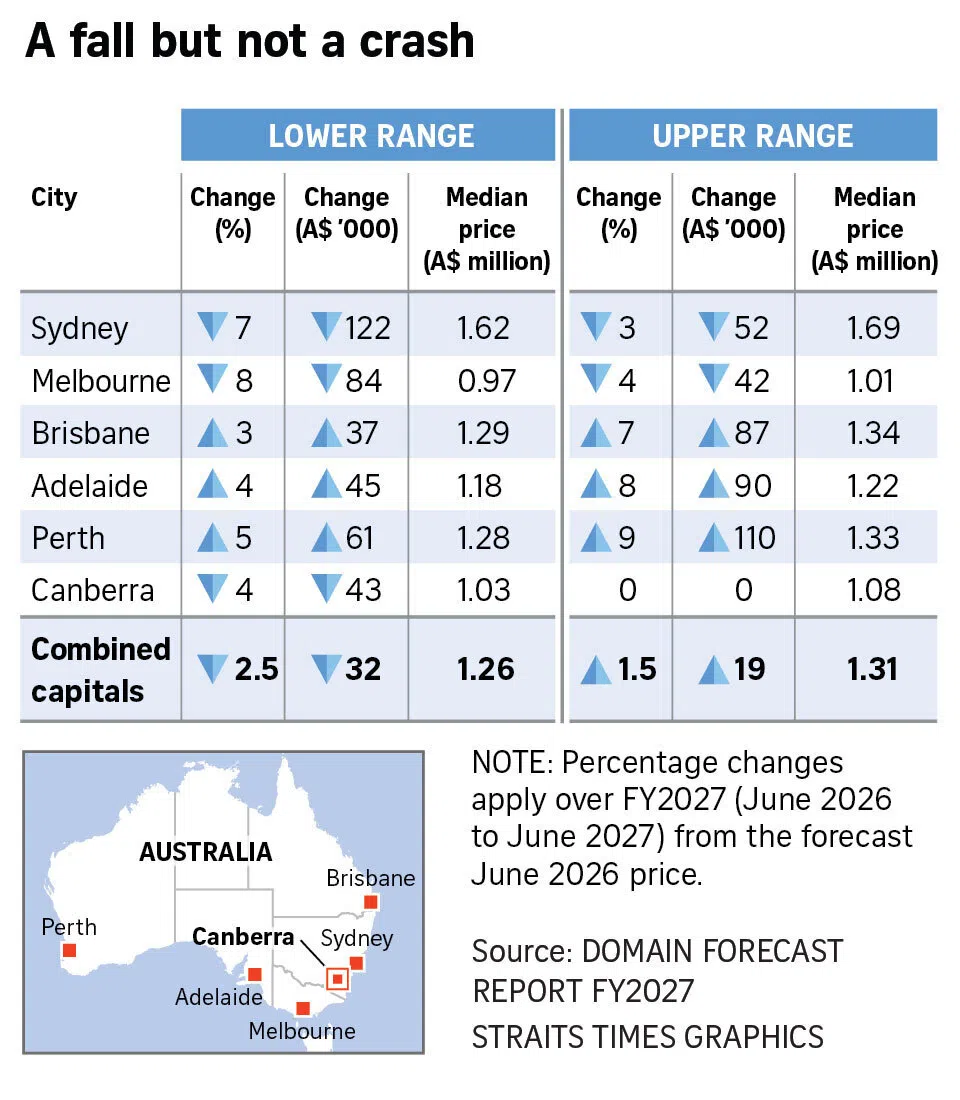
Most analysts believe that the downturn is set to worsen but is unlikely to develop into a full-blown crash that would end the decades-long boom and restore affordability. Instead, Australia’s high levels of migration and shortage of housing supply are expected to keep a floor under prices.
AMP’s Oliver expects nationwide prices, which are down 2 per cent, will fall by a total of 7 per cent in the current downturn and that declines in Sydney and Melbourne could be as high as 11 per cent. He noted that migration remains high and a “chronic” shortage of housing has arisen as a result of population growth, the failure of zoning authorities to open land for development or allow higher-density properties, and rising labour and construction costs.
“I find it hard to see the conditions for a crash,” he said. “We would need higher unemployment. Currently the drops are being caused by tax changes and high interest rates, not forced selling.”
But he added: “The rebound may be more constrained. The tax changes introduce an element of uncertainty that was not there in previous cycles.”
Despite the recent falls, prices are still out of reach for many younger would-be owners, with the average house in Sydney now worth A$1.73 million.
Meanwhile, rents have soared in recent years and are continuing to rise. Despite a 3 per cent drop in home prices in Sydney in the past three months, median rent increased during this period by 1.5 per cent to A$841 a week. Rents in all cities have been increasing because of a low national vacancy rate of 1.6 per cent, which analysts say is due to the lack of housing.
Some analysts believe the government’s tax changes could lead to higher rents as investors seek stronger returns on their investments or avoid funding developments because of weakening prices, high construction costs and rising interest rates.
Property analyst Louis Christopher, founder of investor research firm SQM Research, told ST that he expects the removal of tax breaks to cause Australia’s relatively low rental yields – about 3.8 per cent – to increase to global averages of about 5.5 per cent. This is likely to occur through a lowering of property prices and increased rents over the next two to three years.
He said Australia was facing a “meaningful downturn” but was not facing the sort of conditions that had led to market crashes in recent decades in countries such as the United States, which faced an excess of supply and easy credit, or Ireland, which experienced easy credit and speculative developments. Like other analysts, he said migration-fuelled population growth and a lack of housing will lead prices to recover.
“For the time being, we will see improvements in (affordability),” he said. “Whether we get back to fair value, I don’t know. I think it is unlikely.”
The government said it introduced its property tax changes to address growing intergenerational inequalities as a younger generation has found itself priced out of home ownership.
A Resolve Political Monitor Poll published on July 14 found that 61 per cent of Australians supported the goal of lowering house prices and 10 per cent opposed, with 29 per cent uncommitted.
But it is unclear whether lower prices will improve the prospects of the ruling Labor Party, which currently has a slight lead in opinion polls.
“If prices come off a little bit, Labor won’t be affected,” said Oliver. “But if prices come off significantly and fall by more than 7 per cent, it could affect Labor. I’ve even heard some young people say after the budget that baby boomers got the benefit of negative gearing and then pulled the ladder up.”