By The Straits Times | Created at 2026-09-18 11:06:52 | Updated at 2026-09-18 12:32:18
1 hour ago
By The Straits Times | Created at 2026-09-18 11:06:52 | Updated at 2026-09-18 12:32:18
1 hour ago
TOKYO – Japanese Prime Minister Sanae Takaichi kept eight core ministers in place during a low-key Cabinet reshuffle on Sept 17, signalling policy continuity even as observers warn that her administration remains on shaky ground.
The eight lieutenants, including Defence Minister Shinjiro Koizumi, 45, Foreign Minister Toshimitsu Motegi, 70, and Finance Minister Satsuki Katayama, 67, were kept on because their posts involve building personal rapport with foreign counterparts or driving flagship policy priorities, Takaichi told a news conference.
Yet, the conservative Yomiuri Shimbun, Japan’s most-read daily, offered a stinging assessment of the revamp, observing that the choices betray a focus on “self-preservation” by an administration “standing on thin ice”.
The ruling Liberal Democratic Party (LDP) is gearing up for a leadership contest by September 2027 and Takaichi, 65, insisted her picks had “absolutely nothing to do” with the upcoming poll. But the Yomiuri noted in an analysis that her weak internal party base leaves her acutely vulnerable to backbench revolts.
“An administration loses momentum when cracks in its power structure are exposed,” the paper warned, adding that appointments intended to project stability “could end up serving as a prelude to ousting the prime minister”.
Cabinet reshuffles in Japan are traditionally crafted to inject momentum, lift sagging polls, and present fresh faces to a weary electorate. This shake-up arrives as public approval for Takaichi’s first Cabinet, inaugurated in October 2025, has slipped from around 70 per cent to a still-solid 50 per cent.
Analysts told The Straits Times that Takaichi’s political longevity hinges on the backroom power brokers who initially propelled her to power.
“The greatest strength of the Takaichi administration, which has a weak internal base, is her approval rating. If that plunges, she will be in trouble,” said Sota Kato, a resident fellow at The Tokyo Foundation think-tank. “Conversely, she will survive as long as support for her administration remains strong.”
Doshisha University political scientist Toru Yoshida noted that Takaichi’s public standing rests on an “expectation bubble” fuelled by the novelty of her being Japan’s first woman prime minister and her bold promises to ease economic pain.
“Because these hopes run ahead of reality, the situation is akin to a bubble,” Yoshida told ST. “If she fails to deliver, these high expectations can easily turn into intense backlash.”
Takaichi’s new Cabinet will be put to the test with a critical parliamentary session convening in October, where the legislative centrepiece will be her signature economic promise: a temporary two-year cut to the food consumption tax, slashing the rate from 8 per cent to 1 per cent, starting from April 2027.
While popular with the public, the proposal has unnerved financial markets. Takaichi has yet to identify a concrete funding source to cover the estimated 10 trillion yen (S$81.1 billion) tax revenue shortfall at a time when defence and social welfare costs are surging.
“Takaichi’s bold, expansionary fiscal policies are causing significant market volatility,” said Kato, who was formerly a trade ministry bureaucrat. “If inflation accelerates sharply, interest rates spike, or the yen depreciates rapidly, it will hit the economy and drag down her approval ratings.”
While Takaichi defends her fiscal strategy as “responsible and proactive”, market anxiety has already pushed benchmark 10-year Japanese Government Bond yields above 3 per cent for the first time in three decades. Meanwhile, the relentless weakening of the yen forced Tokyo and Washington into a rare joint currency intervention in July.
Beyond the fiscal battle, the ruling coalition is pushing a contentious plan to reduce Lower House seats. Tokyo is also preparing to revise its three foundational defence documents, including the National Security Strategy, by December.
In assembling her new team, Takaichi adopted an unprecedented selection process: she distributed detailed questionnaires to LDP Lower House lawmakers to assess their policy positions and preferred roles.
On the surface, she seems to have adhered to her previous tried-and-tested formula. The Cabinet’s average age stood at 59.1 years, barely changing from the 59.4-year average of her October 2025 line-up.
Those holding out hope for a breakthrough in gender representation under a female leader were once again left disappointed.
The reshuffle came just one day after the World Economic Forum released its 2026 Global Gender Gap Report, ranking Japan a dismal 117th among 145 nations. Nevertheless, Takaichi appointed only two women to her 18-member Cabinet alongside herself. Both were holdovers: Katayama, the finance minister, and Kimi Onoda, 43, as economic security minister.
Kato was unpersuaded that a female leader would champion gender parity, noting that Takaichi appears uninterested. He said: “The tendency for female leaders to be unenthusiastic about expanding quotas for women is seen in the corporate world as well, perhaps because they feel they reached their positions purely through their own effort.”
Meanwhile, Sophia University political scientist Koichi Nakano argued that Takaichi’s underlying political fragility explains why she appointed lawmakers previously disciplined in the LDP’s damaging 2023 slush-fund scandal. Kazuo Yana, the new Agriculture Minister, had failed to disclose 17.46 million yen, while Yoshihiro Seki, the new Education Minister, omitted 8.36 million yen.
Furthermore, while Takaichi sought to formalise the LDP’s fledgling alliance with the Japan Innovation Party by bringing a JIP lawmaker into government for the first time, Nakano felt that this choice introduces another potential banana skin.
Hiroshi Nakatsuka, the JIP’s secretary-general and the new Minister for Regulatory Reform, was convicted of corruption in 2013 for his role in a municipal bid-rigging scandal when he was the mayor of Hirakata city.
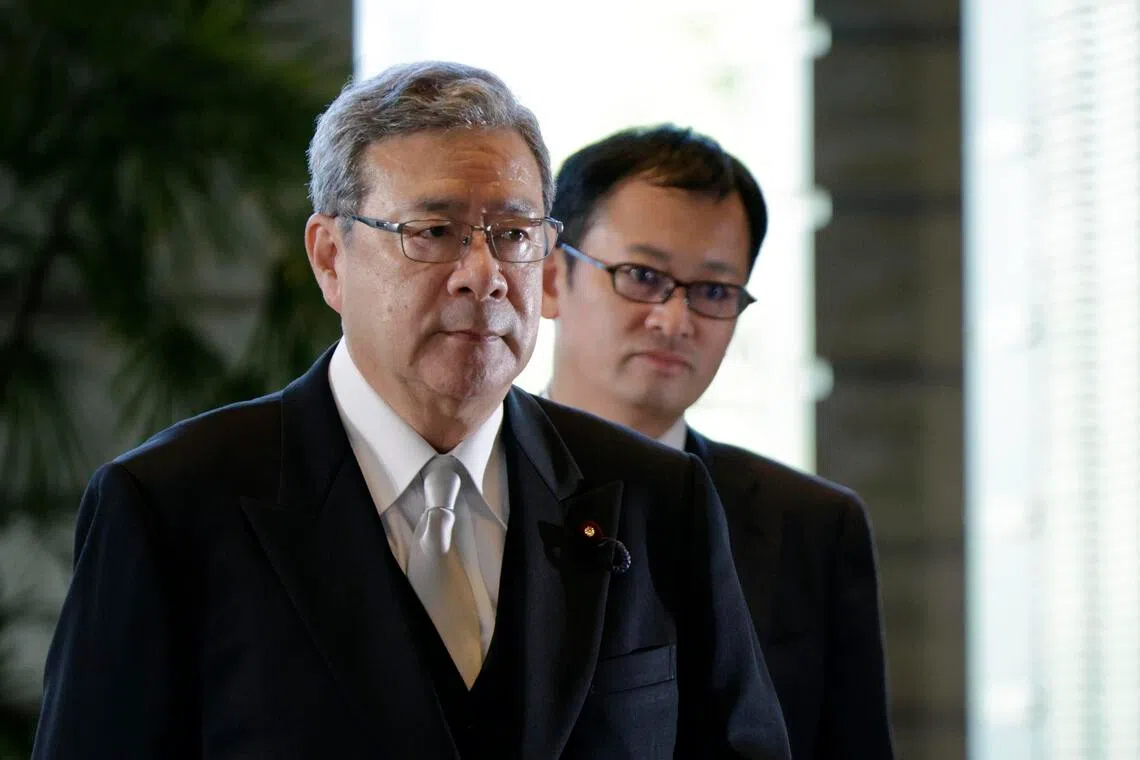
Hiroshi Nakatsuka, the newly appointed minister for regulatory reform, arriving at the Prime Minister’s Office in Tokyo on Sept 17.
PHOTO: EPA
Takaichi insisted that “past wrongdoings were not being wiped clean”, but said that by winning subsequent elections and demonstrating policy execution potential, she wanted them to “straighten their collars and fulfil their heavy responsibilities”.
Observers were divided over whether voters will be forgiving. While the Mainichi newspaper issued a scathing editorial asserting the LDP was like a leopard that cannot change its spots, Yoshida suggested that outrage over scandals has dulled with time.
Yet, Kato warned that voter sentiment “may shift more than the prime minister expects”, even as he acknowledged that Takaichi was likely yielding to pressure from her core conservative base, where many feel that culpable lawmakers “cannot be kept in cold storage forever”.
With Takaichi making fewer overseas trips during her first 11 months in office, visiting 10 countries compared to the globe-trotting itineraries of predecessors Shinzo Abe or Fumio Kishida, Koizumi and Motegi have effectively driven Japan’s front-line defence and diplomatic push.
Koizumi has actively reshaped Tokyo’s security posture to focus on building operational partnerships among like-minded nations, while Motegi has spent much of the past year bolstering Middle East ties amid heightened geopolitical instability surrounding Iran.
On the economic front, Katayama has closely coordinated yen-dollar strategy with US Treasury Secretary Scott Bessent, while the trade minister, Ryosei Akazawa, 65, was Japan’s point man navigating tariff talks with Washington.
Takaichi also retained Minoru Kiuchi, 61, the reflationist growth strategy minister overseeing her flagship 370 trillion yen investment blueprint covering 17 strategic sectors, including semiconductors, defence, and energy, alongside the chief Cabinet secretary, Minoru Kihara, 57, and the labour minister, Kenichiro Ueno, 61.
By keeping her economic, diplomatic and defence heavyweights in place, Takaichi has constructed a Cabinet of continuity to tide over a stormy geopolitical landscape. While she holds the line at home, surviving the fiscal storm and internal party intrigue will determine if she stays afloat.