By The Straits Times | Created at 2026-06-26 09:10:09 | Updated at 2026-06-26 10:16:41
1 hour ago
By The Straits Times | Created at 2026-06-26 09:10:09 | Updated at 2026-06-26 10:16:41
1 hour ago
TOKYO – A quirky urban legend in Japan, known as the Mariko Aoki phenomenon, describes a sudden, inexplicable urge to defecate that some people may experience upon stepping into a bookstore.
Named after the woman who first wrote about it in a 1985 magazine article, this has been discussed by local media and explored by scientists, although none have quite managed to prove it.
Yet one popular theory suggests a poetic truth. The mere act of walking into a bookstore – known as honya or shoten in Japanese – acts as a psychological release valve from everyday stresses, triggered by the earthy scent of paper and the promise of intellectual escape.
Tragically, these brick-and-mortar sanctuaries are rapidly vanishing. As of March 2026, the number of bookstores in Japan slipped below 10,000 for the first time since records began in 1994, said the Japan Publishing Organization for Information Infrastructure Development.
The count stood at just 9,993 stores, a staggering 60 per cent drop from the peak of 24,237 stores in 1998.
And today, about 500 municipalities across Japan do not have a physical bookstore, which the national government has described as an “extremely important social asset”.
The demise of bookstores in Japan is a familiar tragedy driven by e-commerce, lower demand for print publications and a sharp decline in reading habits. An Agency for Cultural Affairs survey in 2024 found that 62.6 per cent of Japanese citizens do not read a single book a month.
Just like in Singapore, the closure of a beloved bookstore in Japan would spark a wave of eulogies over the loss of a community hub and the potential for serendipitous finds.
As a foreign correspondent navigating Japan, I often find myself wandering into these stores simply to while away time, whether getting lost in Tokyo’s literary labyrinths or ducking into mom-and-pop shops in rural towns. They are both a fount for story ideas – the curation of books provides a glimpse into what is trending – and a place for discovery.
In June, I picked up two Japanese novels that caught my eye: Kimi No Kuizu (Your Own Quiz), a mystery novel by Satoshi Ogawa, and Reiwa Gan’nen No Jinsei Gemu (The Game Of Life In the Reiwa Era), a slice-of-life novel by an up-and-coming writer who goes by the pen name Azabu Keibajo.
Japan is chapters ahead of much of the world in reinventing what a bookstore can be amid the fight for survival.
The “book and cafe” concept began in 2003 when the Tsutaya Bookstore in Tokyo’s Roppongi Hills complex allowed customers to browse unbought books over coffee.
Tsutaya’s operator Culture Convenience Club has since pushed the evolution further, transforming bookstores into lifestyle ecosystems by diversifying their products such that these spaces are firmly rooted into daily life rather than an out-of-the-way destination.
Many Tsutaya stores now devote considerable retail space to fashionable household items. Some feature paid “Share Lounges” that are tailored for remote workers, allowing them access to books. Select locations host spaces for trading card battles, while others have built pilates studios and gyms within their walls.
What is undeniable is that many Japanese bookstores are innovating. Nonlecture, which opened in Shibuya in March, marries an art gallery with literature.
Over in the Toranomon business district, magmabooks displays an array of thought-provoking bookmarks that customers can take for free, with existential philosophical questions such as “Must we really lead a capitalist lifestyle?” or “What if we cannot keep up with technology?” printed on one side and related reading titles on the other.
Meanwhile in Osaka, Seiwado Bookstore, which was established in 1970, went viral for its creative take on the Japanese custom of wrapping books in nondescript paper jackets for free. The founder’s grandson Yasuhiro Konishi, 39, came up with the idea of turning these into beautifully designed collectors’ items like popsicle sticks, popcorn, mailboxes and luggage.
Where commercial markets fail, civic pride and local governments have stepped up in a fierce resistance to reverse the trend.
After Oda, a city of 30,000 in Shimane Prefecture, lost its only bookstore in 2024, the local government pitched in a 55 million yen (S$450,000) grant over 10 years to entice the regional chain Imai Books to open a branch there.
The store, which carries 30,000 titles over 290 sq m, opened on June 24 with Oda Mayor Hirokazu Kajino declaring: “The long-awaited light of a bookstore has been switched on again.”
Among the first customers was an 86-year-old resident unable to use online shopping, with the Asahi newspaper documenting his joy at “finally being able to interact with human staff and buy books again”.
Similar stories are slowly unfolding across the Japanese archipelago.
In Kofu, a Tottori Prefecture town of 2,500 residents without a bookstore for 10 years, the local government purchased land outside the train station specifically to build a new community bookstore that is set to open later in 2026.
Over in Shimonoseki, a local real estate developer was behind Neohas, a “book hotel” that opened in 2024. Guests can roam the aisles after hours, while the bookstore also hosts community and cultural events.
Even convenience store giant Lawson is filling the gaps and opening bookstores in areas without one. On June 12, it opened its 32nd “bookstore-konbini“ in a Yokohama suburb, offering 8,000 titles alongside standard convenience store items, 24 hours a day.
But individual ingenuity and subsidies may only go so far without structural reforms and, recognising this, an industry in crisis is finally banding together.
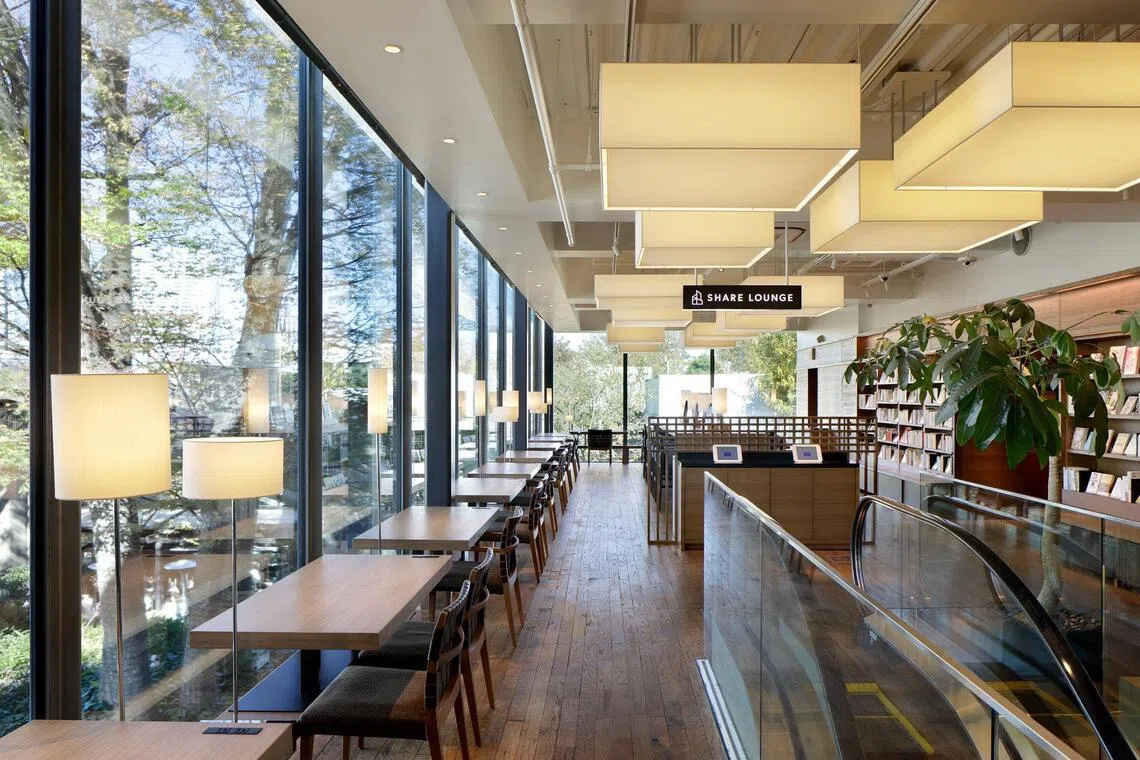
A view of the Share Lounge co-working space within Tsutaya Bookstore at Daikanyama T-Site in Tokyo.
PHOTO: CULTURE CONVENIENCE CLUB
On June 22, 15 bookstore chains across Japan announced a joint alliance to fundamentally overhaul the way books are sold by streamlining logistics, including sharing inventory across rival outlets and buying directly from publishers.
In doing so, they hope to ease the financial burden of an outdated consignment system that has incurred massive losses on bookstores for the return of unsold books, with a rate that hit 33.4 per cent in 2023.
Among the chains is Kinokuniya, whose chairman Masashi Takai said: “If book prices go up, people will inevitably stop reading, and it will be difficult to pass on the price increases. We need to think about efficient sales and logistics.”
Japan’s bookstores are undeniably at a crossroads. The convenience of the digital age is unmatched, but it lacks the soul of a neighbourhood hub. But through government backing, bold reforms and delightfully quirky business models, Japan is demonstrating that it is not ready to close the book on its literary havens just yet.
The goal is no longer just to sell books, but to remind people that bookstores are fun, everyday spaces of comfort.
And this ongoing fight to keep the lights on is a testament to Japan’s enduring love affair with the written word and, as Aoki might have experienced, a universal escape from the anxieties of the outside world.