By The Straits Times | Created at 2026-08-13 13:46:53 | Updated at 2026-08-13 14:55:14
1 hour ago
By The Straits Times | Created at 2026-08-13 13:46:53 | Updated at 2026-08-13 14:55:14
1 hour ago
PONTIAN, Johor - From Sungai Pulai Bridge, the view towards Pontian district, on the south-west coast of Johor, is a vast expanse of dense mangrove swamps and palm oil fields.
But amid this greenery, some residents of villages in Pontian have been finding it hard to get a good night’s rest. A few told The Straits Times (ST) that convoys of trucks would rumble through narrow gravel roads every night, dumping construction scraps believed by Johor officials to be from Singapore.
“It’s been going on since early 2025. We can’t sleep at night because these trucks come in convoys of six to eight trucks at a time after midnight,” said Rafi Mohamad Noor, a resident of Kampung Sungai Senai Belokok.
“Many residents didn’t know what was going on, they initially thought it was construction for a housing project,” said Rafi, 27, a hostel warden who lives near a dumping site. On the worst days, as many as 50 trucks entered the site to dump used construction equipment, he added.
The plight of villagers like Rafi came under the spotlight after the publication of a report by local media outlet Kosmo on Aug 8. This led to a clampdown by the authorities, which ordered the shutdown of more than five sites in Pontian identified as illegal dump sites.
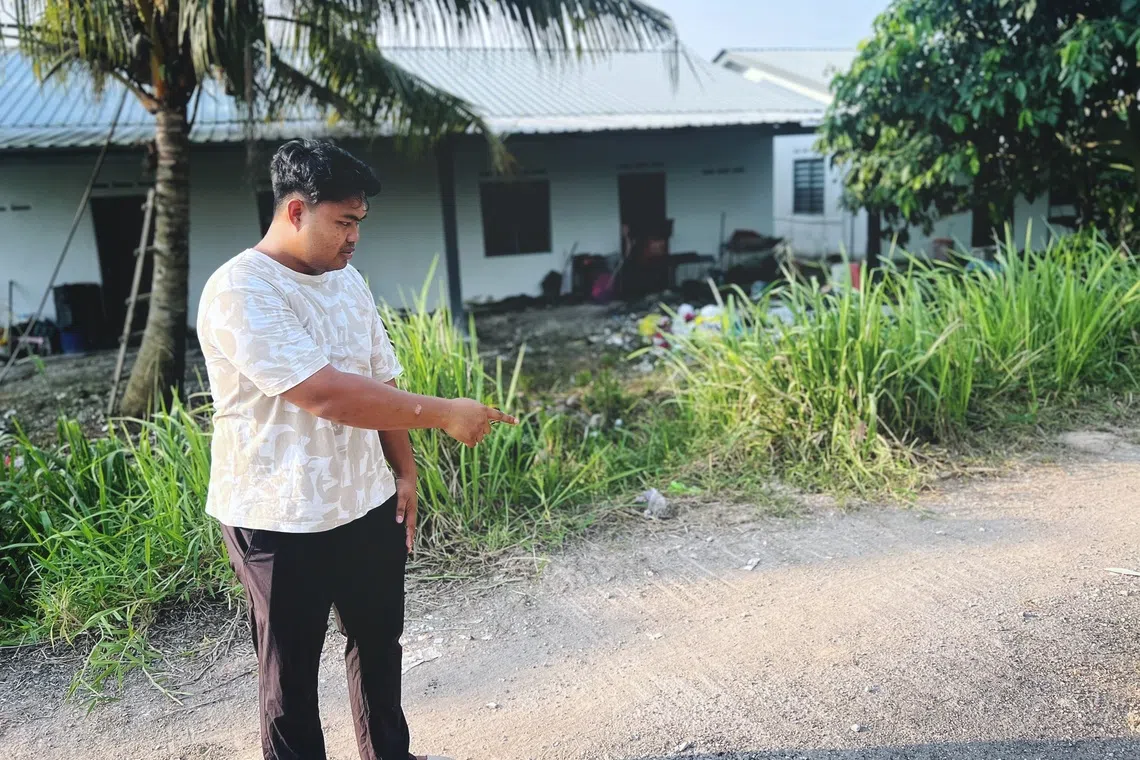
Rafi Mohamad Noor showing the trails on a gravel road near his home believed to be from trailers used for the illegal dumping of construction waste from Singapore.
ST PHOTO: HARITH MUSTAFFA
An investigation has also been launched into three sites: Jalan Kampung Sawah in Pekan Nanas and Tanjung Bin in Kukup, where construction waste was allegedly used for land reclamation, as well as Sinar Harapan in Pekan Nanas, where mixed waste was allegedly dumped at an unlicensed site.
In a report dated Aug 12, the Solid Waste Management and Public Cleansing Corporation (SWCorp), Malaysia’s waste management agency, said it conducted several raids and surveillance operations, and investigated a tipper truck driver caught disposing mixed debris in Jalan Kampung Sinar Harapan.
SWCorp’s Johor director Zainal Fitri Ahmad told ST that early findings from the operations indicated that the waste came from Singapore.
ST followed Johor officials on a visit on Aug 12 to dump sites in Kampung Sungai Senai Belokok. During the visit, ST heard SWCorp officers and district officials telling Johor State Housing and Local Government committee chairman Mohd Jafni Md Shukor that the waste came from Singapore.
In a Facebook post later on Aug 12, Jafni said the state government would not condone any party that carried out, caused or allowed illegal waste disposal activities.
Those caught disposing of, storing, transporting or taking controlled solid waste can be fined up to RM100,000 (S$31,285), jailed for up to five years, or both.
“We also do not want any land, including private land, to be used for uncontrolled waste disposal or land-filling. Landowners have a responsibility to ensure that every activity carried out on their land complies with the law,” Jafni added.
Dumping activities allegedly going on for years
Residents and local activists told ST that the problem of incriminate dumping goes beyond the sites being investigated. They said the problem has been going on for years and involves locally generated construction debris as well as debris from outside Johor.
At Kampung Sungai Senai Belokok, one dumping site sits just 33m across the road from homes, with two more plots behind the village. The three sites each span roughly half the size of a football field.
Broken tiles, cement scraps, rubber hoses, metal bars and construction equipment such as cement buckets and helmets can be seen at the sites. In some areas, smoke billowed from underground, carrying the smell of burnt rubber and wood.
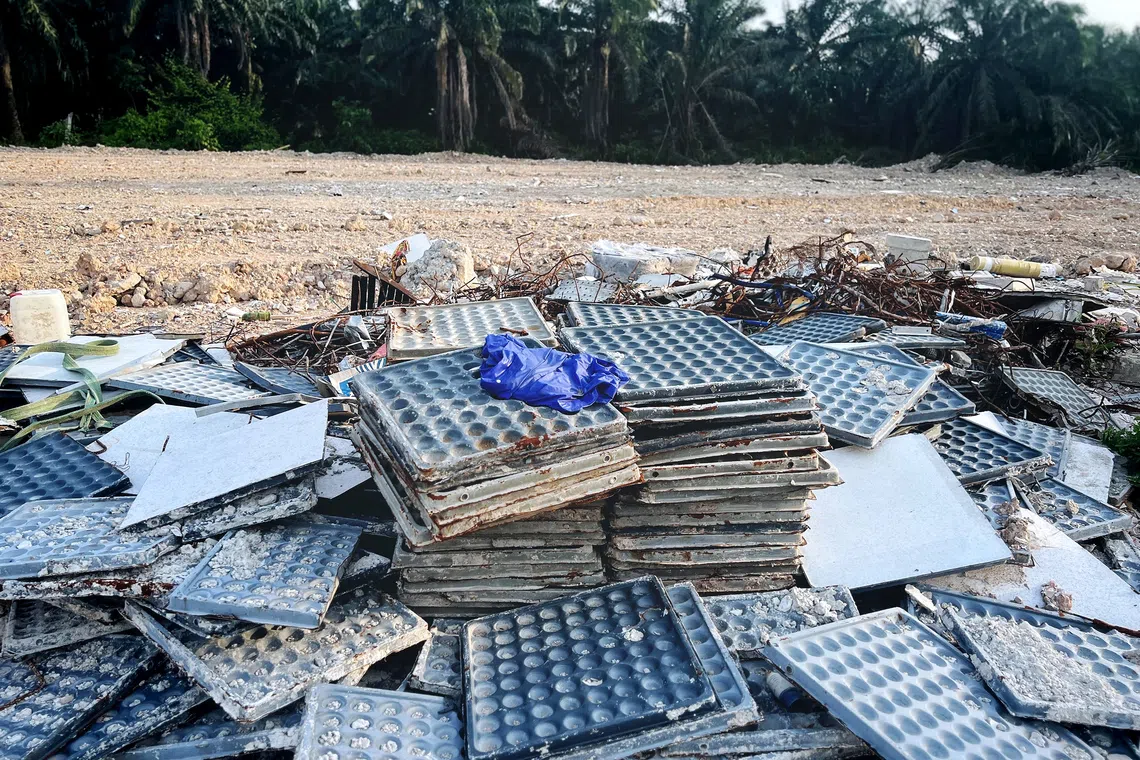
Broken tiles, cement scraps, rubber hoses, metal bars and construction equipment such as cement buckets and helmets can be seen at the sites.
ST PHOTO: HARITH MUSTAFFA
“This used to be palm oil land and then it was left unused and became forested,” said villager Maria Zakaria, 71. She said dumping had gone on for more than two years and intensified earlier this year.
“They used to conduct their operations discreetly behind the tree line up till some time in March this year when they cleared the trees and levelled the land,” she said.
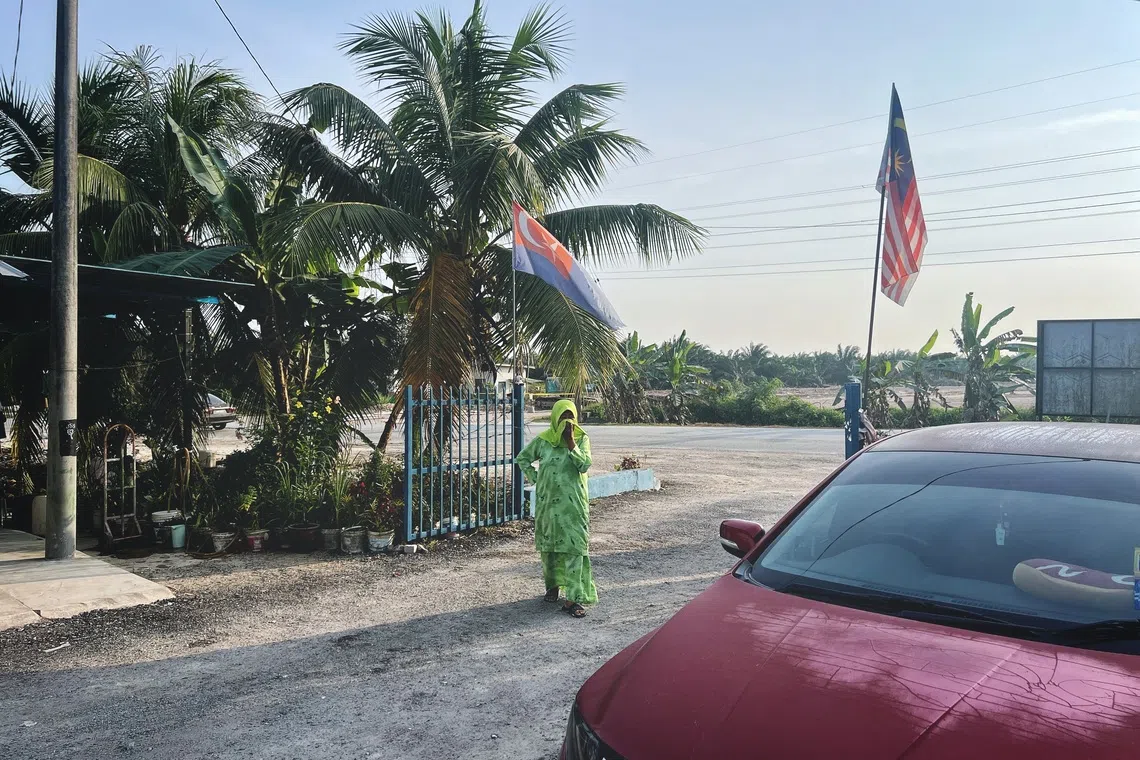
Maria Zakaria said dumping had gone on for more than two years and intensified earlier this year.
ST PHOTO: HARITH MUSTAFFA
Residents complained that their sleep has been affected by trucks and excavators operating late at night.
“The trucks would come in and dump the waste and then an excavator would level the waste and flatten it on the land,” said Amiratul Azwa Kamil, 35.
The mother of one said dust from the debris blows into homes, dirtying laundry and causing persistent itching and coughing, particularly among children.
Yet the same construction waste has value in these rural communities.

Amiratul Azwa Kamil showing the dust on her car caused by construction debris disposed of at a site near her home in Kampung Sungai Senai Belokok.
ST PHOTO: HARITH MUSTAFFA
A Senai scrapyard operator Joe Rahim, 49, said residents sometimes use discarded materials for minor reclamation and land-levelling work, including filling potholes.
“Sometimes these operators will give it to you for free,” he said. “It’s useful material and saves you the cost of buying rocks.”
Irwan Alif, founder of environmental group Sahabat Muda Johor, said the dumping was not confined to the sites being investigated. He said he had come across other plots across Johor where landowners allegedly lease out the land for waste disposal.
Irwan, who has campaigned for more than a decade for stricter enforcement of waste laws, said monitoring what crosses the Singapore-Malaysia border remains a challenge.
The problem is that SWCorp has no jurisdiction at the customs, he said, adding that it is a grey area in terms of who is responsible for restricting the import of construction waste.
ST has contacted Singapore’s National Environment Agency to ask if it has received complaints about companies exporting waste from Singapore to Johor, and the Johor Customs Department to ask if it was aware of the import of controlled waste and the rules pertaining to this.
Responding to queries from ST, SWCorp’s Zainal said the rural location of the Pontian sites makes enforcement more difficult.
While some residents use construction scraps for small-scale work on their properties, such use is illegal and can pose health and fire risks, he said.
“If you use construction debris to reclaim or level your land, and if you are caught doing it, you’ll have to dig it all up and rebuild again,” he said.
Construction waste can release flammable gases such as methane and spark a fire, he added.
“All it takes is for someone to throw a burning cigarette butt and cause a fire. And because the material is buried deep underground, it’s going to be challenging to put the fire out,” he said.
Sign up for our weekly Asian Insider Malaysia Edition newsletter to make sense of the big stories in Malaysia.