 By The Epoch Times | Created at 2026-08-05 23:21:46 | Updated at 2026-08-06 00:29:29
1 hour ago
By The Epoch Times | Created at 2026-08-05 23:21:46 | Updated at 2026-08-06 00:29:29
1 hour ago
A federal judge ruled on Wednesday that the registration and approval requirements for suppressors, short-barreled rifles, and short-barreled shotguns in the National Firearms Act (NFA) are unconstitutional.
In the case of Silencer Shop Foundation v. Bureau of Alcohol, Tobacco, Firearms and Explosives (ATF), U.S. District Court Judge James Wesley Hendrix found that the requirements exceeded Congress’s constitutional authority once the NFA’s taxes on making or transferring those arms were eliminated. The taxes were reduced to zero last year.
The court found that the NFA, as enacted in 1934, passed constitutional muster as an act of Congress’s taxing power because the regulatory requirements—including registration, applications, ATF approval, fingerprinting, and related criminal penalties—aided the collection of NFA taxes.
This is in line with the 1937 U.S. Supreme Court case, Sonzinsky v. United States, in which the high court ruled the NFA is a legal exercise of Congress’s taxing authority. In that decision, the court found that the government could gather information on the owners of certain firearms and their accessories that were subject to the NFA’s $200 excise as part of the tax collection process.
Wednesday’s ruling in response to two consolidated cases—Jensen v. ATF, with Silencer Shop Foundation v. ATF—in the U.S. District Court for the Northern District of Texas, held that once Congress eliminated the taxes for suppressors, the constitutional foundation for registration was eliminated as well.
“In sum, the Court concludes that the challenged NFA provisions exceed Congress’s Article I enumerated powers and are therefore unconstitutional,” Hendrix’s ruling states.
On July 4, 2025, President Donald Trump’s “One Big Beautiful Bill Act” reduced the NFA’s excise tax on suppressors, short-barreled rifles, short-barreled shotguns, and a category labeled “any other weapon” from $200 to $0. However, the items were still required to be registered under the NFA.
Machine guns and destructive devices are still subject to the $200 tax and its requirements. Under Hendrix’s ruling, the category “any other weapons” is still subject to the requirements even though it is not taxed.
The court has issued a permanent injunction against enforcement of the requirements for suppressors, short-barreled rifles, and short-barreled shotguns, but leaves them in place for the “any other weapons” category.
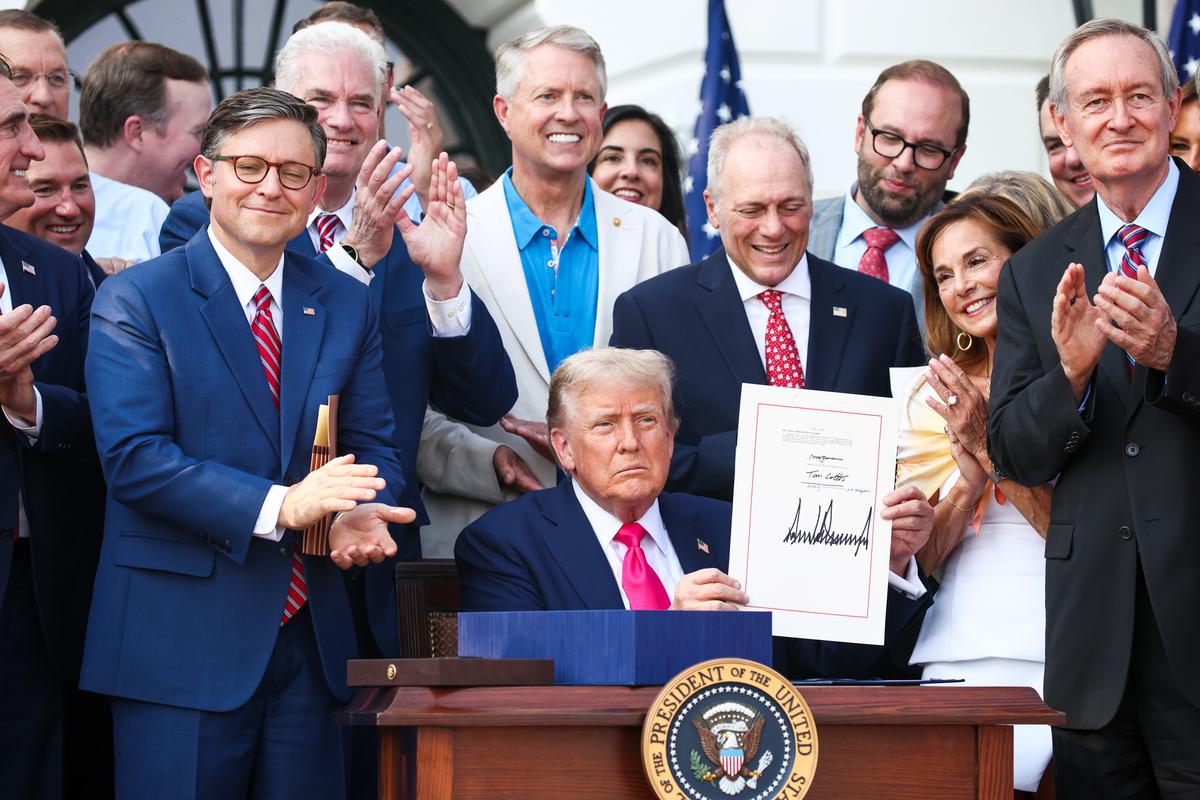
President Donald Trump, joined by Republican lawmakers, signs the One, Big Beautiful Bill Act into law during an Independence Day military family picnic on the South Lawn of the White House on July 4, 2025. Samuel Corum/Getty Images
Hendrix stayed his decision for seven days to allow the government to appeal to the Fifth Circuit Court of Appeals.
The government argued that the provisions were justified under the Commerce Clause or the Necessary and Proper Clause.
In its court filings, the government pointed out that NFA-regulated businesses are subject to other federal taxes. Therefore, the registration requirements are part of the overall taxing process. The defendants said this has been recognized in prior Supreme Court cases.
“It’s long been settled that the NFA’s requirements aid in the assessment, collection, and enforcement of the Act’s taxes and are thus justified under Congress’s taxing power. Shortly after the NFA’s enactment, in United States v. Sonzinsky, the Supreme Court rejected a constitutional challenge to the NFA’s special occupational tax on firearm dealers, holding that Congress had the power to impose the tax even if it was intended to “restrict or suppress the thing taxed,” the government’s response reads.
Second Amendment advocates hailed Wednesday’s decision.
“We are delighted with the ruling from Judge Hendrix,” Citizens Committee for the Right to Keep and Bear Arms Chairman Alan Gottlieb wrote in a statement. “With the tax no longer in existence, there was no logical reason for the ATF’s registration requirement to continue. With this victory setting a precedent, we anticipate success in the other cases involving our sister organization, Second Amendment Foundation.”
National Rifle Association leaders, one of the plaintiffs in Jensen v. ATF, also praised the ruling, and vowed to continue pushing for the end of the NFA.
“Our successful effort to eliminate the $200 NFA tax created the opening for our world-class attorneys to secure this historic federal court ruling that the NFA is unconstitutional. The fight to fully repeal this archaic gun-control measure is not over, but today’s decision is a major step in the right direction,” John Commerford, executive director of the NRA Institute for Legislation Action, stated in an email to The Epoch Times.
The One Big Beautiful Bill Act originally repealed the NFA’s excise tax. That language was removed, and the tax was instead reduced to zero, after Congressional Parliamentarian Elizabeth MacDonough determined a repeal did not comport with the tax purposes of the bill.
Gun Owners of America has contended that the ATF and other federal agencies have used the information gathered to build a de facto gun registry. The group has declared that part of its mission is to have the government destroy information it has that could be used to build a registry.
The ATF has strongly denied that such a registry exists.