By Bitcoin News | Created at 2026-08-15 13:06:54 | Updated at 2026-08-15 14:02:35
2 hours ago
By Bitcoin News | Created at 2026-08-15 13:06:54 | Updated at 2026-08-15 14:02:35
2 hours ago
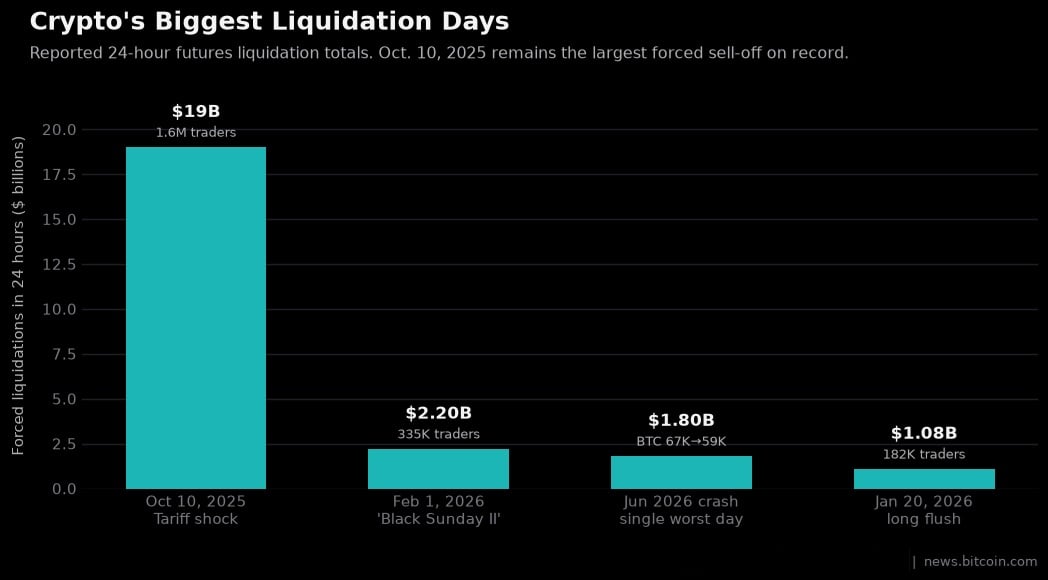
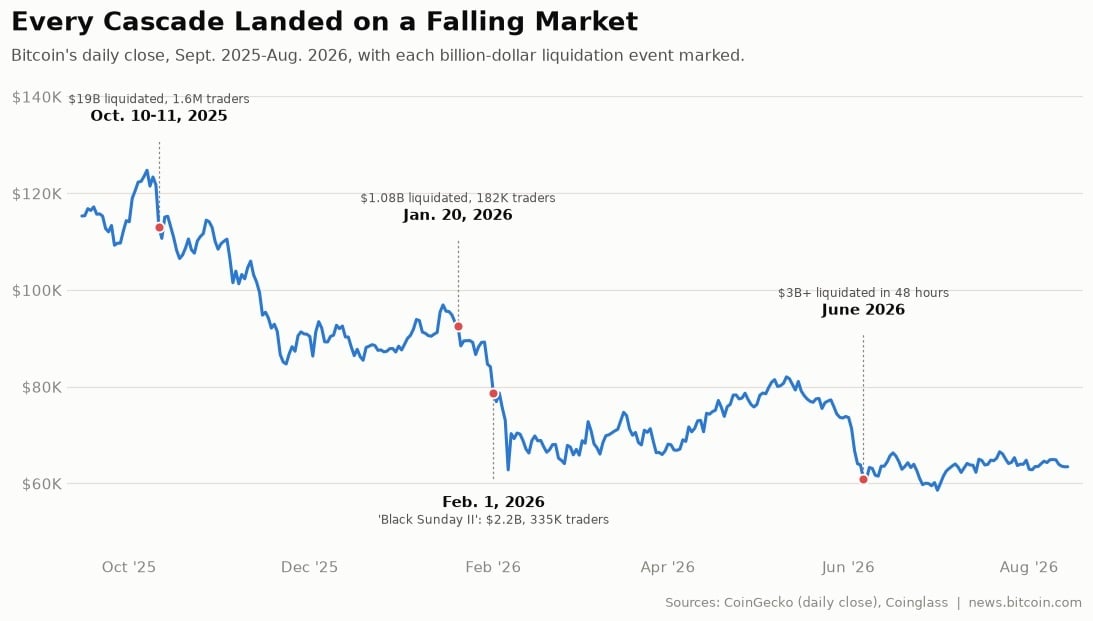
Crypto’s derivatives markets forcibly closed over $19 billion in positions held by 1.6 million traders on Oct. 10, 2025, and 2026 has already delivered three separate billion-dollar sequels.
Key Takeaways
- Oct. 10, 2025 saw $19B liquidated from 1.6M traders, crypto’s largest forced sell-off on record.
- Feb. 1, 2026’s ‘Black Sunday II’ erased $2.2B in 24 hours, with ethereum longs alone losing $961M.
- Data shows leverage rebuilt after each 2026 flush, leaving the next cascade one headline away.
The Machine Behind the Margin Call
Most crypto speculation doesn’t happen in the spot market, where buyers own actual coins; rather, it happens in perpetual futures, derivative contracts that let a trader control, say, $100,000 of bitcoin exposure with $10,000 of margin. When the price moves against the position far enough that the collateral can no longer cover potential losses, the position is automatically sold into the open market.
That automatic sale is where cascades begin, as each forced sell pushes the price down a little more, which pushes the next trader’s position below its maintenance threshold, triggering another forced sell. In a market with billions of dollars of open interest (the total value of outstanding derivative contracts) stacked at similar price levels, one sharp move can knock positions over like dominoes for hours.
And while exchanges do have shock absorbers, they come with their own sharp edges. To elaborate, every major derivatives venue runs an insurance fund meant to cover positions that go underwater faster than they can be closed. When the fund can’t keep up, platforms resort to auto-deleveraging, forcibly closing the positions of profitable traders on the other side of the trade to balance the books.
Simply put, during the worst cascades, even the winners get clipped. And because liquidations execute at whatever price the order book offers, thin overnight and weekend liquidity produces the violent “wicks” (momentary price spikes far below fair value) that make cascade lows so much deeper than spot selling alone would justify.
The Day the Dominoes Fell
On Oct. 10, 2025, President Trump announced a 100% tariff on Chinese imports. Consequently, equities and commodities sold off, and crypto (sitting near record-high open interest with crowded long positioning) became the pressure point. More than $19 billion in leveraged positions were wiped out in roughly 24 hours across Oct. 10-11, hitting over 1.6 million traders. About $16.7 billion of it was long positions.
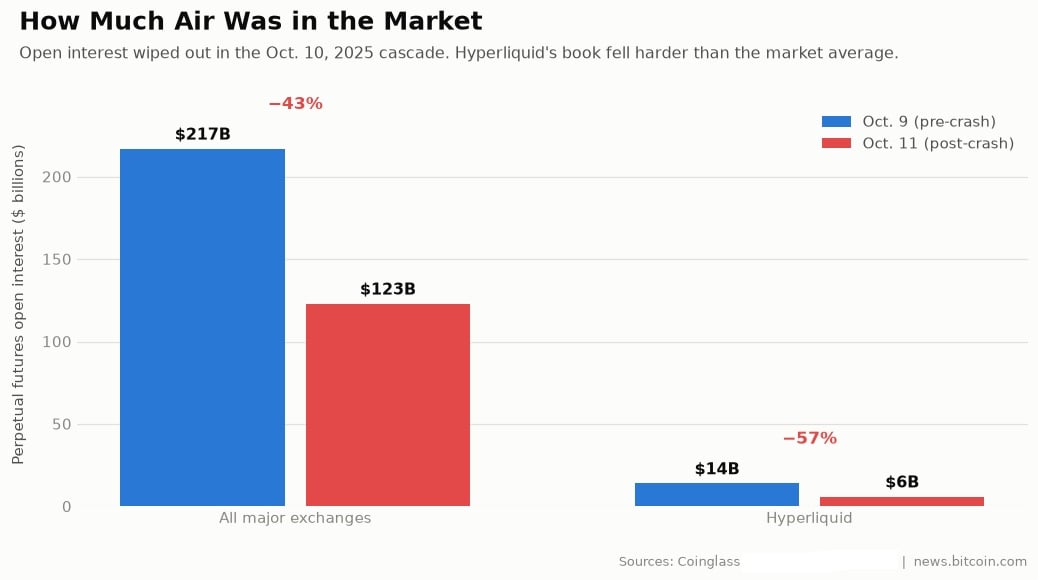
The aftermath showed how much air was in the market as total perpetual futures open interest across major exchanges collapsed 43% in a day, from $217 billion to $123 billion. Hyperliquid, a decentralized derivatives exchange, saw its open interest fall 57%, from $14 billion to $6 billion.
And because some platforms cap or delay what they disclose, market makers estimated the true liquidation total may have approached $30-40 billion. For all of 2025, analysts counted more than $150 billion in liquidations.
2026’s Repeat Offenders
Traders rebuilt their leverage, and 2026 kept collecting it, but on Jan. 20, more than 182,000 traders once again lost over $1.08 billion in a single day, nearly all of it long positions on bitcoin and ethereum futures.
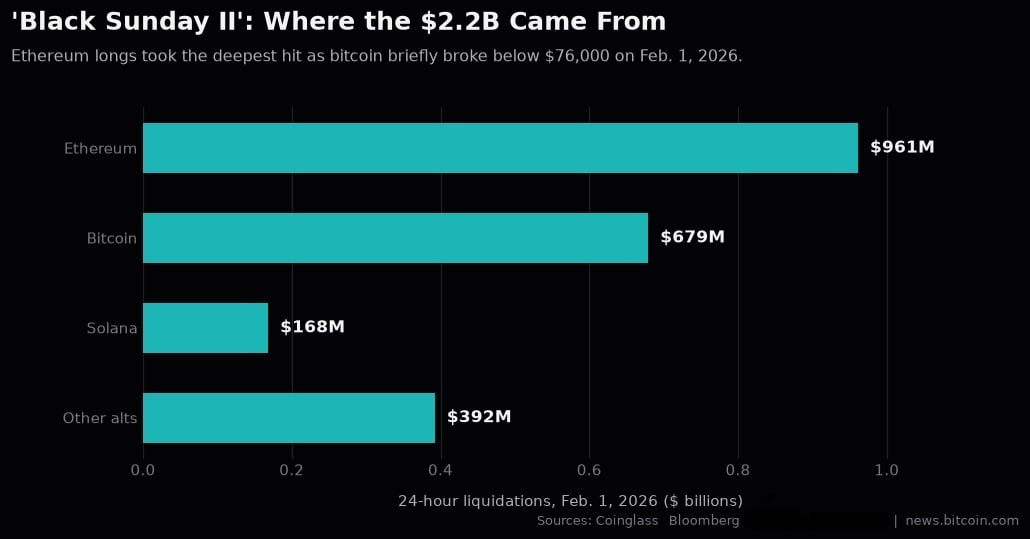
Twelve days later came the day traders dubbed “Black Sunday II” (Feb. 1), when roughly $2.2 billion in positions were forcibly closed within 24 hours, hitting over 335,000 traders. Ethereum led the damage with $961 million liquidated, bitcoin followed at $679 million, and Solana added $168 million, with long positions making up roughly 80-85% of the losses as bitcoin briefly broke below $76,000.
June brought the year’s deepest spot damage, with bitcoin sliding from about $67,000 to $59,100 in 48 hours, triggering over $3 billion in forced liquidations across the window ( including a single worst day near $1.8 billion) as each wave of selling handed the next wave its trigger.
How Traders Get Caught
The mechanics punish the same behavior every time, i.e. high leverage, crowded positioning, and stop levels clustered where everyone else put theirs. Funding rates (the periodic payments long and short traders make to each other) flash the warning first and when longs are paying heavily to stay in the trade, positioning is crowded, and a modest dip can start the dominoes.
The uncomfortable lesson in all of this is that cascades are not rare accidents; they are the market’s default way of deleting excess leverage. Open interest has rebuilt after every flush this year, which means the fuel is already stacked for the next one.
The spark (be it a tariff headline, an exchange exploit, a fork scare) is never scheduled in advance and cascades don’t wait for bear markets either, since some of the largest on record hit within weeks of all-time highs, precisely when confidence and leverage peaked.