By Literary Hub | Created at 2026-09-15 09:58:22 | Updated at 2026-09-18 16:47:51
3 days ago
By Literary Hub | Created at 2026-09-15 09:58:22 | Updated at 2026-09-18 16:47:51
3 days ago
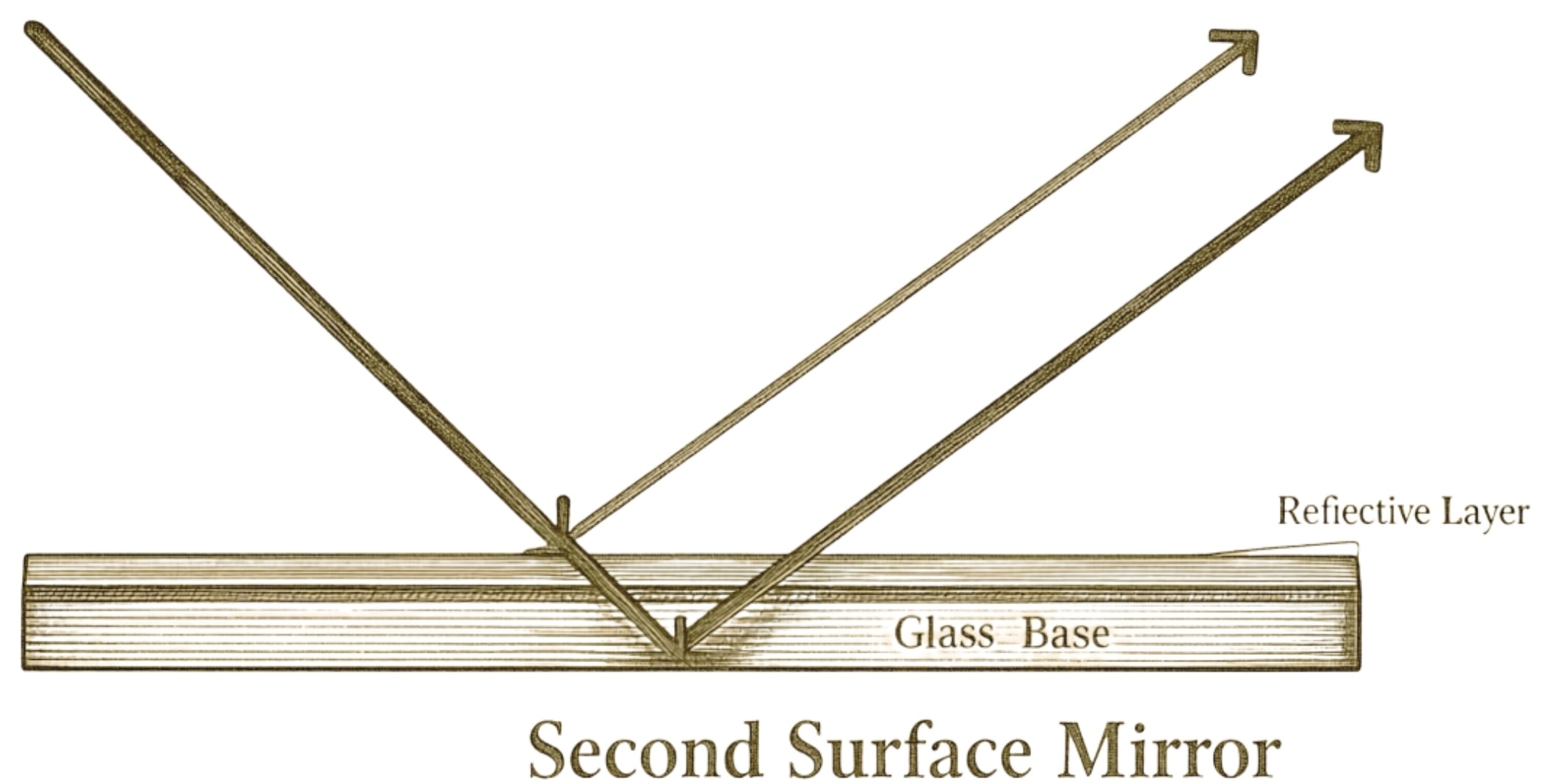
“A second surface mirror, also known as a standard or regular mirror, creates a ghosting effect (double image).”
______________________________________________________________
“Displaced people also lived in two time zones, the here and the there, the present and the past, being as we were reluctant time travelers.”
–Viet Thanh Nguyen, The Sympathizer, as quoted in his essay “Horrific Surrealism: Writing on Migration,” Paris Review blog, March 6, 2025
*
I have one photo of myself in South Korea. It was taken by someone at the Holt International adoption agency. A notecard is leaning against the front of my sweater. On it is written in English: my name Shin, Sun Yung, my orphan case number K-6596, and my birthdate. The back of the photo, like the back of a mirror, is blank.
My name, the case number, and my birthdate are all assigned by the agency.
You could say that my case number was a fact and my birthdate and my name were, and are, fictions.
With this kind of origin, how could I not become a writer? Out of the 26 letters of the Roman alphabet, or any writing system, an identity can be assigned, fixed—and made, if not real, then socially legible and governmentally legal.
*
Looking at ourselves.
Humans have been using materials such as polished obsidian as mirrors for 8,000 years. Mirrors manufactured in China, technology that could date as far back as the Han Dynasty (206 BC-24 AD), eventually made their way to Korea and Japan. One of my favorite stories from The Story Bag, one of the few books I had as a child that were from or about Korea, is “The Bridegroom’s Shopping.”
I suspect every adopted person or anyone raised in a family or situation in which she is not genetically related to anyone else has a special relationship to mirrors.
This folktale opens by describing a venerable old farming family whose only daughter has just married. As was the custom in ancient Korea before the Joseon Dynasty and its adoption of Confucianism, husbands lived with their wives’ families. The inciting incident of the story is the bridegroom’s trip, which begins at the matrilocal dwelling:
A few days after the marriage it so happened that the bridegroom had to go to town on some business. As he prepared to leave, his bride asked him: “Will you please buy me a comb in town?”
“Why, of course,” he answered, all eager to please his pretty bride.
However, his wife knew that her husband was a very forgetful man. Hadn’t her in-laws told her so? As she wondered how he could be made to remember, she chanced to look at the sky. There was a new moon, a thin crescent of pale light, shining softly in the sky. It was only three days old, and it looked just like the moon-shaped comb she wanted.
The young wife tells her husband to look at the comb-shaped moon and if he forgets his shopping task, he should remember to look at the sky.
In town, the bridegroom carries on with his business which takes several days, and as his wife feared he forgets about the comb. As he prepares to leave by looking around the room in which he’s been staying to see if he has everything, he happens to look out the window, “and there he saw a big, round moon shining in the sky. Ten days had passed since he had left home. The moon was no longer a small sliver of light but a round, laughing globe of silver.”
It reminds him that his wife asked him to buy her something. He asks a shopkeeper to sell him something that looks like the moon for his wife. The shopkeeper is delighted to show him a mirror: “A young bride would want it when she pretties herself. I am sure it could be nothing else.”
The bridegroom had never seen a mirror for they were very rare, and sure the shopkeeper is correct, he purchases it. When he returns to his house and his wife asks him if he did her shopping, he hands her the “strange round object.” She peers into “the smooth glass.”
She is met by a vision of a “pretty young woman” and angrily complains to her mother that she asked him for a comb and he brought home a “strange young woman.” Of course when her mother looks into it, she sees “a wrinkled old woman” and says the stranger must be an “old relative of ours from a neighboring village.” The two argue angrily. A small boy enters while eating a rice cake; he looks into the mirror, and sees a stranger who has taken his rice cake. He throws up his arm to strike the boy, and the other boy does the same, and they both begin to cry in fear.
The grandfather comes in and spies “a fierce-looking old man” in the mirror and is about to strike the aggressor for interfering with quarreling boys. He drops the mirror and it falls, crashes loudly, and then “the grandfather, and the boy, and the two women, and the bridegroom all fell silent and stood staring dumbly at the hundreds of pieces of broken glass beneath their feet,” which is the end of the story.
What I enjoyed about the story was seeing adults being taken in by something that I as a child already knew about—mirrors. In terms of the story’s situation, looking back I know that I internalized this and many other narratives of men leaving the home to work in the outside world. The secondary lesson of the tale was that women are dependent on forgetful men for purchasing what they desired.
Almost all folktales are lessons about family, about roles and belonging. Who is known, and who is a stranger.
This also mirrored the home in which I was raised; my father went to an office every day and my mom stayed home (and drove all over town) taking care of my older brother and I, the house and garden, our pet dog, and our father. I grew up observing my mother make three meals a day, wash and dry the dishes by hand, wash and iron my father’s shirts and handkerchiefs, clip coupons and shop for groceries, vacuum, mop, dust, wash windows, balance the checkbook, and make sure we got to and from school, our lessons and activities, doctors and dentist appointments, friends’ houses, and on and on, day after day, for years and years.
“The Bridegroom’s Shopping” is also a portrait of being vs. doing (the woman exists, the man acts) and Simone de Beauvoir’s ideas presented in The Second Sex on man-constructed-as-subject and woman-constructed-as-object. The household turns to chaos because the husband prioritizes his business and forgets his wife’s single request. In addition, it’s a story about modernity; the bride is from a prosperous family yet they are still “country” people, not “city” people. They are not cosmopolitan, exposed to the latest technologies, and don’t know what a mirror is or what it’s for.
The woman’s vanity and the husband’s forgetfulness collide to sow chaos and discord in the house. You can see this pattern in many American sitcoms, in which the wife wants something beautiful or useful for herself or the home, in order to elevate the family in some way, and the husband is a well-meaning bumbler who introduces comedy into the situation.
“The Bridegroom’s Shopping” may have also been a lesson to my young mind that if a woman wants something done right, she should do it herself, but either she wasn’t inclined or allowed at that time in Korea. Almost all folktales are lessons about family, about roles and belonging. Who is known, and who is a stranger.
The Story Bag: A Collection of Korean Folktales by Kim So-un and translated by Setsu Higashi was published by Tuttle in Tokyo, Japan in 1955. This was ten years after Japan lost World War II and had to surrender its imperial territories, including Korea, which it had annexed in 1910, and two years after 1953, the unofficial end of the devastating Korean Civil War.
Kim So-un, fluent in both Japanese and Korean, grew up in colonial Korea. In his foreword, he writes, “…stories do not like to be hoarded, but want to be told and told again, passing always from lip to lip. These stories were first heard in my childhood in Korean, then written down by me in Japanese, and finally translated into English by Mrs. [Setsu] Higashi.”
There weren’t mirrors in our house except above the bathroom sinks and attached to my parents’ and brother’s bedroom dressers. I didn’t have a mirror in my room until I was a teen. My mother is always dressed neatly, comfortably, but is not a vain woman or someone overly concerned with appearances; for example, she did not wear makeup except on holidays and special occasions, and then it was only a modest swipe of dark pink drugstore lipstick.
In some ways my life as an immigrant, since the age of about one-and-a-half years old, feels like a second surface.
I suspect every adopted person or anyone raised in a family or situation in which she is not genetically related to anyone else has a special relationship to mirrors. The people in your family are not your mirrors—you can’t look at your mother and see the genetics of your eyes or your smile; you can’t look at your father and see your skin color or hair texture if you’re a different race from your adoptive family. You don’t have the same hands as a sibling. You don’t know where your personality comes from. For many intercountry adoptees, you don’t know where the parts of you or the whole “you” come from, beyond the country and perhaps the city or region.
If you’re an adopted kid, any mirror in your dwelling confirms, every time you look in it, just like in a family photo, that your belonging was a jiggered thing, and that you’re out of place in one way, and in place in another. It’s both. You’re not between anything. You are in one place, but there’s a permanent echo of that other place, the you then before you became this you.
The mirror is an uncanny place, fixing you, reminding you that you are here and not there. “America” and not “Korea.” This family, known, and the other family or families, unknown. Forever conjoined, appearing, as in “The Bridegroom’s Shopping,” like an uncanny stranger in the reflection.
*
There are several kinds of mirrors—concave, convex, flexible, plane, front-silvered, back-silvered, and more.
Most everyday mirrors are back-silvered and are thus considered “second surface” mirrors, which means they are made of a glass substrate with a reflecting coating behind it.
For me as an immigrant, as an adopted person, there are some aspects of this multilayered, multi-material tool that work as a metaphor.
The poetics of the mirror.
The poetics of self-perception, memory, time, surface, depth, flatness, dimension, boundaries.
In some ways my life as an immigrant, since the age of about one-and-a-half years old, feels like a second surface. There’s a liminal place between the outside of the glass and the reflecting material. Light enters, and an image is reflected, but one’s consciousness is scaleable, elastic, shrinkable to the space within the glass. One’s consciousness can try to get close to the first layer behind the thin metal layer without ever merging with it.
As someone raised separately from my original family and my original culture, and who despite efforts by available means, has not been able to identify, locate, or make contact with any original relatives, I have no stories about, or evidence of, my Korean family or Korean ancestors. For now, I am the story and I am the evidence.
To be separated from your family of origin means intimacy without proximity. Form without knowledge.
*
I think about DNA and our individual, interrelated forms. I think about how my own children can look at their (biological, genetic, gestational) parents (who are one and the same with their social and legal parents—the people who raised them) and know exactly why one of them instinctively loves art and the other instinctively loves things with wheels.
Being the product of reproduction but not knowing from whom is, to me, like the back of a second surface mirror, the part that provides the surface for the silvered layer, which is then covered with a piece of glass. There is always a refraction.
*
Looking into the mirror of my past is part historical exploration, private investigation, community recovery, and personal guesswork. When there are informational dead ends, which is mostly what I have, it is not unlike looking at the back of a mirror. It’s not nothing; it’s a surface with nothing written on it, and no reflection. It’s a doorway with no door, a window made of solid wood. But this is what I have, this is what many adopted people have. Before I had my two children, my “reverse engineering” process was even more information-poor. I’ve passed down that structure of absence to my children, and they will carry it for the rest of their lives. How much does nothing weigh, when the nothing is filled with longing, curiosity, confusion, discomfort, and grief?
Being an adoptee is a lifelong lesson in impermanence.
There’s a quality of paranoia to not knowing—like when you suspect something is behind you, perhaps you feel a breeze on your skin, but you can’t see it or sense its shape or size or speed or distance, and when you turn around, it’s gone. In many cultures, spirit doubles, or doppelgängers, are considered bad luck.
What is the physics—the velocity, frequency, mass, volume—the force of absence? Not just one absence, but a thousand absences. Questions that will not be answered but keep forming, like air bubbles rising to the surface, only to break.
What the burning desire to know where one comes from proves that we are not truly individuals, but parts of a continuity. As a test case for individuality, the rewritten adopted person like myself shows individuality to be, in some ways, a hoax.
The sense of being outside the patterns of human familial weaving is very sharp. A sense of newness and self-invention which can look like freedom but internally more often feels like meaninglessness. An existential condition. I exist, but why? From where?
Being part of a second, adoptive, family means you know that families can be deconstructed, constructed, and further deconstructed. Having a second or third name means you can be decoupled from language at any time, and that it might be wise to hold onto names lightly. Being an adoptee is a lifelong lesson in impermanence. But if you let go too soon, or too much, you might let go of everything. Psychiatry calls it depersonalization. Taken to its most extreme logic of detachment from humanity, exerting the the will into a detachment from one’s physical life—the Romans called it suicide.
Without knowing who my family is, and was, I am limited in how much I can know about myself. My body is the result of their reproduction, but no decoder to know where I get my exact skin color, the shape of my fingers, my temperament and personality. It can feel like looking into a mirror, but seeing nothing but the glass.
*
To be severed from your people and your history—your inheritance—but to want to know, to have a mind that, as an adult, is always wondering about what combination of people, places, and circumstances came together to create your existence, is a kind of constant hunger. The majority of the time in my life, other more pressing and practical life matters present themselves to be sorted, managed, resolved, etc. But when I pause, as I am now, to attempt to describe what living with this condition feels like, my mind searches for metaphors, for multipart objects like a second surface mirror. Unlike a polished piece of metal which is reflective and the same material from every direction, a second surface mirror is an assemblage, has a transparent layer, a reflective layer, and an opaque layer.
*
As an immigrant I seek to understand what it means to be mobile, to have been moved, removed, to cross an ocean, to be placed, to be held, to be kept, to transform from resident to citizen. It feels like a kind of time travel, folding of time back and forth. Prisms. Refractions.
I don’t really know how any immigrant could entirely avoid ever imagining a parallel life in which they never migrated. In science fiction stories about time travel, there’s often a kind of shimmer, a ripple, or a portal, not unlike a mirror. One can dream, one can speculate, one can contemplate Borgesian forking paths. I suppose the trick is to not get lost, not stop too long in the gaze, forever, like Narcissus, drawn permanently into the dream of the reflection.
*
A company called “FSM,” standing for First Surface Mirror, has a simple diagram on its website with this caption, “A second surface mirror, also known as a standard or regular mirror, creates a ghosting effect (double image).”
A company called Abrisa Technologies explains when you would sometimes want to use a first surface mirror as opposed to a second surface mirror:
Most people are familiar with conventional mirrors that we see and use every day, from the bathroom mirror, a hand held mirror, or a car’s rearview mirror. These mirrors use glass as a protective surface and have the mirror coating, commonly referred to as “silvering,” on the back side, or “second surface.” The exposed glass helps protect the mirror coating underneath from scratching or degradation due to environmental factors such as weather, fingerprints, and dust.
In high-precision applications, second surface mirrors have some very distinct disadvantages. Light traveling through the glass to strike the reflective material on the backside or second surface creates a refracted or bent image as well as some loss of energy, essentially dimming and distorting the reflection. A faint secondary reflection is also created from light striking the front of the glass. This secondary image is referred to as a “ghost image” or “ghosting effect.”
This, too, is a good metaphor, the ghosting effect. I think even when I’m not writing autobiographically, I’m writing to understand the ghosts and distortions that result from the second surface, or even the space between my first life and my second life. It’s hard, or impossible, to always tell what is reality, what is fantasy, and what is some combination. Does my affect, my grief, my sorrow, and my shame come from pre-verbal, pre-remembered wounds, trauma? Or from an inborn and immutable temperament? From stories? Which ones? DNA? Hormones? Bacteria? Microplastics? It’s exhausting and cyclical and the finer-grained the questions, the more diminishing the returns. The light can only bounce around so much before it disappears and leaves you, again, in the dark, alone.
Ghosts are an ancient human technology, and I don’t believe we as a species are done with them, or perhaps they are not done with us. That works for me. Betty Jean Lifton, a psychologist, white domestic adoptee, and author, wrote the book Journey of the Adopted Self: A Quest for Wholeness which was published in 1995. In the chapter “Ghost Kingdom” she writes:
Carl Jung said that among all possible ghosts that haunt us, the spirits of the parents possess the greatest significance. Having been banished from the adopted child’s everyday world by the closed adoption system, the birth parents become little more than the ghosts I described in chapter 1. (“Hereditary ghosts,” the Finnish psychiatrist Max Frisk labeled them.) I call the spectral place in which these ghosts reside as the Ghost Kingdom. It is an awesome sphere, located only in the adoptee’s psychic reality. The Forbidden Self, and occasionally even the Artificial Self, slips into the Ghost Kingdom to rendezvous with the lost mother and the lost baby, who never had a chance to grow into the child it should have been. One man described it as “a forbidden world, like a hole—wonderful, terrifying, ghostly—that you could fall into completely.” Once there, it is not necessarily a peaceable kingdom, for the adoptee is free to express not only love but anger at being, as one woman put it, “cast out into the world with strangers.”
_________________________________
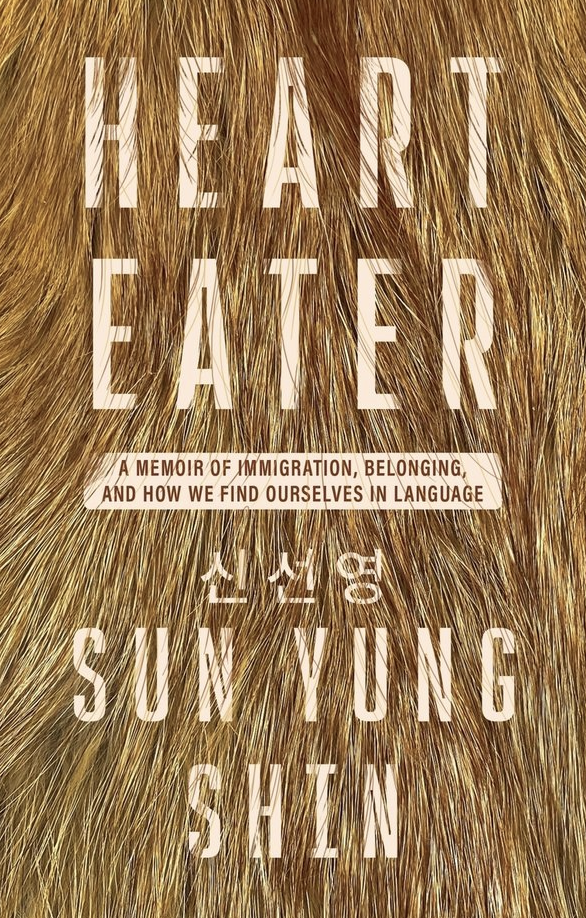
Sun Yung Shin’s Heart Eater is available now from Black Lawrence Press. Sun Yung Shin will be launching the memoir at Minneapolis’s Moon Palace Books, September 15 at 7pm.