 By The Epoch Times | Created at 2026-09-03 13:23:31 | Updated at 2026-09-03 14:00:54
54 minutes ago
By The Epoch Times | Created at 2026-09-03 13:23:31 | Updated at 2026-09-03 14:00:54
54 minutes ago
Attorneys representing former Venezuelan leader Nicolás Maduro petitioned a U.S. federal judge on Sept. 2 to dismiss drug trafficking charges against him, arguing that his position as the head of a sovereign country should give him immunity from prosecution.
Maduro, a socialist, was captured on Jan. 3 in the Venezuelan capital of Caracas by U.S. special forces acting under the orders of U.S. President Donald Trump.
He was immediately brought to New York, arraigned on federal charges of narco-terrorism and conspiring to traffic thousands of tons of cocaine to the United States, and has been held in a federal jail in Brooklyn ever since.
The charges, filed in a federal court in Manhattan, formed the basis for the raid, but Maduro’s attorney, Barry Pollack, petitioned U.S. District Judge Alvin Hellerstein to dismiss the case.
Maduro has pleaded not guilty and is due to go on trial in June 2027, but Pollack claimed in court on Sept. 2 that Maduro was president at the time of his arrest.
Pollack made the assertion of immunity in a motion to dismiss Maduro’s indictment.
“This unprecedented prosecution violates the absolute immunity from criminal jurisdiction to which heads of state and foreign officials acting in their official capacities have been entitled for hundreds of years,” Pollack wrote in the petition.
Pollack also stated that Maduro “vehemently denies” the allegations.
Maduro took office in 2013, after the death from cancer of his mentor, Hugo Chávez, but under his leadership, Venezuela went into economic freefall.
On Jan. 23, 2019, in his first term, Trump withdrew recognition of Maduro as the Venezuelan president and, for a time, recognized opposition leader Juan Guaidó as interim leader.
After Maduro was captured, his vice president, Delcy Rodriguez, took over and has run Venezuela, with the tacit support and cooperation of the Trump administration.
In a March 4 post on Truth Social, Trump said Rodriguez was “doing a great job.”
Pollack highlighted the ambiguity of the current situation in his motion.
“Despite the incongruous position of the United States, recognizing Ms. Rodríguez, whom Mr. Maduro appointed vice president following his re-election in 2018, as head of state while not recognizing Mr. Maduro as such since the 2018 election, the United States has never contested that, regardless of his de jure status, Mr. Maduro remained the de facto head of state continuously since 2013,” Pollack wrote.
Pollack said the indictment stated that Maduro “is now, having remained in power despite losses in recent elections, the de facto but illegitimate ruler of the country.”
The Noriega Precedent
But there are legal precedents, such as former Panamanian leader Gen. Manuel Noriega.
In December 1989, U.S. forces invaded Panama, and on Jan. 3, 1990, Noriega surrendered. He was brought back to the United States, where he was convicted in Florida on drug-smuggling charges and spent 20 years in prison.
During Noriega’s rule, Panama became a major distribution platform for cocaine from Colombia, with Pablo Escobar’s Medellin drug cartel paying him millions of dollars in kickbacks.
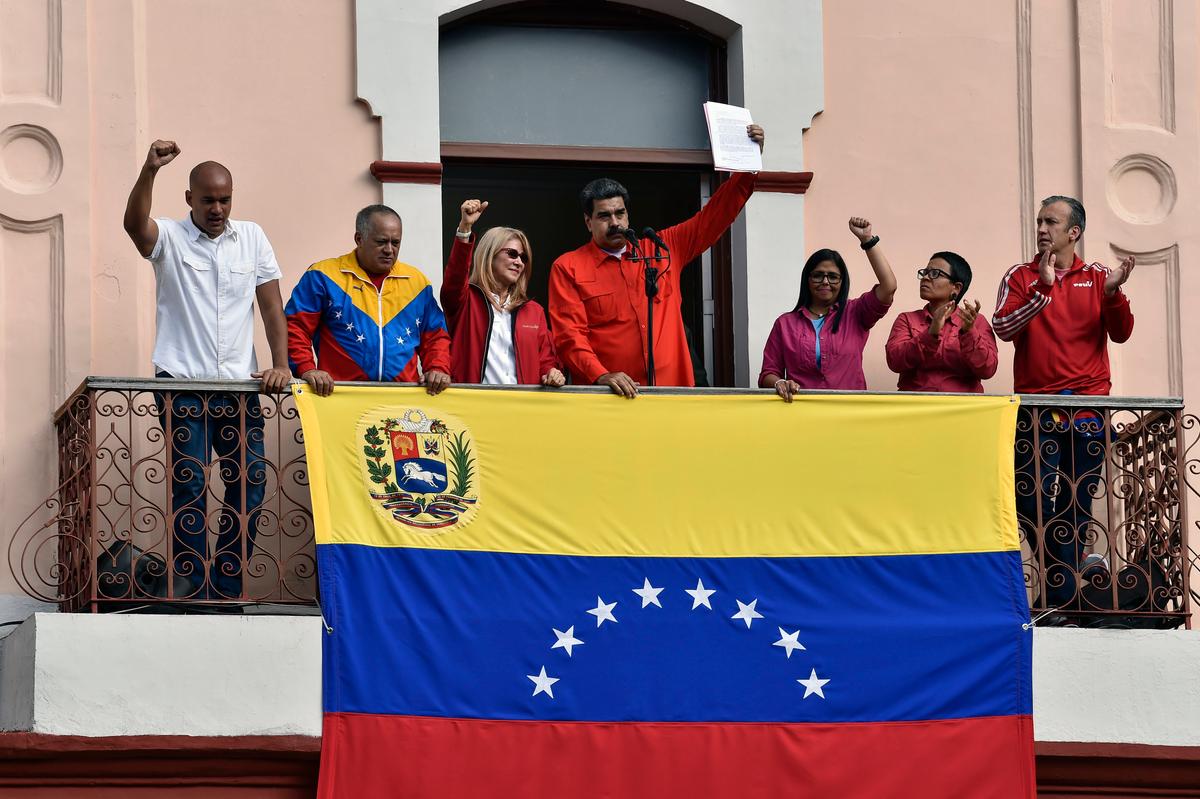
Nicolas Maduro (C) speaks to a crowd of supporters flanked by his wife, Cilia Flores (2nd L), Venezuelan Vice President Delcy Rodriguez (R), and other members of his government, in Caracas, Venezuela, on Jan. 23, 2019. Luis Robayo/AFP/Getty Images
But Pollack argues there is a fundamental difference between the Noriega and Maduro cases.
“Unlike in Noriega, the Executive Branch does not dispute that Mr. Maduro was Venezuela’s head of state, but instead merely claims that, after 2019, he did not occupy that position legitimately,” Pollack wrote.
Federal prosecutors have been given until Oct. 2 to respond to the motion to dismiss the indictment, and Hellerstein said he would hold a hearing on Nov. 17.
Maduro and Noriega are not the only former leaders from Latin America to be indicted in the United States.
In 2014, former Guatemalan President Alfonso Portillo was jailed for 70 months for money laundering.
In November 2025, former Honduran President Juan Orlando Hernández was pardoned by Trump.
Hernández had been sentenced to 45 years in a U.S. prison in June 2024 for his involvement in smuggling narcotics to the United States, but Trump said in a post on Truth Social that he had been treated harshly and unfairly.
The Epoch Times reached out to the U.S. Department of Justice for comment but did not receive a response by publication time.
Reuters contributed to this report.