By The Straits Times | Created at 2026-09-04 12:46:39 | Updated at 2026-09-04 13:28:53
58 minutes ago
By The Straits Times | Created at 2026-09-04 12:46:39 | Updated at 2026-09-04 13:28:53
58 minutes ago
KUALA LUMPUR – If Deputy Prime Minister Zahid Hamidi’s call for Malaysian polls to be held “the earlier the better” comes to fruition, Prime Minister Anwar Ibrahim may not get to table his 2027 “election” budget as planned on Oct 9.
For that to happen, however, Zahid’s UMNO-led Barisan Nasional (BN) coalition would need enough support from other government-aligned parties to defeat the Budget. This would show that Anwar no longer commands the confidence of Parliament, forcing either his resignation or a dissolution of the House and paving the way for fresh polls. Malaysia’s next general election, or GE16, must be held by early 2028.
Malaysia’s upcoming Budget 2027 is widely anticipated by analysts and observers to function as an “election” budget. With the next general election due by early 2028 and Anwar facing calls for an earlier snap poll, the Budget is seen as a key opportunity for the government to win voter support.
The UMNO president made his party’s position public on Sept 3, although it was already an open secret, especially after BN’s handsome wins in the Johor and Negeri Sembilan state polls in July and August, respectively, along with newfound ally Parti Islam SeMalaysia (PAS). The Islamist party also expressed its support for Parliament to be dissolved soon.
But PAS leads the opposition Perikatan Nasional (PN). Zahid’s hope can only become a reality if his BN, with 30 MPs, can get the backing of other ruling colleagues to defeat the Budget, paving the way for fresh polls possibly by end-November. A general election has never been held in December or January, which in recent years have frequently been marked by deadly floods that displace tens of thousands nationwide and cost billions in economic damage.
It could coincide with the Melaka state polls, which are likely to be held well ahead of a February 2027 deadline as that month will see both Chinese New Year celebrations and the start of the Muslim fasting month of Ramadan.
Why Anwar can afford to wait
If the push for early polls fails, Anwar has repeatedly signalled that he wishes to see out the five-year term that only ends in December 2027. On paper, the prime minister has the support of 150 MPs in the 222-seat chamber. But the federal legislature has three vacancies, meaning he can afford to lose the backing of 40 MPs and still have a simple majority of 110.
“I still think that Anwar will hold off as long as possible,” ISEAS – Yusof Ishak Institute principal fellow Francis Hutchinson told The Straits Times when asked if his prediction of a 2027 general election, made during an Asian Insider podcast in June, still held.
“BN is pushing, but Anwar is fighting back. There are a lot of corruption cases involving UMNO personalities, or concerning alleged financial mismanagement that occurred during UMNO’s tenure in power. There are also indications that PETRONAS and the Sarawak government could be close to an agreement over the management of oil and gas,” said Hutchinson, referring to the national oil giant’s dispute with the East Malaysian state. “This could encourage Gabungan Parti Sarawak (which rules the state and has 23 MPs) to retain its support for the unity government for the rest of the term.”
The ISEAS-Yusof Ishak Malaysia studies programme coordinator also said it was “interesting to note that there appear to be budgetary tensions between Anwar’s Ministry of Finance and Zahid’s Ministry of Rural and Regional Development.”
Still, an early-2027 election cannot be ruled out. Early April comes after the Hari Raya Aidilfitri celebrations in March and is also the absolute latest for Sarawak to hold state elections.
Barring that, the typical post-Hari Raya Haji (which falls on May 17, 2027) to November period becomes Anwar’s final chance to choose an opportune date.
After that, the choice is largely taken out of his hands as the final window is in January 2028 - both Chinese New Year and the start of Ramadan fall at the end of the month - after Parliament automatically dissolves the month before. Elections must be held within 60 days of the dissolution of any legislature in Malaysia.
Historically, the March to May quarter has been the most popular, hosting eight of Malaysia’s 15 general elections, and four of the last five. But for 2027, the two Hari Rayas mean that March and May are unlikely.
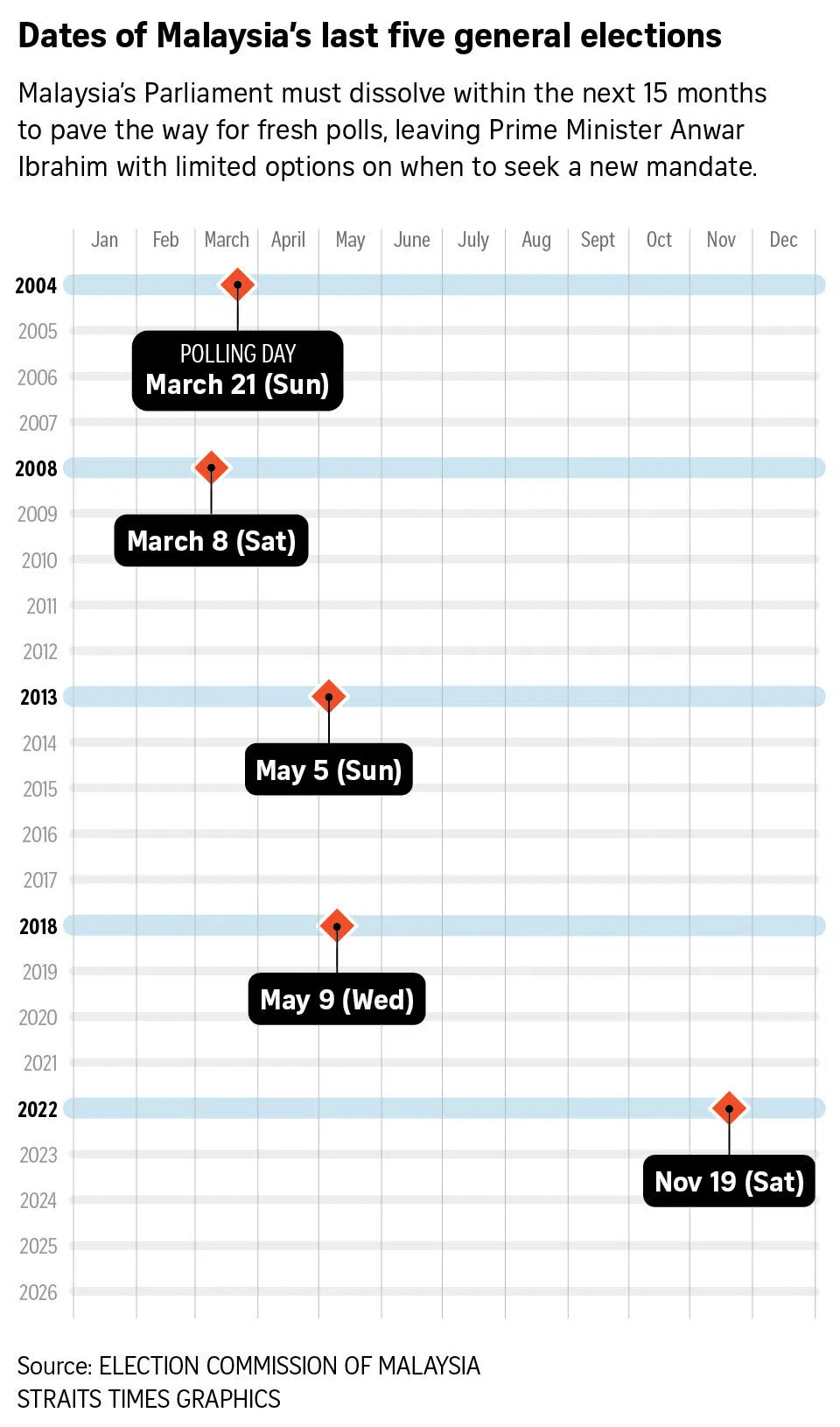
August to November has also been a popular period, with six general elections held.
This is also the most likely window for GE16, given several key events and Anwar’s desire to see out as much of his term as possible. Aug 31 will mark 70 years of independence before Malaysia hosts the SEA Games in September.
Host nations have typically dominated the event and Anwar could ride the boost or double down by tabling another budget in October, promising more spending for 2028 despite his mandate expiring early in the year.
Sign up for our weekly Asian Insider Malaysia Edition newsletter to make sense of the big stories in Malaysia
Shannon Teoh is The Straits Times’ bureau chief for Malaysia, where he has reported on various beats since 1998.