By The Straits Times | Created at 2026-08-08 22:16:37 | Updated at 2026-08-08 23:00:33
1 hour ago
By The Straits Times | Created at 2026-08-08 22:16:37 | Updated at 2026-08-08 23:00:33
1 hour ago
KUALA LUMPUR – Until health workers knocked on her door, Riza Halow thought her youngest son was simply small for his age.
The 16-month-old, who was born weighing 2.8kg, did not eat much and lagged behind other toddlers his age in growth.
As at June, he was 74cm tall, while other children his age are about 82cm tall.
Riza, who has six children, thought little of it, but doctors found that her son was among many Malaysian children whose growth had been stunted by undernutrition.
“Before this, we didn’t know about the problem,” she told The Straits Times at a community programme in Puchong, Selangor, that provides nutritional support and monitoring for children with growth concerns.
The 40-year-old cleaner said that three of her six children took after her with their shorter stature.
Riza’s son has been on the programme for five months and benefits from nutritional support, including iron and multivitamin supplements, high-calorie milk formula donated by a manufacturer, regular health checks and dietary advice.
Stunting is when a child is shorter than expected for their age. Caused by various factors, it can lead to developmental delays and may be irreversible if not addressed early.
The Kiddo Foodbank programme in Puchong, a town of about 375,000 people in Petaling district, is run by Democratic Action Party lawmaker Yeo Bee Yin and supports around 70 children aged one to five who have been identified as having stunted growth.
Each quarter, a doctor and volunteers monitor their height and weight, screen them for iron deficiency, provide vitamins and milk, and coach parents on nutrition.
The programme, which began in November 2023, is aimed at supporting children who are malnourished, stunted or underweight.
It was launched after a health event in Puchong screened 228 children below the age of six and found that 35 per cent were affected by malnutrition, including stunting.
It addresses a national concern: At least one in five Malaysian children is affected by stunting, a crisis that defies the country’s economic progress.
Generally, children leave the programme once they turn seven.
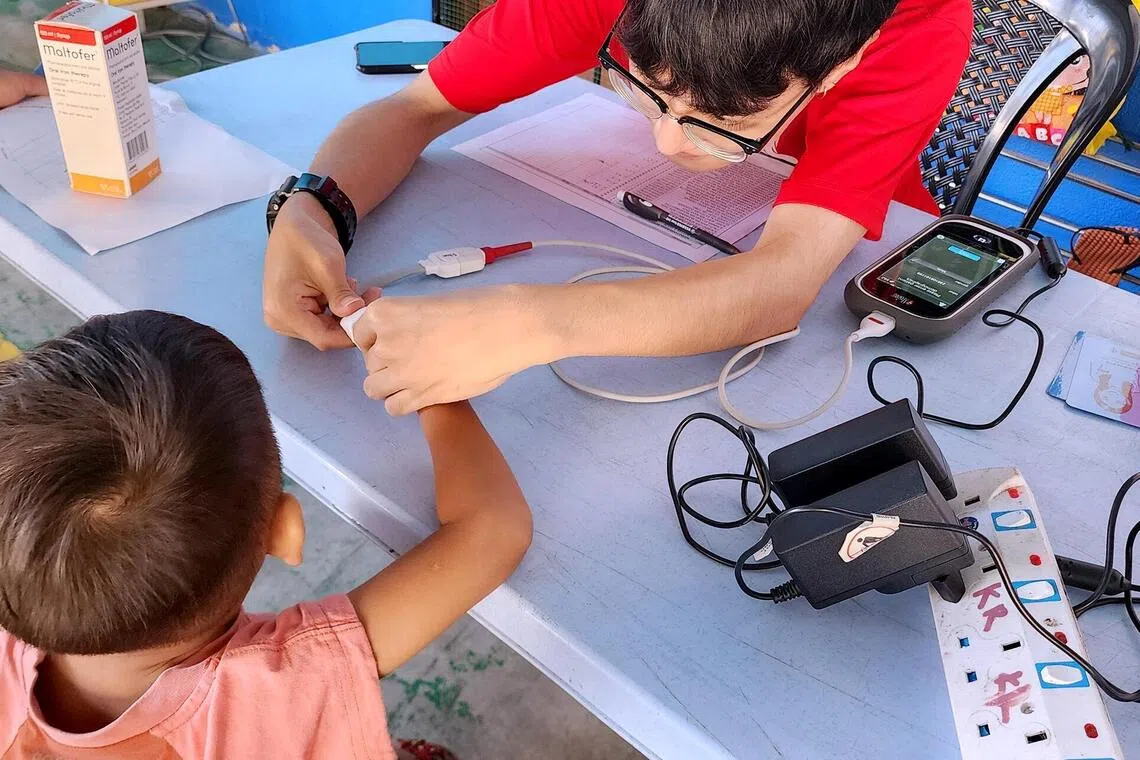
A child undergoing health checks at a stunting intervention programme in Puchong, Selangor.
ST PHOTO: HAZLIN HASSAN
Health Minister Dzulkefly Ahmad said the National Health and Morbidity Survey 2022 put the national stunting prevalence at 21.2 per cent, down from 21.8 per cent in 2019.
Malaysia is hoping to lower the rate to 14.2 per cent by 2030.
A fight on many fronts
The consequences of child stunting extend beyond short stature.
“Numerous studies show that stunting has devastating and practically permanent effects on a person’s cognitive development, educational achievements, future health outcomes, and earning potential in adulthood,” said Derek Kok, a senior research analyst studying child stunting at Sunway University’s Jeffrey Cheah Institute on Southeast Asia.
There is no single cause of stunting. Experts say it is driven by a combination of factors, including nutrition, maternal health, healthcare access and living conditions.
“Stunting is actually a proxy for a lot of macroeconomic factors of a country,” Kok told ST.
“It is a powerful indicator of whether a government and country have healthy systems and structures in place for their citizens, as reflected in the well-being of their children,” he said.
“What is important is that policies must target the first thousand days of the child’s life. This is the critical window. Once that window passes, most stunting is irreversible.”
The issue has also begun surfacing in unexpected places.
In May 2026, the Malaysian Army said it had lowered its minimum height requirement for recruits from 162cm to 157cm as part of broader recruitment reforms.
“It’s a hint that perhaps the average height of Malaysians is stagnating, or even worse, declining,” noted Kok.
He said middle-income countries such as Malaysia usually perform worse because, as incomes and costs rise, household spending shifts towards high-calorie but low-nutrient foods.
“As overall living costs and food prices rise, fresh sources of protein and produce suffer the highest inflation,” he explained.
“Energy-dense, ultra-processed foods like processed snacks, sweetened condensed milk and instant noodles are a cheap and fast way to ensure a child feels full.”
Parents working long hours or multiple jobs can lack the time or energy to prepare fresh meals, he added.
But while addressing income disparity is key to solving child stunting, better nutrition education is also important.
Abdul Razin Abdul Aziz, a 36-year-old executive at a government-linked company, enrolled his three children, aged eight, six and four, in the Puchong programme after noticing that his eldest was smaller than a cousin of the same age. Two of his children also had low iron levels.
At 165cm tall himself, he assumed his children were small because of genetics.
But after receiving nutritional guidance, supplements and regular monitoring, he has noticed improvements in their growth.
“Now they are above the line,” he said. His eldest daughter has improved enough that she is no longer on the programme.
For 31-year-old homemaker Carmen Law, her son’s growth challenges were linked to his food allergies.
After two years in the same programme, Law said the now four-year-old’s appetite has improved, although he is still short for his age. His iron levels have also improved with supplements.

Homemaker Carmen Law, 31, with her son, who has been receiving nutritional support and monitoring through a community programme in Puchong, Selangor.
ST PHOTO: HAZLIN HASSAN
The race to intervene before it is too late
Identifying a problem is only the first step, said Poh Bee Koon, professor of nutrition at Universiti Kebangsaan Malaysia.
“The challenge is ensuring that monitoring leads to timely follow-up and practical support when growth faltering is detected,” she said.
Poh said government clinics routinely monitor children’s growth through regular weight and height or length measurements, with nurses trained in growth monitoring and clinics following Health Ministry guidelines for assessment and follow-up.
Private clinics are also required to monitor children’s growth, she added.
Kok said a whole-of-government, multi-sectoral approach that goes beyond nutrition alone is needed to tackle the stunting crisis.
The solution would have to address maternal anaemia, expand affordable childcare, strengthen primary healthcare, improve dietary diversity for infants, support families during the first thousand days of life and ensure growth problems are detected before they become permanent.
The issue of child stunting has been highlighted in national policy frameworks and raised in parliamentary debates.
Since 2019, the Health Ministry has implemented the First 1,000 Days of Life Programme, which focuses on maternal nutrition, infant feeding practices and health education.
Between 2022 and 2025, the ministry trained more than 12,600 parents and over 21,000 childcare operators and early childhood educators in child nutrition.
It also rolled out a campaign to improve nutrition before and during pregnancy, alongside the National Strategic Plan to Combat the Double Burden of Malnutrition Among Children 2023-2030.
“These sustained and evidence-based interventions reflect the government’s commitment to reducing stunting prevalence and safeguarding the future potential of our children,” Dzulkefly told Parliament in February.
In another initiative, free milk is dispensed through vending machines in three lower-income housing areas in the Klang Valley. The initiative is expected to expand to around 20 schools in Putrajaya by the end of 2026 to dispense subsidised milk.
But Kok said that there is a gap in terms of multi-sector integration and scale.
Although government clinics provide broad antenatal care coverage, access to services such as maternal anaemia monitoring remains inconsistent among vulnerable populations, particularly in urban poor communities and mothers living in rural or indigenous areas.
Affordable, quality childcare with nutritious meal programmes is also out of reach for low-income urban families, he said.
Kok said South Korea and China achieved significant reductions in stunting within a generation by improving the broader environment in which children grow.
Both countries invested in universal access to clean water and sanitation, helping to reduce infections that cause chronic gut inflammation and diarrhoea.
South Korea also introduced milk and protein supplementation in schools, while China provided free daily micronutrient supplements to millions of rural infants and subsidised hot, protein-rich school meals.
In contrast, Kok said Malaysia’s growth environment is increasingly constrained by urban challenges, particularly in low-income housing.
He argued that reducing stunting requires improving the broader conditions that shape child growth, including maternal health, overcrowded living environments, access to safe spaces for early childhood development, and urban food environments where inexpensive ultra-processed foods have become the default choice for time-poor working families.
“What we are seeing now is years and years of government failure. Stunting is a policy choice and now our children are bearing the brunt,” said Kok.
For many families, the question lies in whether help arrives in time.
Seeing her son grow after joining the programme, Riza hopes other families will not have to wait until their children fall behind before getting support.
“The government should conduct checks from house to house. This is an important issue,” she said, adding that many families may not realise their children have growth problems until it is too late.
Sign up for our weekly Asian Insider Malaysia Edition newsletter to make sense of the big stories in Malaysia.