 By GB News (World News) | Created at 2026-06-12 05:41:06 | Updated at 2026-06-12 09:19:45
4 hours ago
By GB News (World News) | Created at 2026-06-12 05:41:06 | Updated at 2026-06-12 09:19:45
4 hours ago
A huge earthquake fault line has been found underneath Auckland, New Zealand's largest city.
The fault line, just south of the city, is active and could cause a city-destroying earthquake, new research shows.
The discovery has also raised questions over a recent decision to exempt Auckland from earthquake building regulations.
A study in the New Zealand Journal of Geology and Geophysics shows that the Mangatangi Fault - located 50 kilometres southeast of central Auckland - is active.
Auckland has a population of more than 1.5 million and is thought to be home to as many as 60,000 Britons.
But all those inhabitants could be in line for a 6.8 magnitude earthquake.
The fault, located in New Zealand's Hunua Ranges, has ruptured in the past 10,000 years.
Any fault which has moved in the last 125,000 years is considered active.
Geologist Dr James Muirhead, senior lecturer at the University of Auckland, told The Guardian: "If the whole fault ruptured, there would likely be serious consequences for people living in South Auckland, and possibly further into central Auckland as well."
The metropolis of Auckland could face an earthquake with a magnitude up to 6.8

GETTY
This is the first time a fault line in Auckland or the Hunua Ranges - nearly 100 miles long - has been radiocarbon dated, revealing how long ago it has ruptured.
The major city has a lower risk of shaking than other regions, according to the national seismic hazard model, which was last updated in 2022.
Anna Kaiser, the chief scientist for earthquake hazards at Earth Sciences NZ, a public research organisation, said the study was important and would be used to refine the hazard model.
"It's best not to worry if we can but it is best... to really use the evidence, the information we have, to be better prepared for the case of future earthquakes," she said.
New Zealand sits on the boundary of two tectonic plates, and experiences around 20,000 earthquakes a year.
Wayne Brown, Auckland's Mayor, successfully appealed for the city to be exempt from earthquake regulations in 2025

GETTY
Around 250 are strong enough to be felt, but most of these occur on the South Island and lower parts of the North Island.
In 2011, one of these earthquakes proved fatal, killing 185 people in Christchurch and crumbling 80 per cent of the city centre.
Wayne Brown, Auckland's Mayor, lobbied the government to ease building regulations in 2023, saying there had been no earthquakes in the city for the past 100,000 years.
And in 2025, the National Party-led Government announced it would exempt the city from rules around earthquake-prone buildings - meaning no strengthening work is required.
But the risk of an earthquake may be "significantly higher" than intially believed, Dr Muirhead said, adding that further research into the fault lines was needed.
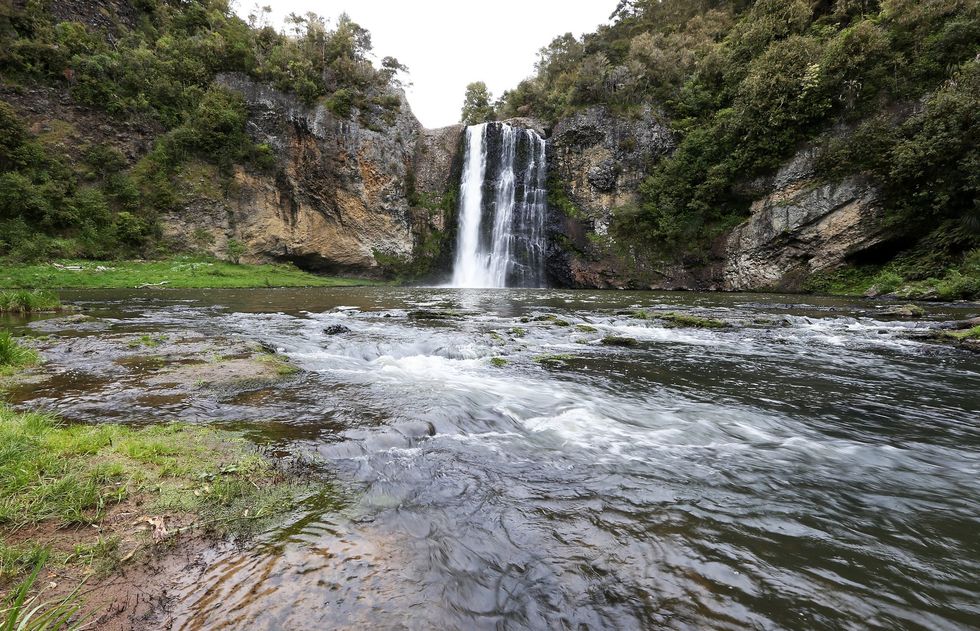
The research marks the first time a fault line in the Hunua Ranges had been radiocarbon dated
GETTY
He said: "We could see that the risk is actually lower than what we think right now, but we could also collect data and find actually it’s a little bit higher, and at that stage... We should really think about whether we have the right legislation for buildings in the city."
In a statement, Building and Construction Minister Chris Penk said the new research on Auckland's fault lines will be considered but "a single study does not in itself warrant an immediate change to the proposed classification or regulatory approach".
The Auckland Mayor said in a statement the research was "nonsense".
He said: "What you've got around the harbour is sedimentary sandstone right along the cliffs. That's the same stuff that's underneath my city.
"There may be a fault line a long way from here, but it's quite different geology from what's in my city."