By Finbold | Created at 2026-09-03 13:56:56 | Updated at 2026-09-03 14:55:54
1 hour ago
By Finbold | Created at 2026-09-03 13:56:56 | Updated at 2026-09-03 14:55:54
1 hour ago
Exchange data from Binance shows that 58.5% of bStocks holders also trade perpetual futures, direct equities, or all three, with 20.7% remaining active across all three formats. This behavioral overlap indicates that the segmentation separating a stock investor from a derivatives trader from a cryptocurrency holder describes account structures rather than people. That taxonomy stops working when one account carries all three instruments.
One investor, three instruments
The retail investor taxonomy the financial industry uses was largely inherited from an infrastructure constraint. Equities, derivatives, and digital assets historically lived in separate accounts at separate firms under separate regulators, prompting the industry to describe the people using them as distinct populations.
Collapse the accounts, and the taxonomy has nothing left to sit on. Independent data from Kaiko shows that between April 1 and May 25, 2026, Binance and Hyperliquid each averaged around $2 billion in daily volume on perpetuals referencing traditional assets. Binance platform data shows 25% of bStocks holders trading perpetual futures alongside their tokenized equities, while 12.7% pair direct equities with the tokenized version.
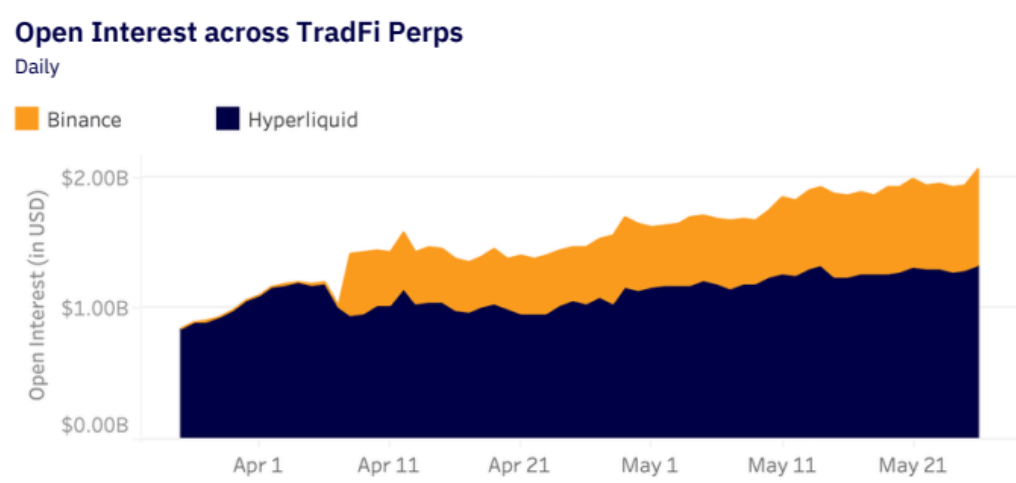 Source: Kaiko Level 1 & 2 data
 “Tokenized stocks are opening the door to a new generation of investors and with bStocks accounting for 58% of equity-linked volume on Binance outside U.S. market hours, it is clear that users increasingly expect access on their own terms,” said Shunyet Jan, Head of Exchange & Trading at Binance. “We’re seeing more users explore traditional finance through an experience that is borderless, always available, and integrated with the digital assets they already hold. As user demands evolve, we will continue expanding bStocks to make global investment opportunities more accessible and intuitive.”
Choosing between a token and a direct share for the same underlying company is a decision about market liquidity, the custody model, and what hours an asset trades, rather than a measure of conviction. That is a structural decision regarding instrument choice that did not previously exist at a retail scale.
The mechanism is the conversion, not the token
On most platforms, moving between a tokenized security and its underlying share requires selling the token into a stablecoin and then buying the equity.
That process involves two separate transactions, each carrying a fee and a spread. Offering free, instant, two-way conversion removes that friction entirely, and the economic effect of that efficiency shows up directly in the arbitrage data.
Between June 11 and July 8, 2026, Binance Research data shows that 2,806 users executed fast-matched trades across bStocks and their matching equities, generating $216 million in volume.
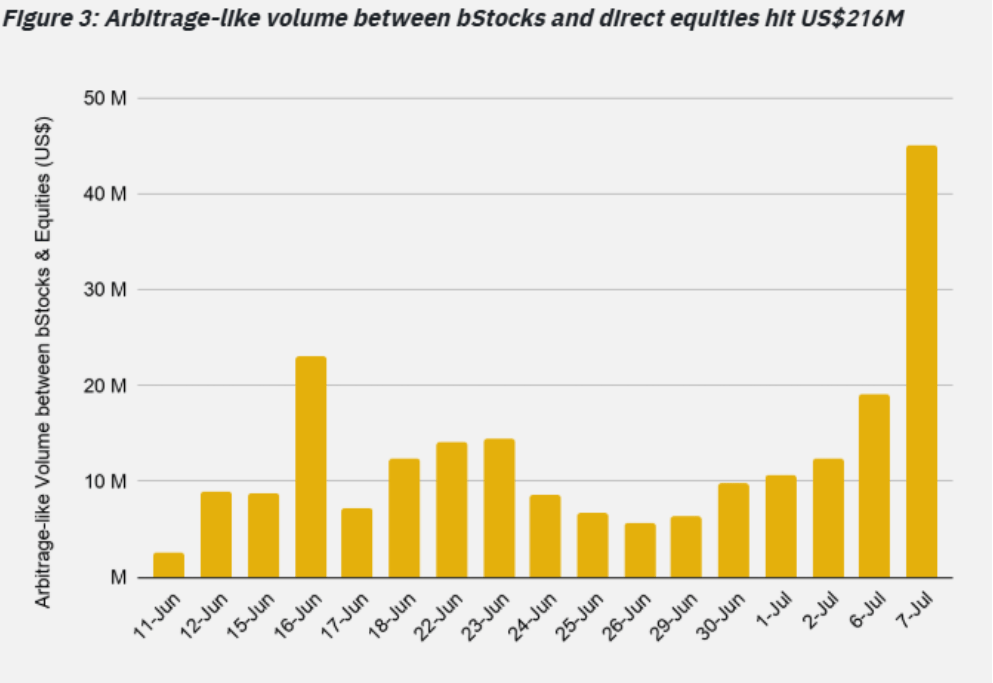 Source: Binance research as of July 8, 2026
The distribution of that activity is the interesting part. A group of 206 systematic traders accounted for $198.2 million, operating with a median 3-minute gap between legs and capturing roughly $636,000 in gross spread. Meanwhile, 2,600 users appeared just once, caught a temporary gap, and left, generating $6.46 million collectively.
Exchange-traded funds keep their prices in line through a functionally similar creation and redemption process, but that mechanism is strictly restricted to a small set of authorized participants. Here, it ran to nearly 3,000 regular accounts in under a month.
The SPCX lifecycle
The lifecycle of SpaceX-linked instruments provides the clearest case study of a single user base moving across three product formats around one company. The sequence began before the public listing. SpaceX pre-IPO perpetuals opened on Binance 22 days before the actual equity debuted, generating close to $2 billion in volume across more than 11 million trades. The market averaged roughly $88 million a day and peaked at $5.85 billion in volume on the day of the initial public offering.
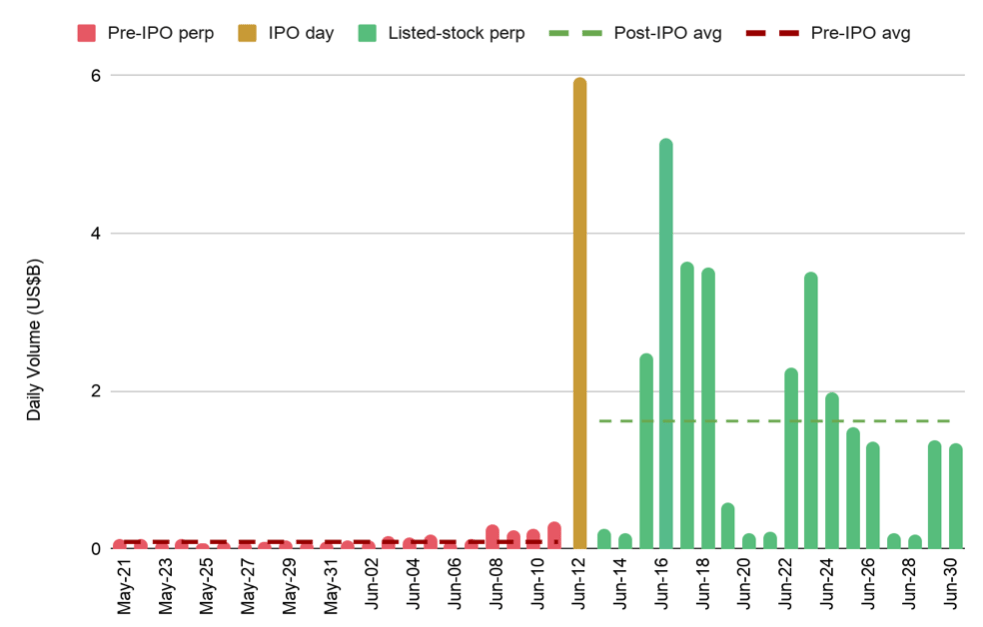 Source: Binance
 After the listing, SPCX became the highest-volume equity on the platform. It drew more than $70 million in fund flow, of which over 93% was minted into the tokenized bStock version rather than held as the direct share. The conversion metrics highlight the preference: of the roughly 245,000 users who traded the pre-IPO perpetual, 8.6% went on to trade the bStock, against just 0.6% who moved into the direct stock. That represents a roughly 14-fold edge for the tokenized format as an on-ramp.
The two instruments are not equivalent. A bStock delivers economic exposure to the underlying share, including dividend treatment through a rebasing mechanism, but not the shareholder voting rights that come with the direct equity. Familiarity, rather than economics, is the most plausible explanation for the ratio. The tokenized format’s advantage here is effectively a user-interface advantage, which means the dominance of the token may not survive once the direct product becomes equally familiar.
When a token becomes collateral
The structural shift accelerates when a tokenized stock is used as backing for other positions. As of early July, bStocks are accepted as margin collateral under cross margin and unified account modes for eligible users across 25 tokens. They can also be deployed across lending and liquidity protocols on BNB Chain. As of July 8, 2026, Binance Research reported PancakeSwap liquidity-pool yields in a wide range of roughly 32% to 228%, while native credit pools operated between 5% and 10%.
Accepting leveraged sector products as collateral concentrates exposure. A sharp downturn in a single sector can simultaneously hit both the trading position and the asset backing it. That is the standard critique of correlated collateral, and it applies directly to equity tokens.
Kaiko’s four-layer framework for exchange business models maps this transition, dividing platforms into trading cores, yield products, payment rails, and institutional collateral. The collateral layer is specifically where institutional capital enters the ecosystem, and it is scaling.
Kaiko put the tokenized US Treasury market at $15.2 billion across 76 products by early May 2026, while the market value of all tokenized traditional assets reached roughly $37 billion in early August, about double the level of a year earlier. Applying that same collateral utility to tokenized equities marks the point where convenience ends and a significant market-structure question begins.
The category that segmentation missed
When the same company can be held as a share, a token, or a perpetual contract inside a single account, the meaningful distinction stops being the asset class and becomes what the position is actually for. Retail segmentation models will have to catch up to a market that has already integrated itself.
Featured image via Shutterstock.