By The Rio Times | Created at 2026-10-09 06:07:05 | Updated at 2026-10-09 07:59:56
2 hours ago
By The Rio Times | Created at 2026-10-09 06:07:05 | Updated at 2026-10-09 07:59:56
2 hours ago
ECONOMY · NAMIBIA
Key Facts
- —The country Namibia, a desert nation of about three million people on Africa’s southwest coast. Its currency is pegged one to one to the South African rand.
- —Why it matters Namibia imports its fuel and prices it off dollar oil markets, so Middle East disruption reaches pump prices and household budgets within weeks.
- —Why now The Namibia Statistics Agency released its September consumer price bulletin on Thursday 8 October.
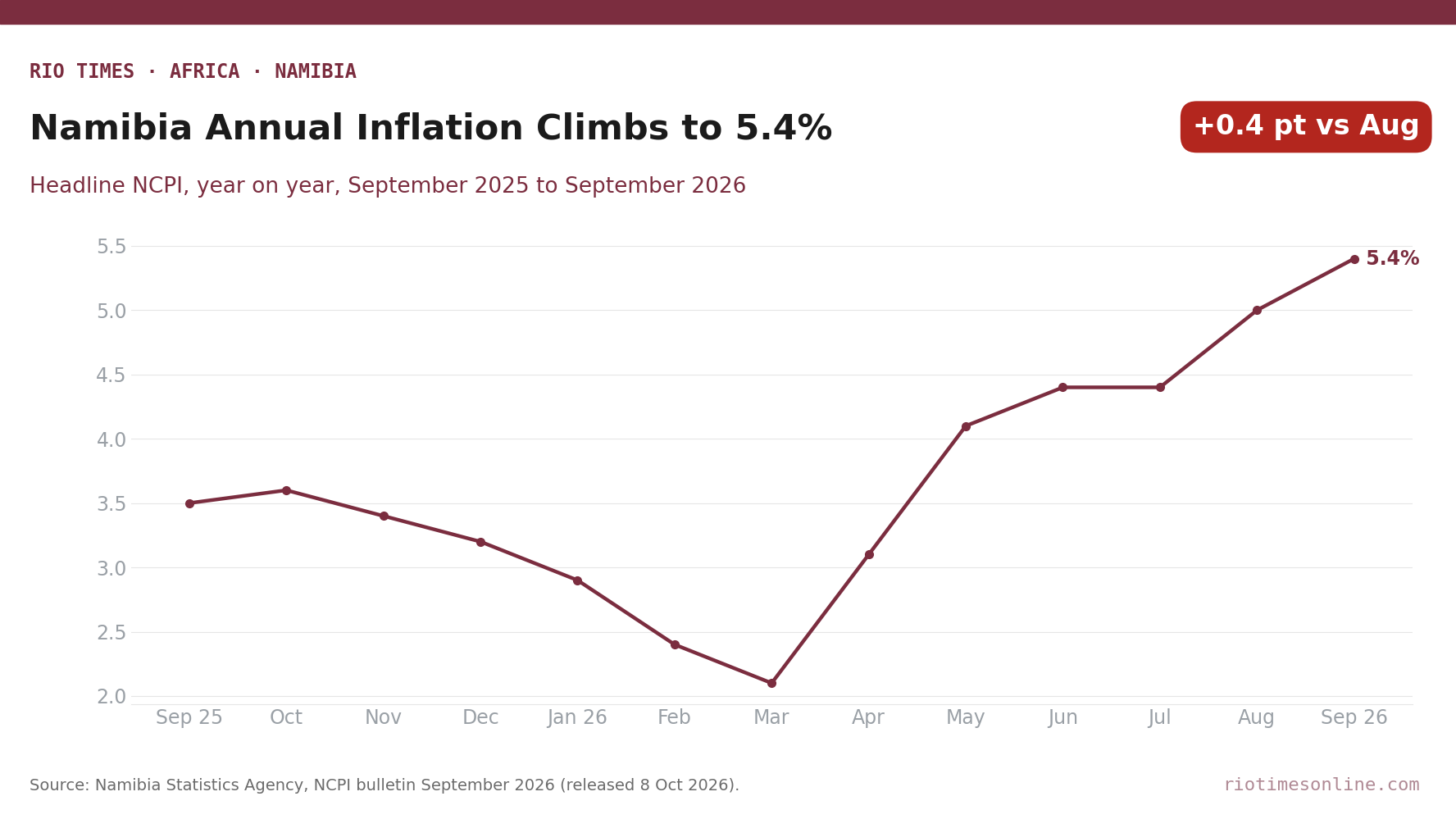
- —What happened Annual inflation rose to 5.4% in September from 5.0% in August. Prices rose 0.4% in the month, slower than August’s 0.6%.
- —The numbers Transport prices are up 14.9% on a year earlier and petrol and diesel 30.4%. Core inflation is 4.0%. Inflation was 2.1% in March.
- —What it means for US readers Fuel, flights and road trips cost more for visitors and firms. The ministry blames Middle East supply disruption, including the Strait of Hormuz.
- —Still open Whether October’s petrol increase lifts inflation further, and whether the Bank of Namibia keeps its repo rate at 6.75%.
Namibia inflation climbed to 5.4% in September, its fastest pace in the past year, as fuel and transport costs kept rising. The Namibia Statistics Agency (NSA), the state statistics office, published the figure on Thursday 8 October. For foreign readers it is a clear case of a distant oil shock, priced in US dollars, landing in a small African economy within weeks.
Annual inflation stood at 5.0% in August and 3.5% in September 2025, according to the NSA’s bulletin. On a monthly basis, prices rose 0.4% in September, down from 0.6% in August. That slower monthly pace is the first sign the fuel shock may be losing some of its force.
The bulletin is signed by Alex Shimuafeni, the Statistician-General and chief executive of the NSA. The local business weekly Namibia Economist reported the same figures on Thursday.
Fuel Drives Namibia Inflation Higher
Transport did most of the work. The category carries 14.3% of the consumer basket and recorded annual inflation of 14.9% in September. A year earlier it was 1.3%.
Transport alone added 2.2 percentage points to the 5.4% headline rate, the NSA said. Petrol and diesel prices were 30.4% higher than a year earlier. Air fares rose 22.1%, taxi fares 15.4% and bus fares 12.6%.
Housing, water, electricity and other fuels, the largest part of the basket at 28.4%, added another percentage point. Food and non-alcoholic drinks added 0.8 points.
The fuel numbers have a clear source. On Friday 2 October, Minister of Industries, Mines and Energy Modestus Amutse, who sets pump prices each month, announced October’s adjustment. Petrol 95 rose by N$1.50 per litre (about US$0.09) from 7 October, while both diesel grades stayed unchanged, the state daily New Era reported.
In Walvis Bay, the main port, petrol now costs N$26.58 a litre (about US$1.60), roughly US$6.05 a gallon. Diesel 50ppm stays at N$27.86 a litre (about US$1.67). Amounts here are converted at the South African Reserve Bank rate of R16.64 per US dollar on Thursday 8 October.
The ministry blamed Middle East tensions, attacks on oil infrastructure and constrained flows through the Strait of Hormuz. It said the average international petrol price rose 19.27% to US$148.36 a barrel in the first 25 days of September. A weaker Namibian dollar added to the cost of imports.
Follow this story
Get an email when there’s news on Namibia
Free. One email a day at most, and only when there is news. This also signs you up to our weekday newsletter, Africa Intelligence. Nothing arrives until you click the confirmation link, and you can stop either with one click. Privacy policy.
Where the Pressure Is Easing
The picture is not one-sided. Beneath the Namibia inflation headline, the core measure, which strips out volatile food and energy, was 4.0% in September, well below the headline rate. That suggests the rise is still concentrated in fuel rather than spreading through the whole economy.
Food inflation slowed to 4.0% from 4.9% a year earlier. Meat prices rose only 3.3%, against 8.1% in September 2025, and beef inflation fell from 14.1% to 2.6%. Fruit (14.4%) and vegetables (8.5%) remain the exceptions. Communication prices fell 0.9%.
The capital feels it most. Zone 2, the Khomas Region around Windhoek, recorded 6.2% annual inflation. Zone 3, covering //Kharas, Erongo, Hardap and Omaheke, recorded 5.8%. The northern Zone 1 recorded the lowest rate at 4.3%, even though its drivers paid the most for fuel: N$25.76 a litre for petrol (about US$1.55).
For context on the economy and its oil hopes, see our explainer Namibia Explained: The Country, the Oil Hopes, the Economy and What to Watch.
What It Means for US Readers
For investors, Namibia inflation now sits closer to the Bank of Namibia’s policy rate. The central bank held its repo rate at 6.75% at its meeting of 10 and 11 August. It said it was mindful of the need to protect the peg to the rand.
The peg ties Namibia’s rate decisions closely to South Africa’s. The South African Reserve Bank’s policy rate stood at 7.25% on 8 October, half a point above Namibia’s. With inflation at 5.4%, Namibia’s real policy rate is now only about 1.35 points.
For travellers, the message is mixed. Self-drive safaris and air travel cost noticeably more than a year ago, and restaurant and hotel prices rose 6.3%. Visitors paying in US dollars are partly shielded, because the Namibian dollar trades at about 16.6 to the US dollar.
For companies shipping through Walvis Bay or running mines inland, the frozen diesel price matters most. Diesel moves trucks, mining fleets and generators, so the unchanged October price takes some pressure off freight costs. Namibia’s beef exporters face their own headwinds, covered in Namibia Beef Exports Hit by EU Foot-and-Mouth Suspension.
What Is Not Known
The October petrol increase is not yet in the Namibia inflation data. The NSA will only show its effect in the October bulletin, due in mid-November.
It is not known whether the Bank of Namibia will raise rates. Its next decision is due on Wednesday 28 October, according to the central bank’s calendar. Nor is it clear how long Middle East supply disruptions will keep fuel prices high, or whether government will keep absorbing part of the cost. The ministry said it still faced an under-recovery of about N$3.80 a litre on petrol (about US$0.23) as of 25 September.
Frequently Asked Questions
What was Namibia’s inflation rate in September 2026?
Namibia inflation was 5.4% year on year, up from 5.0% in August, according to the Namibia Statistics Agency. Prices rose 0.4% during the month itself.
Why is inflation rising in Namibia?
Mainly fuel, which drives most of Namibia inflation today. Transport prices were 14.9% higher than a year earlier and petrol and diesel 30.4% higher, after Middle East supply disruptions pushed up international fuel prices.
What is core inflation in Namibia?
Core inflation, which excludes volatile food and energy prices, was 4.0% in September, below the 5.4% headline rate.
Which part of Namibia has the highest inflation?
The Khomas Region around Windhoek, at 6.2%. The northern zone recorded the lowest rate, at 4.3%.
What is the Bank of Namibia’s interest rate?
The repo rate is 6.75%, held at the central bank’s meeting of 10 and 11 August 2026.
Sources: Namibia Statistics Agency, Namibia Consumer Price Index bulletin, September 2026; Namibia Economist, Annual inflation surges to 5.4% in September; New Era, Diesel holds steady as fuel shock eases into October; Bank of Namibia (repo rate decision, August 2026); South African Reserve Bank (exchange and policy rates, 8 October 2026).
Editorial responsibility: Matthias Camenzind, Editor-in-Chief · Editorial standards · Report an error