By Engadget | Created at 2026-10-13 13:45:37 | Updated at 2026-10-13 16:26:26
4 hours ago
By Engadget | Created at 2026-10-13 13:45:37 | Updated at 2026-10-13 16:26:26
4 hours ago
The nuclear-powered buggy has now traveled 28.10 miles, besting NASA's Opportunity rover.
NASA/JPL
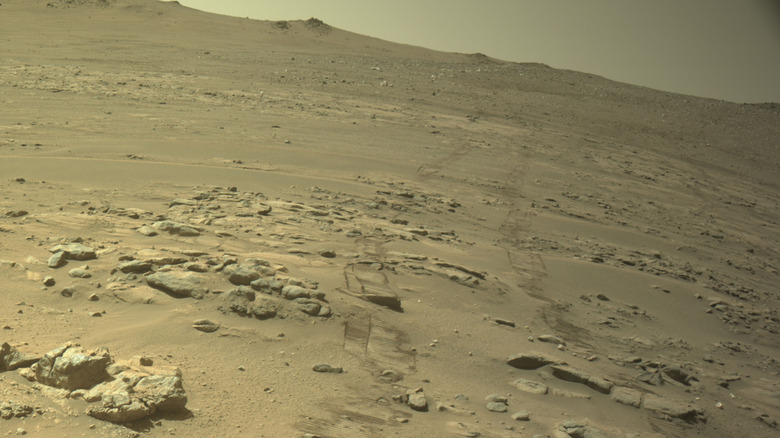
NASA's Perseverance Mars rover just broke the record for the farthest distance traveled by any vehicle on another world, the space agency announced. The six-wheeled, nuclear-powered buggy has now traveled 28.10 miles (45.22 km) as of October 11th, besting NASA's Opportunity rover that rolled 28.06 miles (45.16 km) across the red planet's surface. Perseverance managed the feet in just five and a half years, compared to nearly 15 for the plucky Opportunity.
Last we checked with Perseverance, it was officially a marathon finisher with 26.2 miles under its pock-marked metal wheels. While the 28.1 miles it's covered to date may not seem like much, it's pretty good considering the vehicle's maximum speed is a glacial 0.1 mph. It's also impressive considering the challenging terrain it's been tasked to transit, as NASA showed in the video below.
The 2,260 pound rover attained the milestone traveling to a region called Idubi, where it will investigate a feature called "Lac de Charmes" with some of the oldest terrain ever explored in our solar system. "The rocks and terrain of Lac de Charmes are so ancient that their Earthly equivalents have long since been erased by erosion and plate tectonics (Mars doesn't have tectonic plates), and Idubi is where the science team hopes to find traces of ancient hydrothermal systems," NASA explained.
Perseverance's longevity can be chalked up in part to smart navigation decisions powered by its autonomous AutoNav system. Using that, the rover can image terrain and find hazards in real time while driving automatically between waypoints chosen by its planners. By processing 600,000 measurement points with each glance, it has been able to travel more than 90 percent of its total distance autonomously.
Thanks to a recent software update, Perseverance can now roll more and steer less to save wear on parts, while checking its own position against orbital maps in mid-drive. Next, the team wants to overcome camera glare issues from sunlight that impede its vision, so the rover can work longer days.
Perseverance may have out-driven Opportunity, but the Curiosity rover is still exploring Mars as well and has traveled 38.15 km (23.7 miles) to date. The next most traveled US vehicles are the manned rovers from the Apollo 16, 17 and 18 missions — of those, Apollo 17 rover went the farthest at 35.74 km (22.21 miles).