By CryptoSlate | Created at 2026-09-03 01:03:42 | Updated at 2026-09-03 01:54:04
53 minutes ago
By CryptoSlate | Created at 2026-09-03 01:03:42 | Updated at 2026-09-03 01:54:04
53 minutes ago
Silicon Network is shutting down with nearly $10 million still on-chain, giving users until year-end to exit.
The Ethereum layer 2 stopped accepting new bridge deposits and ended its network on Sept. 2, starting a withdrawal period that runs through Dec. 31.
Silicon said its explorer and network will shut down afterward, leaving assets that remain on the chain unrecoverable.
It stated:
“This network is a non-custodial service, meaning that the custody and withdrawal of assets are managed directly by each user. Once the service has been terminated, assets that have not been withdrawn cannot be recovered.”
The closure unwinds a network that had sought to connect Korean centralized-exchange users with Ethereum’s onchain economy. Silicon was built with Polygon CDK, connected to Agglayer and closely integrated with Korbit, one of South Korea’s major crypto exchanges.
Korbit’s Web3 Wallet, which ran on Silicon and was designed to give exchange customers access to DeFi and decentralized applications, is also being discontinued less than two years after launch.
Nearly $10 million now has to find an exit
The imminent shutdown now turns from a network decision into an asset-recovery problem, with different tokens facing very different paths off Silicon.
Data from L2Beat showed Silicon held about $9.75 million in assets, led by $2.66 million of USDC, $2.54 million of WBTC, $2.08 million of ETH and $1.85 million of USDT.
How easily that money can leave now depends on what users hold.
The network stated that assets originally bridged from Ethereum can return to the mainnet during the withdrawal window. External-wallet users must initiate a withdrawal, keep enough ETH for gas, and complete the required finalization before the cutoff.
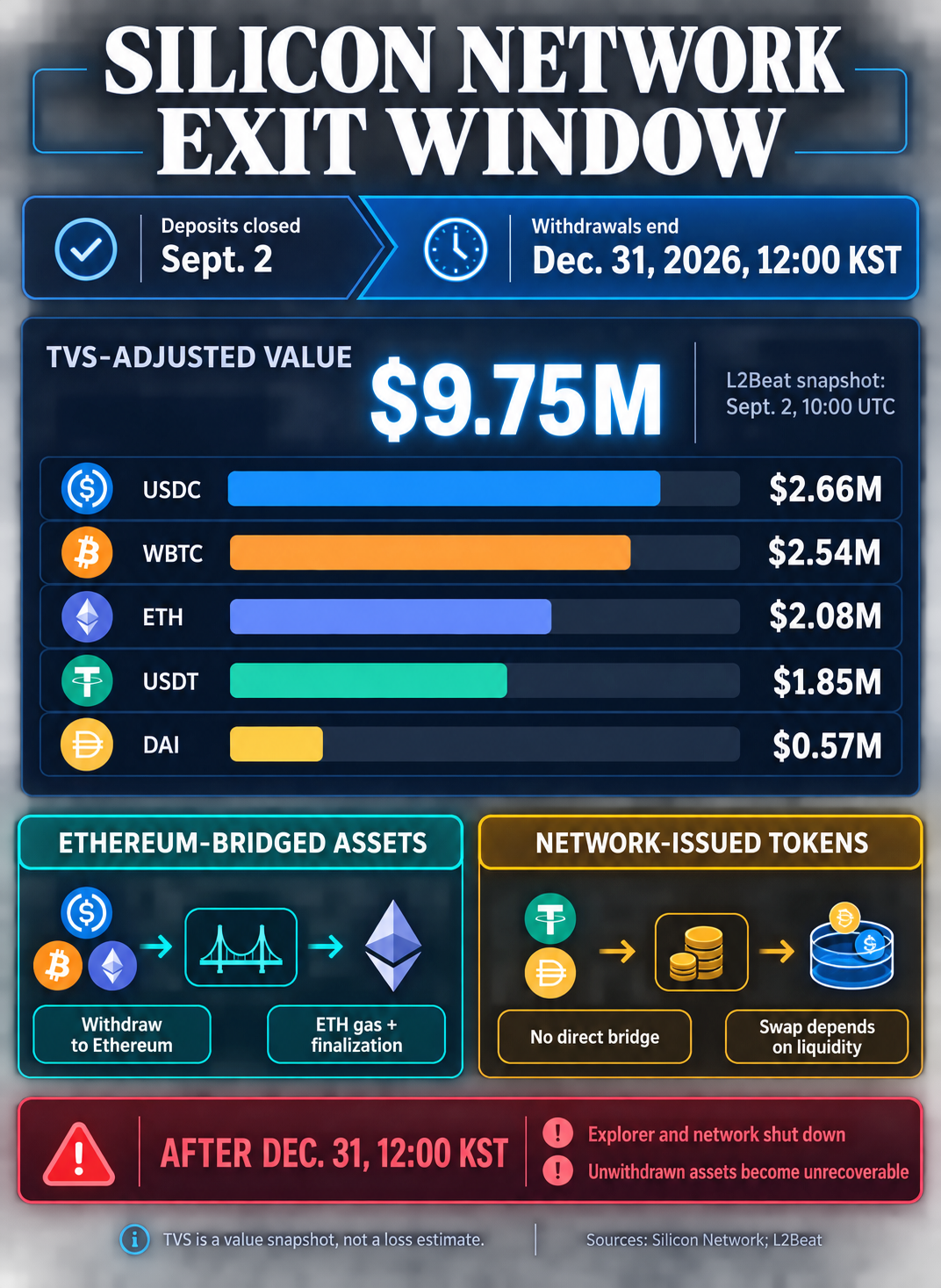
Tokens issued directly on Silicon face a harder route. They cannot be bridged directly to Ethereum and instead depend on liquidity remaining inside the network, which Silicon warns could make swaps or withdrawals difficult or impossible as activity winds down.
The network describes itself as non-custodial and says it has no obligation to redeem assets that users fail to move. It explained:
“Whether and how to handle these tokens is a decision to be made at the user's own discretion and responsibility. Once the network has been fully terminated, recovery will not be possible.”
Silicon’s exit comes as Ethereum’s scaling market becomes increasingly concentrated around its largest networks.
Coinbase-backed Base and Arbitrum now secure about $24.7 billion between them, more than 80% of the roughly $30.5 billion held across Ethereum networks tracked by L2Beat.
Earlier in the year, Ethereum co-founder Vitalik Buterin has also argued that the original vision of layer 2 networks simply acting as Ethereum’s “branded shards” no longer fits as the base layer scales and L2s develop at different speeds. He has urged networks to offer value beyond cheaper execution.
Silicon has not attributed its shutdown to those broader pressures. Its closure nevertheless shows what consolidation can mean at the smaller end of Ethereum’s scaling market: users must unwind bridges and find liquidity before the chain itself disappears.