By The Straits Times | Created at 2026-08-29 19:16:17 | Updated at 2026-09-19 09:57:31
2 weeks ago
By The Straits Times | Created at 2026-08-29 19:16:17 | Updated at 2026-09-19 09:57:31
2 weeks ago
KATHMANDU - Nepali army rescuers broke through to a hydropower tunnel on Aug 29 and began pumping air and sending a camera inside, raising hopes of reaching workers trapped since devastating floods struck the site three days earlier.
Nepal’s government says more than 100 workers may still be alive and trapped inside tunnels at hydropower projects, with rescue efforts focused on the Trishuli 3A and 3B sites.
Those trapped are among 933 hydropower workers missing since a wall of mud and debris swept down on the morning of Aug 26, according to the National Disaster Risk Reduction and Management Authority.
The US Geological Survey said the disaster on the China-Nepal border was caused by a glacial collapse, with nearly 3,000 people missing and 682 confirmed dead.
At Trishuli 3A, army rescue teams using drills broke through on Saturday evening into the upper part of a mud-swamped tunnel.
“We have already started sending air through the small opening, and we will now begin excavation work and send the rescue team inside,” Nepali Home Minister Sudan Gurung said in a statement.
The Ministry of Energy reported that “partial success has been achieved in the drilling operation”, adding that “efforts have begun to try to send a camera and oxygen into the tunnel”.
Rescuers continued to work to clear “the mud accumulated inside the tunnel”, it added.
Specialised Indian and Chinese tunnel-rescue teams have also joined the effort.
India has extensive experience with difficult Himalayan tunnel rescues, including teams of “rat-hole” miners skilled in being able to crawl into narrow spaces.
Initial reports suggested the 100 trapped were in a single location, but Energy Minister Biraj Bhakta Shrestha said that “rescue efforts are going on in multiple tunnel sites”.
Shrestha said operations were ongoing “despite the adverse weather and extremely challenging circumstances”.
Photographs shared by the disaster office showed workers wading through churned mud and navigating vast boulders left by the floods.
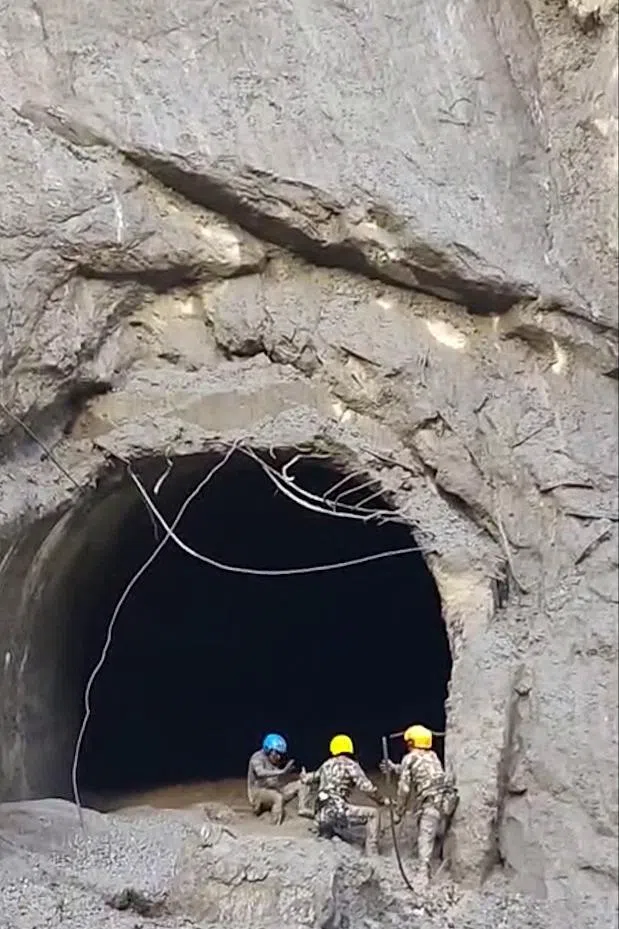
Members of the Nepali Army rescue a person trapped inside a tunnel at a hydropower project in Nepal's Rasuwa district, in a screengrab from video.
PHOTO: AFP
Nepal appealed on Aug 29 for specialised rescue kits, including heavy-lift drones and “technologies that help us locate people alive in the affected areas”.
Nepal’s expert mountain rescue teams – used to aiding climbers on the world’s highest peaks, including Everest – are also joining the search for missing people at another damaged hydropower site.
“We do similar work on the mountains, with rescue operations for people trapped in risky places so I believe our skills will be useful,” Tul Singh Gurung, president of Nepal National Mountain Guide Association, told AFP. AFP