 By The War Zone | Created at 2026-08-07 16:50:53 | Updated at 2026-08-07 17:36:09
59 minutes ago
By The War Zone | Created at 2026-08-07 16:50:53 | Updated at 2026-08-07 17:36:09
59 minutes ago
The TWZ Newsletter
Weekly insights and analysis on the latest developments in military technology, strategy, and foreign policy.
Taiwan’s newest M1A2T Abrams main battle tanks have deployed to Taoyuan International Airport, the main hub serving Taipei, the capital of Taiwan, for the first time. The deployment is part of the ongoing Han Kuang 42 exercise and reflects a growing emphasis on denying critical infrastructure to an invading force from the Chinese mainland.
The airport defense drill simulated an attempt by enemy airborne forces to seize Taiwan’s largest international airport and establish it as an airbridge for follow-on troops and logistics. Alongside M1A2T tanks, Republic of China Army (ROCA) Clouded Leopard 8×8 infantry fighting vehicles occupied defensive positions around the airfield while engineers erected obstacles across key approach routes.
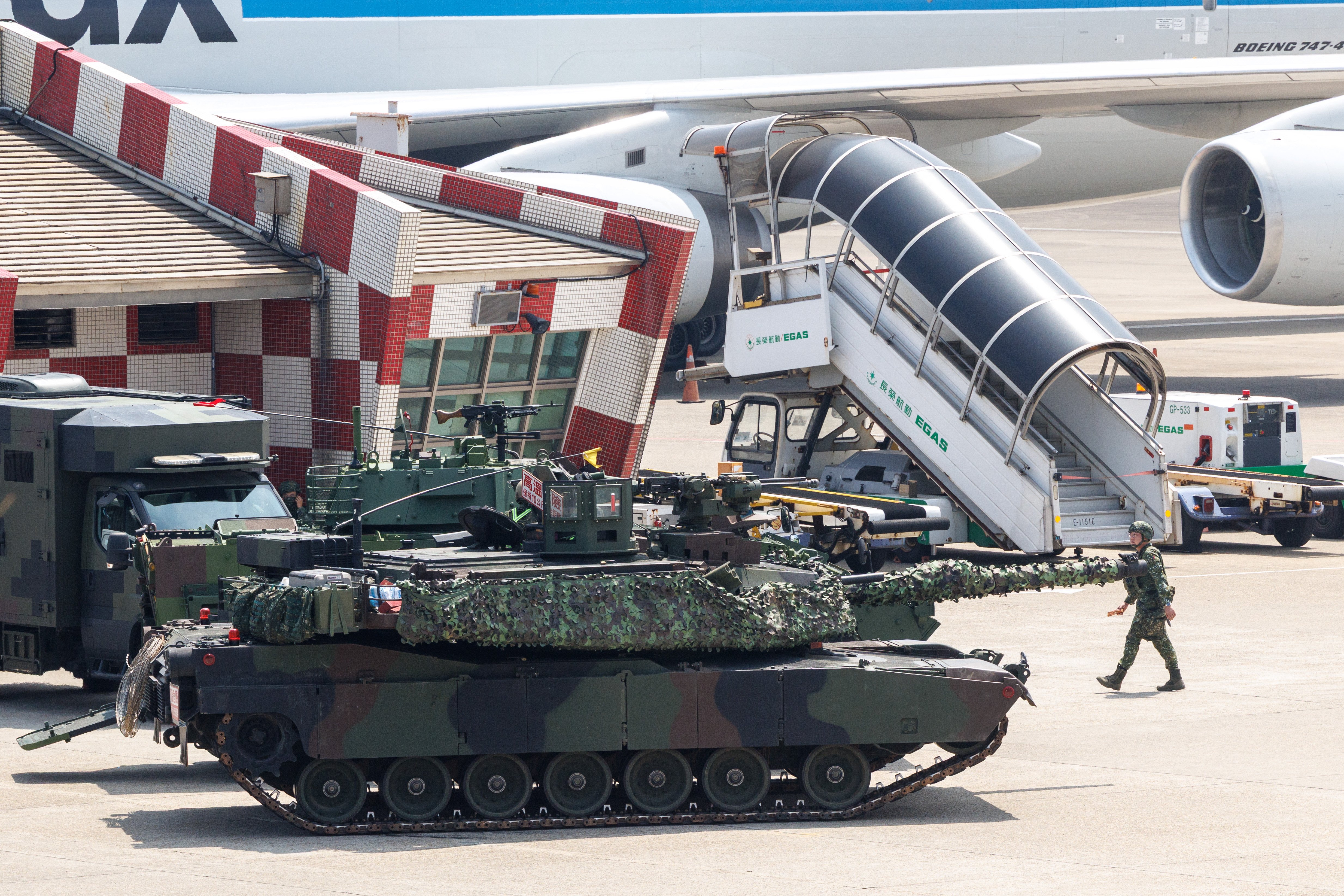 A Taiwanese M1A2T tank during a drill simulating an enemy airborne assault at Taiwan Taoyuan International Airport in Taoyuan on August 7, 2026. Photo by CHENG Yu-chen / AFP
 During the exercise, armored vehicles from the ROCA’s 584th Armored Brigade, including four M1A2Ts and six Clouded Leopard vehicles in three different variants, established firing positions while engineering units emplaced temporary obstacles intended to prevent the landing of enemy aircraft, airborne troops, and special operations forces.
Combat engineers assembled steel “hedgehog” anti-vehicle obstacles in three-man teams, creating a defensive barrier along the airfield. Additional obstacles were constructed using cargo containers and airport vehicles provided by airport authorities, demonstrating how civilian infrastructure is incorporated into wartime defensive planning.
The scenario focused on preventing an airborne assault from establishing control of Taoyuan Airport, a long-recognized strategic objective in Chinese People’s Liberation Army invasion planning because of its proximity to Taipei. Taiwanese military planners assess that if an attacking force secured the airport intact, it could serve as a hub for reinforcements, logistics, and the rapid advance of mechanized forces toward the capital.
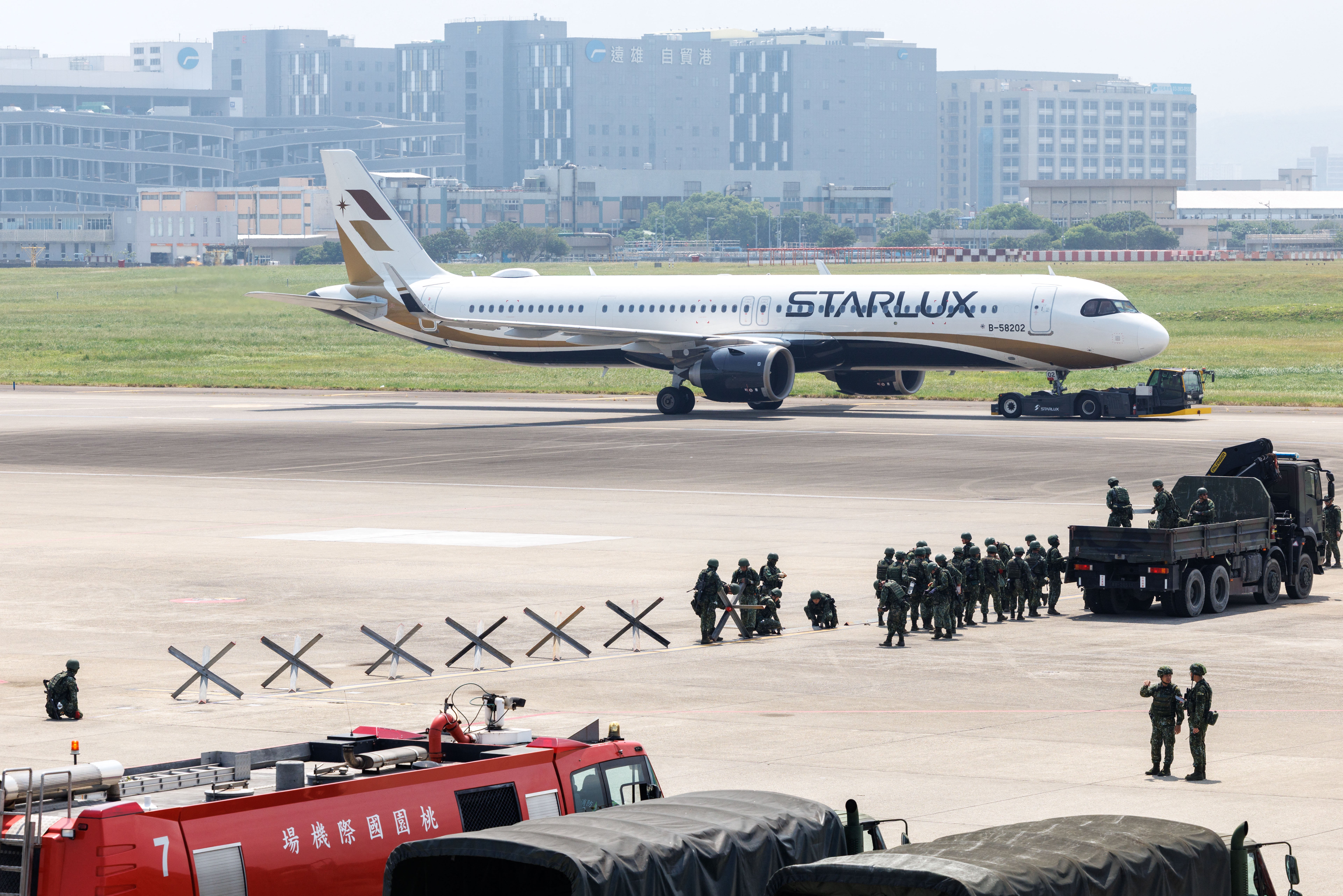 Taiwanese soldiers set up “hedgehog” obstacles during a civil-military drill simulating an enemy airborne assault at Taiwan Taoyuan International Airport in Taoyuan on August 7, 2026. Photo by CHENG Yu-chen / AFP CHENG YU-CHEN
The exercise also rehearsed casualty treatment and evacuation under combat conditions, with medical personnel conducting battlefield trauma procedures before evacuating simulated wounded. Meanwhile, Taoyuan Airport Fire Department firefighting vehicles participated by spraying water across parts of the training area to simulate decontamination and firefighting operations following chemical incidents or attacks.
❗️🇹🇼 "Han Kuang-42" Exercises
August 7, 2026.
Defense of Facilities
The 584th Combined Arms Brigade deployed four M1A2T Abrams tanks, six CM-32 armored vehicles, and medical and fire-fighting vehicles to Taoyuan International Airport. The objective was to thwart any attempt by… pic.twitter.com/Z0dhM9jE2F
Military officials said the drill was designed to validate joint military-civilian coordination during wartime while ensuring normal airport operations continued uninterrupted. Commercial flights continued to arrive and depart throughout the exercise.
The airport defense scenario also included a final escalation phase. Should defending forces prove unable to hold the airfield, other ROCA units would coordinate with the 53rd Engineer Group and airport authorities to demolish runways and other critical infrastructure, denying their use to an occupying force.
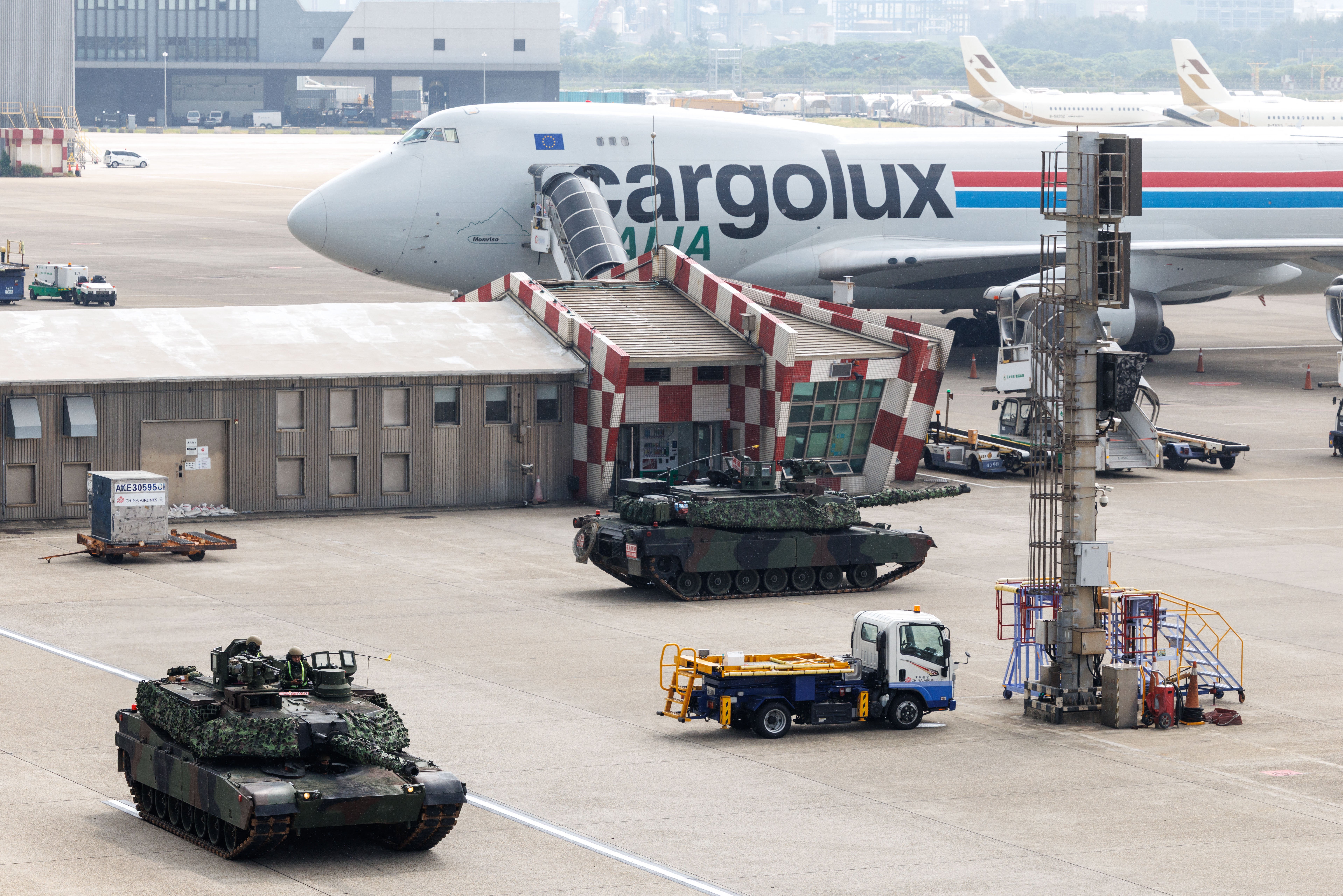 A pair of M1A2T tanks next to a Cargolux 747 at Taiwan Taoyuan International Airport in Taoyuan on August 7, 2026. Photo by CHENG Yu-chen / AFP CHENG YU-CHEN
For a deeper look at how Taiwan plans to counter a Chinese invasion, you can read our detailed analysis here.
Suffice it to say, the Han Kuang 42 scenario echoes the battle for Hostomel Airport during the opening phase of Russia’s full-scale invasion of Ukraine in February 2022. Russian airborne forces succeeded in capturing the airport after an initial helicopter assault, but the airfield was heavily contested and damaged in the ensuing fighting, preventing it from functioning as the airbridge Moscow had envisioned for rapidly flying in large numbers of reinforcements and heavy equipment. Ukrainian counterattacks ultimately forced Russian troops to abandon Hostomel as they withdrew from the Kyiv region weeks later.
Returning to Taiwan, the ROCA has received all 108 of the M1A2T tanks it ordered as part of the modernization of its armed forces, which face an expanding military threat from Beijing. Generally speaking, the M1A2T is equivalent to the M1A2 SEPv3 version — or System Enhancement Package version 3 — which you can read more about here.
Taiwan’s Ministry of National Defense (MND) confirmed today that the first shipment of M1A2T tanks had arrived from the United States in December 2024, as we reported here. The final examples were reportedly delivered in April of this year.

U.S. M1A2T Abrams Tanks Arrive in Taiwan | TaiwanPlus News
The M1A2T procurement led to some questions about how suitable the big and heavy Abrams is for Taiwan’s very particular defensive requirements.
The Abrams is arguably not ideal for the kinds of urban warfare that the ROCA might have to engage in if it meets a PLA invasion — something that it already regularly trains for in these kinds of settings. Scenarios like this also pose a particular challenge for main battle tanks.
However, the drill at Taoyuan Airport reflects the reality that, were it to face a PLA invasion, Taiwan could not afford to leave any armored vehicle on the sidelines. Beijing continues to claim the self-governed island as its own and has repeatedly threatened to seize it by force if necessary, compelling Taiwan to keep even aging armored vehicles in service.
Despite questions about the utility of heavy armor in potential conflicts in the Indo-Pacific region, the ROCA is clearly looking at how the M1A2T and other armored vehicles could help defend key objectives in urban areas.
It’s also worth noting that the M1A2Ts are only one element of Taiwan’s layered defense. The ROCA also fields AH-64 Apache attack helicopters, long-range artillery, multiple-launch rocket systems, coastal anti-ship missile batteries, and air defenses intended to disrupt and attrit an invasion force well before it can land troops and armored vehicles on the island. Increasingly, drones, too, are part of this defensive equation.
Should the ROCA have to fight the PLA in its cities, this is another area in which specialist tactics are regularly trained.
We have reported in the past how Taiwan has demonstrated the extraordinary measures it is prepared to take to keep its armored forces alive in a conflict with China. During combat readiness drills, the ROCA conceals tanks and other armored vehicles throughout urban areas using improvised camouflage, disguising them as piles of scrap or civilian construction equipment in an effort to complicate PLA targeting.
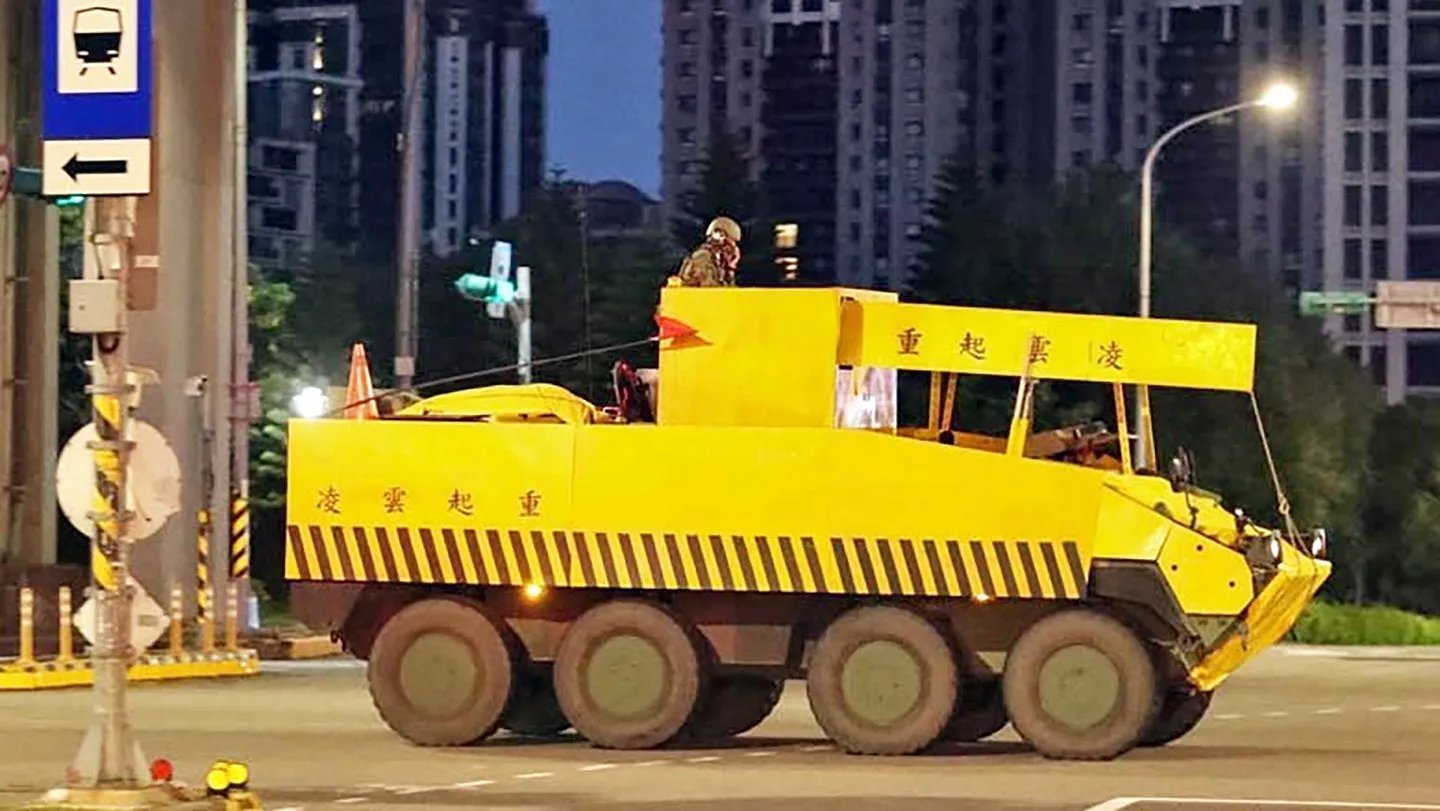 A Clouded Leopard 8×8 infantry fighting vehicle adapted to look like a yellow civilian crane. ROC Military News Agency
 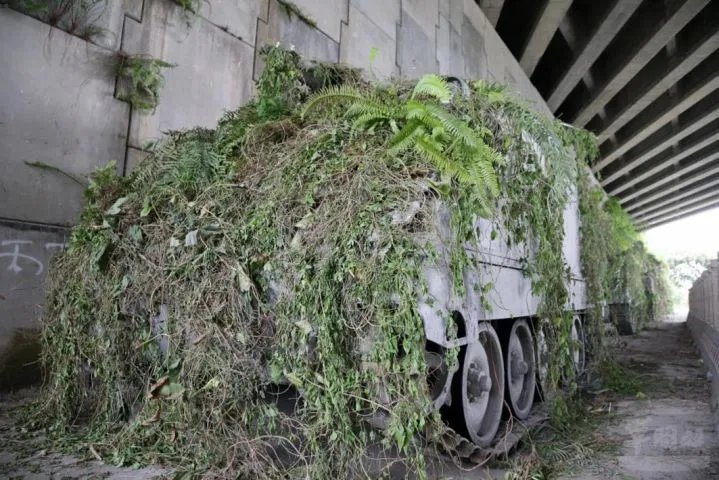 An ROCA M113 armored personnel carrier concealed under a bridge during an urban warfare exercise. ROC Military News Agency
 Taiwan’s military has also begun incorporating Taipei’s subway system into its wartime planning. During exercises last year, troops — including teams armed with Stinger shoulder-launched surface-to-air missiles — used the Taipei Metro to move around the capital in what appeared to be the first public demonstration of the concept. In a conflict with China, the underground network could provide a comparatively protected route for shifting troops, air defense teams, and supplies between key sectors while roads and other infrastructure above ground come under attack.
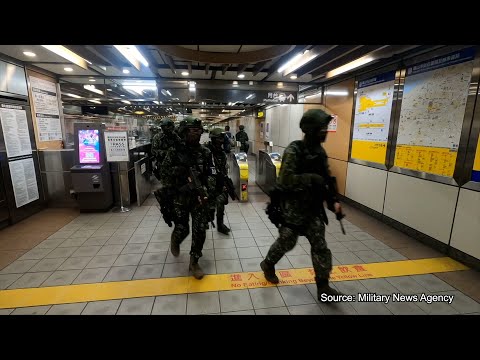
Military, civil forces team up in Taipei Metro drill
At the same time, it is clear that the PLA, too, would expect to take on Taiwanese forces in urban settings, and there is plenty of evidence of its units training accordingly.
The Han Kuang exercise has increasingly emphasized defending Taiwan’s critical infrastructure against airborne and special operations attacks. The appearance of the M1A2T at Taoyuan Airport marks the first time Taiwan’s newest and most capable tanks have participated in this high-profile airport defense mission, highlighting their growing operational role beyond conventional armored warfare.
Contact the author: [email protected]