 By Daily Mail (U.S.) | Created at 2026-07-23 23:39:09 | Updated at 2026-07-27 18:12:54
3 days ago
By Daily Mail (U.S.) | Created at 2026-07-23 23:39:09 | Updated at 2026-07-27 18:12:54
3 days ago
Lately, the special relationship between the US and the UK has seemed a little less fond and a little more flaky.
With seven prime ministers in the last ten years, American presidents would be wise not to get too comfortable with any resident of 10 Downing Street, much as fans of Chelsea FC and the Cleveland Browns have learned to sequentially detach from their teams' parade of head coaches.
Cameron. May. Johnson. Truss. Sunak. Starmer. Now comes Burnham. Andrew Murray Burnham, former Mayor of Manchester and longtime Labour Party MP, known to his friends and constituents as 'Andy', was, until now, completely unknown to the American public and most members of the Trump administration.
Burnham's fast ascent to the PM slot comes as the ledger of vital business between Washington and London is suddenly brimming again. On one page, it's national security: Ukraine, Russia, China, the shared burden of NATO, intelligence cooperation and the crosswise dissonance over how much of the European obligations America is expected to assume.
On another page it's economics: arguments over tariffs, trade, investment, artificial intelligence, energy, pharmaceuticals and who gets to write the rules for the next iteration of 21st century industries.
Flick the page again, it's culture, specifically the yawning societal divides: immigration, free speech, identity politics, social media, elite institutions and a fractured Anglosphere.
The close bond between Great Britain and the United States has survived world wars, the Cold War, Brexit and (so far) Donald Trump. The question now isn't whether it endures. It's what, exactly, makes the relationship so special in the first place.
On paper, Andy Burnham and Donald Trump have almost nothing in common. In practice, their political biographies rhyme in some surprising ways.
Andrew Murray Burnham, known to his friends and constituents as 'Andy', was, until now, completely unknown to the American public and most members of the Trump administration
With seven prime ministers in the last ten years, American presidents would be wise not to get too comfortable with any resident of 10 Downing Street (Pictured: Former PM Keir Starmer gives his farewell speech on July 20)
Both have an instinctive insight into voters who moan that the people in charge stopped listening a long time ago. Both have built powerful personal brands that, at times, matter more than the party logo next to their names. Both have been perfectly willing to irritate their own side, ignore the consultants, and trust their political gut. And both understand something many polished pros never do: in modern politics, voters will forgive almost anything except inauthenticity. Neither Trump nor Burnham ever sound as if they were assembled by a focus group.
Nevertheless, their lives could hardly have unfolded more differently. Trump inherited wealth, made his name in Manhattan real estate, became a tabloid fixture, a reality television star and ultimately the most disruptive figure in modern American politics.
Burnham grew up in a modest home, read English at Cambridge, climbed the traditional Labour ladder, spent decades in Parliament and government and reinvented himself not as a national celebrity but as the hands-on mayor of Greater Manchester.
Trump has always seemed happiest turning every disagreement into a national spectacle. Burnham's reputation rests on patiently building local credibility, sweating the quotidian details of buses, policing, housing and the NHS. Trump spent a lifetime seeking the biggest possible stage; Burnham largely made his name by proving that politics close to home can matter just as much.
Against a global backdrop of turmoil and combat, Burnham and Trump will feel pressure to promptly form a solid, working relationship. In connecting effectively with Trump, Burnham's greatest advantage may be that he is not his immediate predecessor, Keir Starmer.
Starmer's initial strategy with Trump was overt: flatter when necessary, disagree quietly, never make himself the story and preserve the special relationship no matter what.
For a while, it worked. He delivered the King's unprecedented second state visit invitation, won a comparatively favorable trade arrangement, and mostly swallowed Trump's provocations. But the fault lines kept widening – Ukraine, Iran, tariffs, North Sea energy, China's role in the British economy, Palestinian statehood, even Trump's periodic digs at Britain's military involvement and Starmer's leadership style.
What began as careful diplomacy gradually gave way to mutual exasperation. Trump came to see Starmer as too cautious, too European, and too constrained by Labour orthodoxy. Starmer eventually realized that there was no amount of tact that could insulate Britain from a White House that increasingly viewed allies less as trusted partners than as negotiating counterparts, foils and scapegoats.
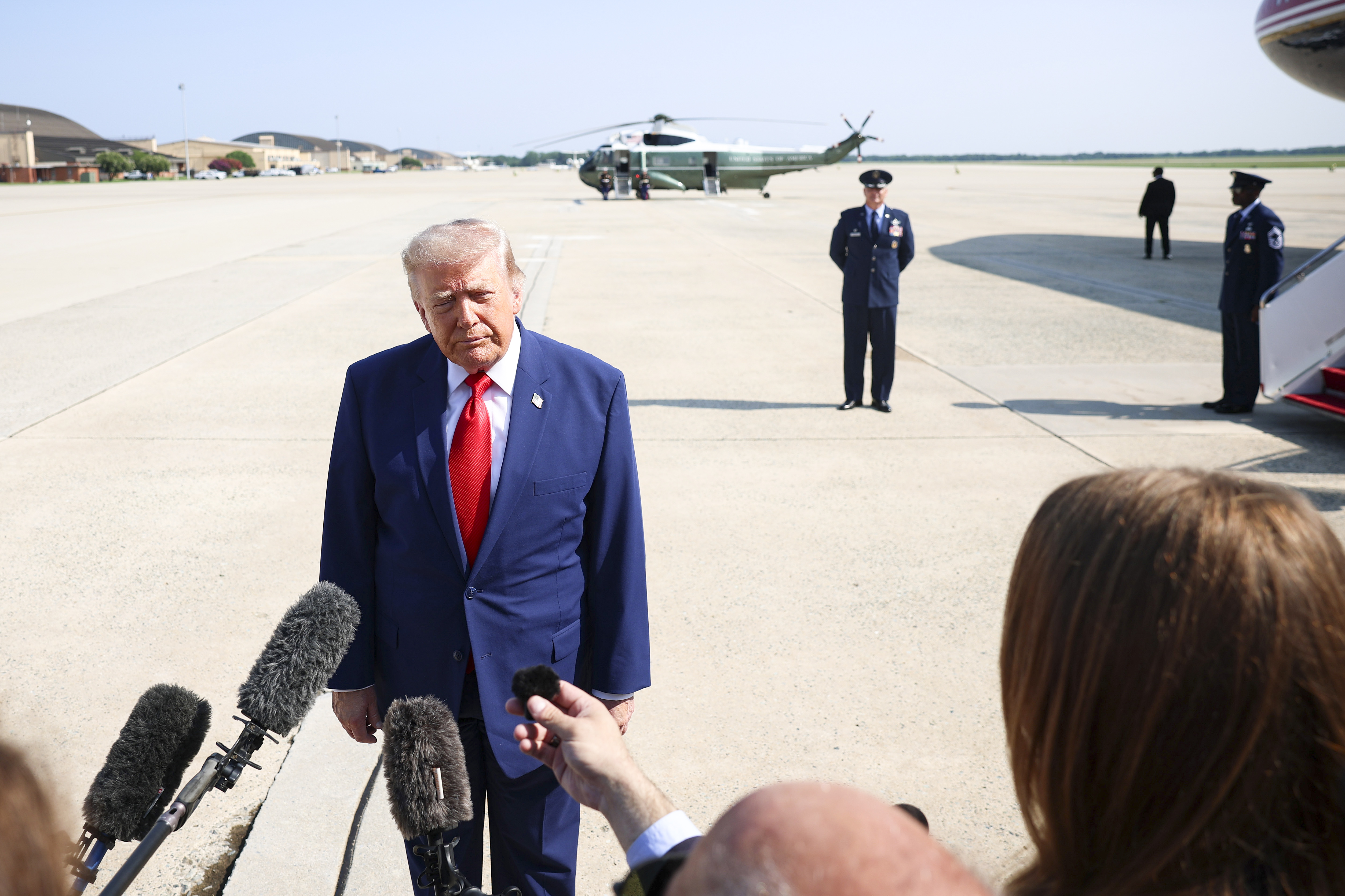
If the early signals are any guide, Donald Trump and his team have decided that Andy Burnham deserves something Mr Starmer never really got: the benefit of the doubt. Publicly, Trump has been almost conspicuously cordial. 'I had a very good conversation with the new British prime minister,' he said this week, adding that the two would soon meet in person and stressing the importance of revitalizing the relationship.
Starmer's initial strategy with Trump was overt: flatter when necessary, disagree quietly, never make himself the story, and preserve the special relationship no matter what
If the early signals are any guide, Donald Trump and his team have decided that Andy Burnham deserves something Mr Starmer never really got: the benefit of the doubt
Mark Halperin is the editor-in-chief and host of the interactive live video platform 2WAY and the host of the video podcast 'Next Up' on the Megyn Kelly Network
Even Trump's unsolicited advice – that Britain should dramatically expand North Sea oil and gas production because it could become 'one of the richest countries' – was delivered less as a rebuke than as friendly encouragement.
Privately, the mood is similar, if a bit less guarded. The consensus inside Trump world is to hope that Burnham is a pragmatist, not an ideologue and a man who appreciates the art of the deal.
Washington is keeping an eye on Burnham's selection of ministers and aides, and the broad impression on the Washington side of the pond is that Burnham is choosing practical figures, sending signals that he intends to govern rather than prosecute old Labour arguments.
The choice of Ed Miliband as Foreign Secretary, however, appears to be the principal source of anxiety inside the Trump administration. Officials see him as sharply at odds with Trump's worldview on energy, climate policy, Iran and the role of international institutions. If there is an anticipated trouble spot between Washington and the new British leadership, it is less likely to be Trump versus Burnham than Trump (and Rubio and Vance and Miller) versus Miliband.
The choice of Ed Miliband (above) as Foreign Secretary appears to be the principal source of anxiety inside the Trump administration
Yet the initial DC reaction has been measured. So far, there have been no colorful quips leaking from Vance's office, no tart broadsides from Miller, no sardonic eye-rolls from the Oval Office. That's a marked contrast with the Starmer era, when scathing criticism over immigration, energy, trade and foreign policy became almost routine. The message from Trump's orbit, at least for now, seems to be: Burnham gets a clean slate. Judge him by what he does, keep a close eye on who's whispering in his ear, and see whether the pragmatist turns out to be the politician – or just another Labour prime minister boxed in by his own party.
One Trump World source, granted anonymity to speak candidly about the president's thinking, sees the fresh optics as a strength for Burnham, especially when compared to Starmer's image. 'He obviously has a better political disposition than Starmer,' the source said. 'He can come across as a friendly guy. Starmer was stiff…[Burnham's] not my type of guy, but he's not as cranky-looking as Starmer.'
That doesn't mean Burnham will get a free pass. Quite the opposite. 'He has a clean slate,' the person said, 'but he's going to run into the same problems. People are unhappy. The constituency that supports him doesn't want the difficult changes.' The source argued that, whatever tone Burnham adopts, the arithmetic of governance eventually catches up with everyone.
'He put some people around him that seem more moderate, but in terms of what he needs to do, the reality is that the welfare programs need to be cut. The things that have to be done, his people won't be for.' Which is one reason, the source added, that Trump's allies continue to keep one eye on Nigel Farage. 'Nigel is further along than he's ever been.' The source also sounded this warning bell: 'In the end, [Burnham's] a dorky guy and not Trump's kind of guy.'
If past is prologue, it won't be long before King of the North crosses the King of Queens. Burnham surely may believe he has more pressing problems than the US president. The Canadian PM Mark Carney probably thought the same thing.