 By The Epoch Times | Created at 2026-07-22 09:02:15 | Updated at 2026-07-22 10:06:59
1 hour ago
By The Epoch Times | Created at 2026-07-22 09:02:15 | Updated at 2026-07-22 10:06:59
1 hour ago
WASHINGTON—Newly declassified documents illustrate attempts by foreign actors to influence U.S. elections and by some American intelligence agencies to downplay election-related connections.
“I’m basically running a shadow government across the FBI at this point,” FBI agent Nikki Floris wrote in 2020 to a colleague whose name was redacted from the files, amid disagreements between various analysts and agencies about how best to frame intelligence reports related to the Chinese Communist Party’s (CCP’s) role.
The documents were released by the White House on July 16 during President Donald Trump’s primetime address to the nation.
A long-time intelligence analyst for the FBI, Floris served as the agency’s election security lead for the 2020 elections. She was also managing all intelligence and strategic functions for the FBI’s counterintelligence program.
In 2022, she was appointed analyst in charge of the intelligence division of the agency’s Washington Field Office, the first person to hold that position.
While some analysts in the intelligence community were fighting to include language about China influencing U.S. elections in agency reports, Floris consistently argued against it. She pushed for a narrative that “there [was] no evidence of said intention,” although “we note there was an awareness of this potential effect,” she wrote in an email at the time.
“Another [expletive] IIR went out re election security,” Floris wrote in a Skype message on Sept. 25, 2020, alerting others in the agency about intelligence information reports distributed by other field offices—reports she deemed potentially problematic because of conflicting opinions on foreign interference among various agencies.
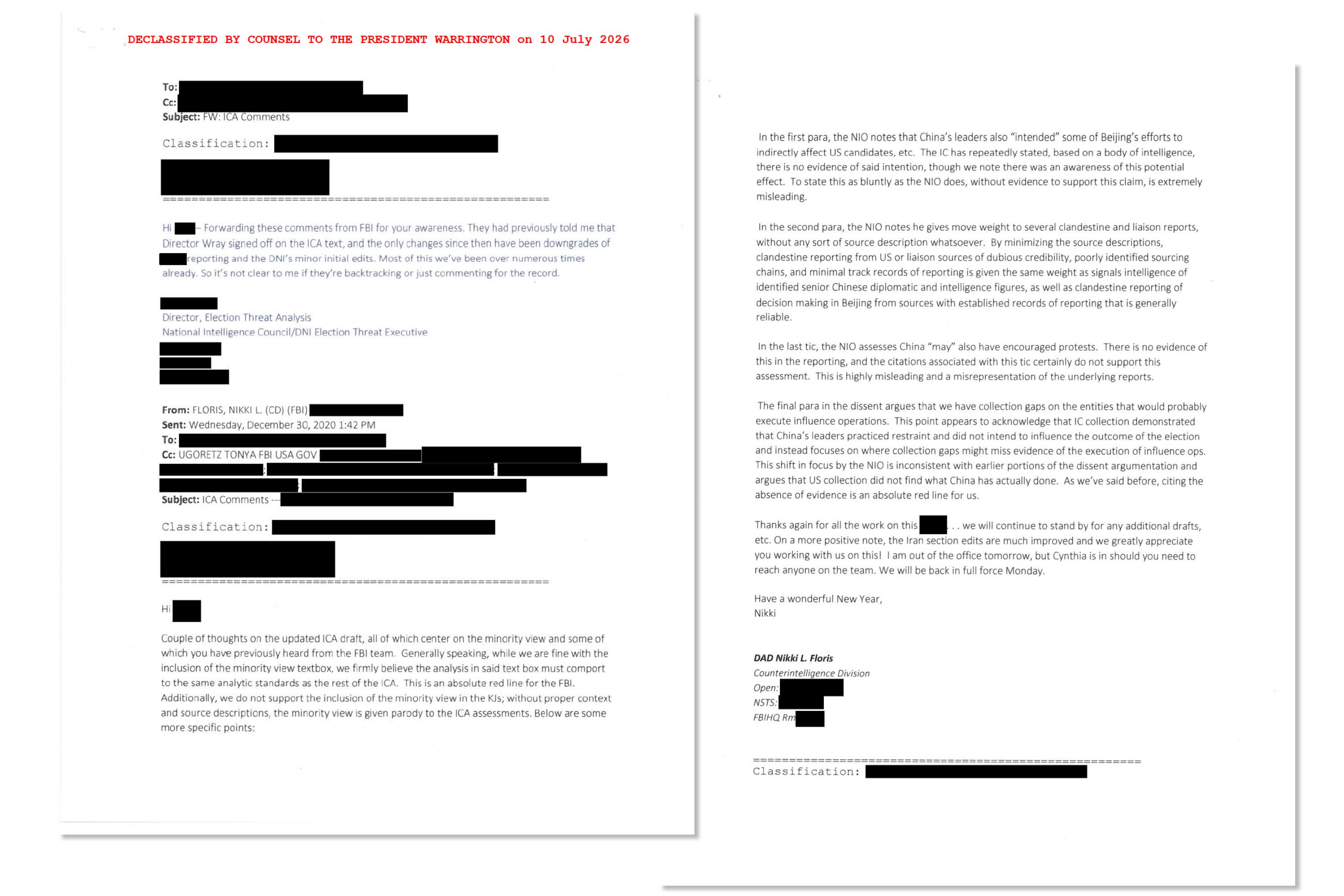
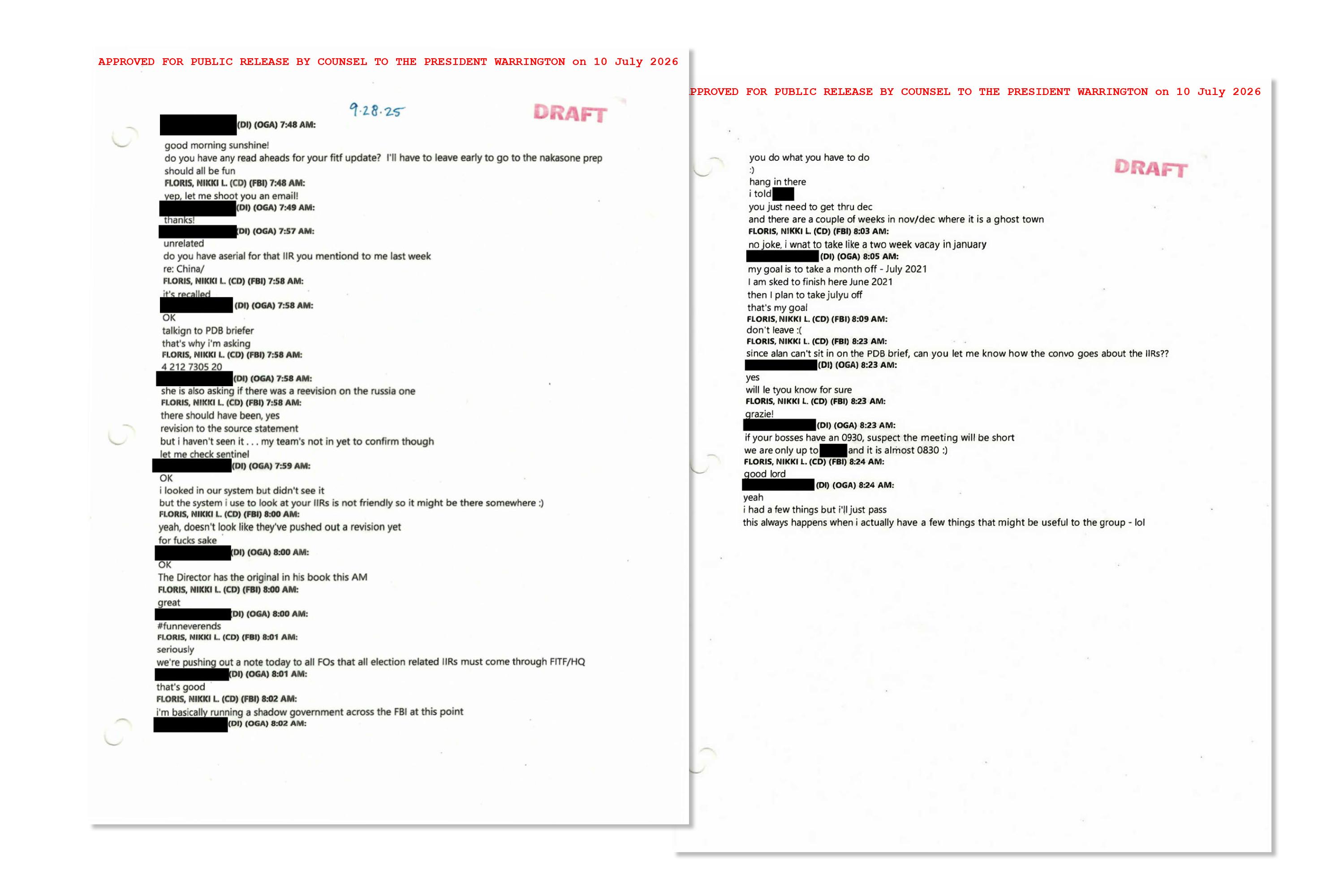
(Top) An email sent by former FBI election security lead Nikki Floris in December 2020, part of a trove of documents declassified and released by the White House on July 16, 2026. (Bottom) An email sent by former FBI election security lead Nikki Floris in which she comments, “I'm basically running a shadow government across the FBI at this point.” White House
An agent identified as SC Benavides emailed a colleague on Sept. 25, 2020, informing them that the New York and Albany field offices had published two intelligence information reports, writing, “Neither of which should have gone out, in my opinion.”
A flurry of messages between agents ultimately resulted in the reports being recalled.
“This is moving fast,” one officer wrote to Floris. “He just notified me they will recall it. Boom mic drop.”
Floris responded shortly after, congratulating the team for their success in getting the contested reports rescinded, while also preparing for future incidents once the unidentified source who provided the information in question was interviewed again.
“Crisis averted!” she wrote. “We will stay engaged for when they track the source down again.”
Administration officials published the documents—many of which contain heavy redactions—on a new election integrity page on the White House website.
The information is divided into four categories: China’s acquisition and exploitation of American voter data; electronic voting and ballot counting systems’ vulnerabilities; the Michigan voter registration investigation; and the inclusion of noncitizens on state voter rolls.
‘Opportunistic Intrusions’
A CIA wire memo from July 2020, which included information from the FBI and the National Security Agency (NSA), reported that the CCP was targeting “personal e-mail accounts of senior U.S. leadership, including officials in the Executive Office of the President and high-ranking officials in multiple Executive Branch organizations, Congress, and the federal judiciary.”
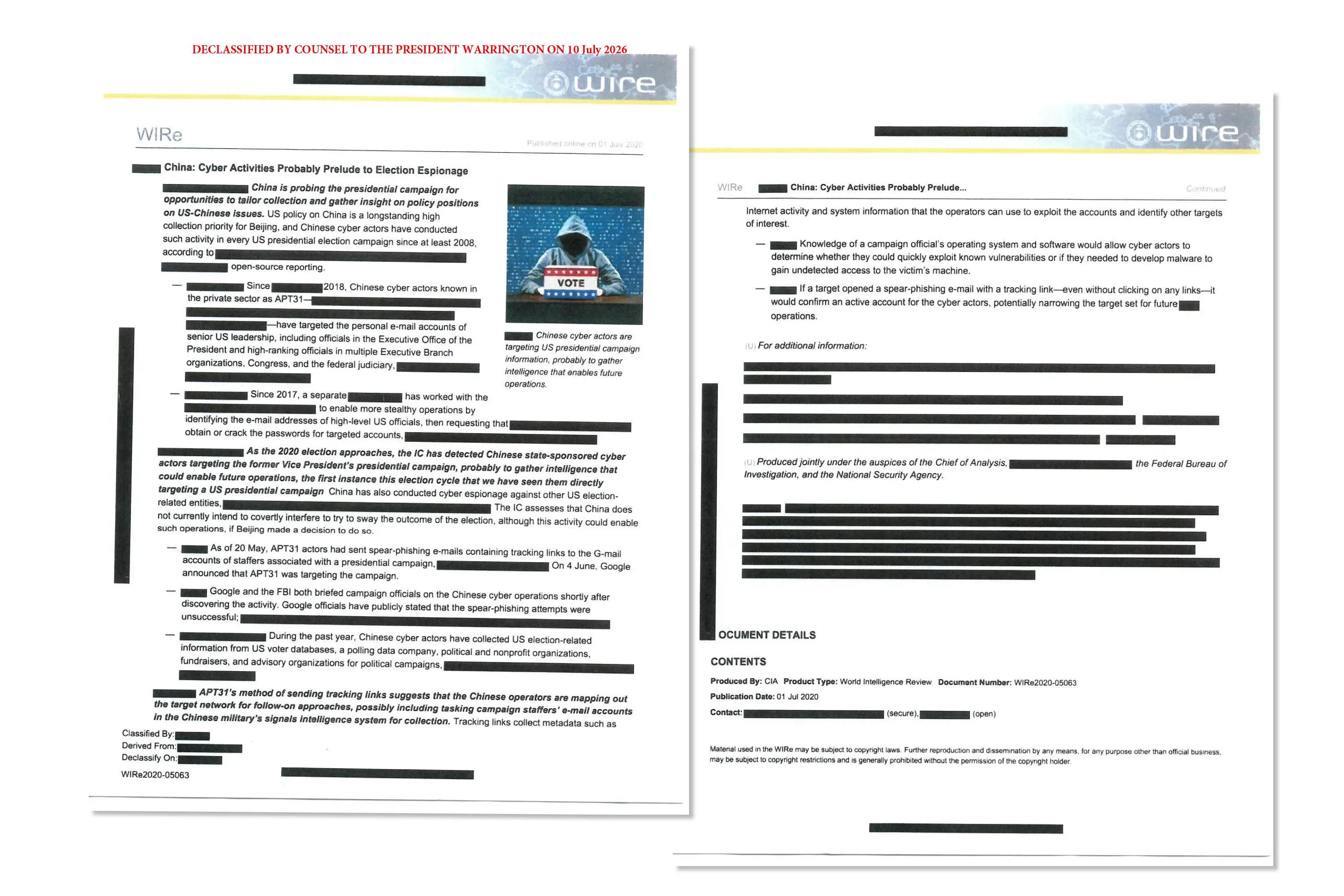
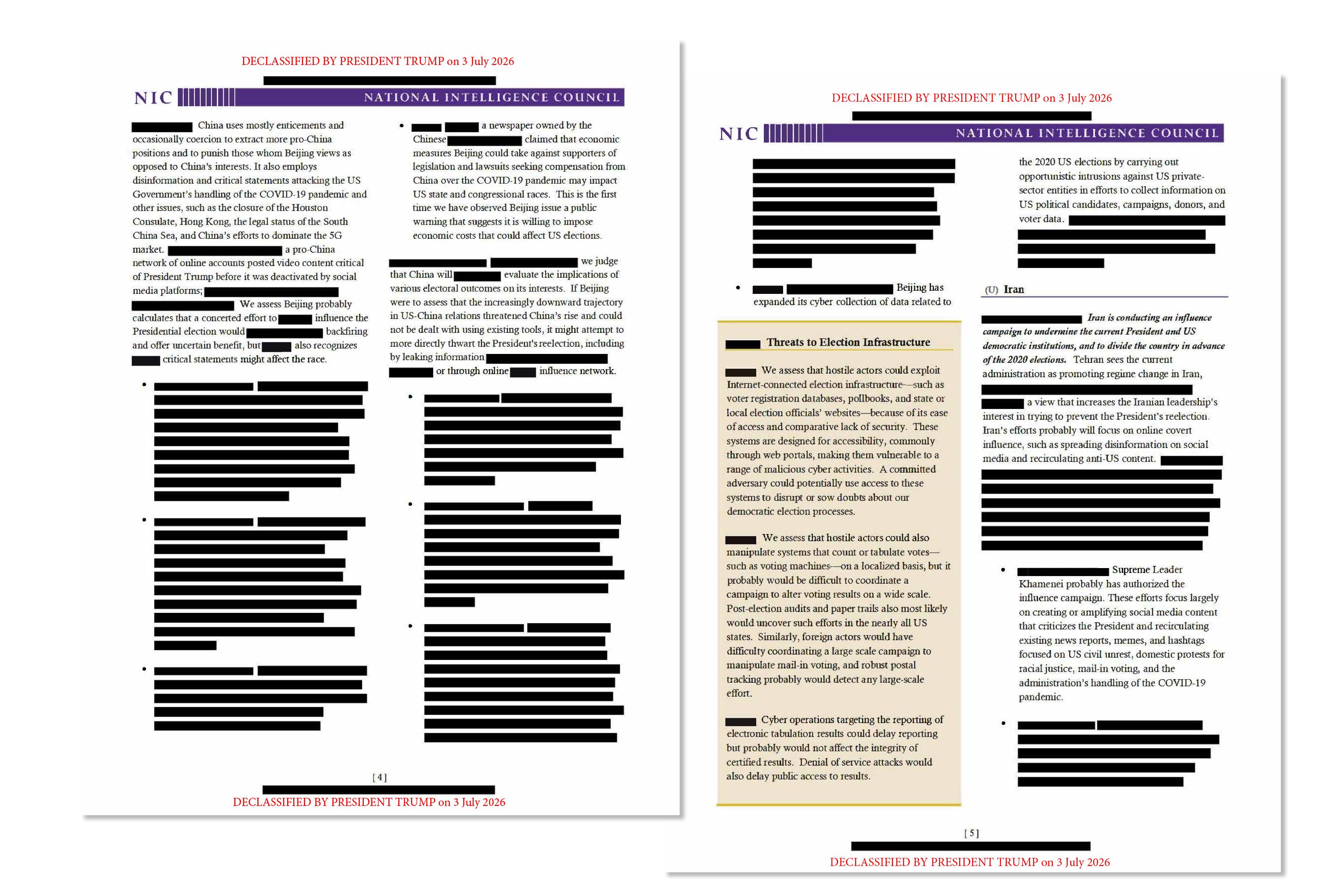
(Top) A CIA intelligence wire analysis notes that Chinese cyber activites could be a prelude to election espionage, part of a trove of newly declassified documents released by the White House on July 16, 2026. (Bottom) A declassified National Intelligence Council report cites potential attempts to influence U.S. elections on the part of China and Iran. White House
According to the report, CCP-related cyber actors around the world compiled more than 200 million Americans’ personal information from U.S. election data. Compromised data were amassed from publicly available sources, including campaigns, databases, political organizations, polling companies, and nonprofit groups, analysts concluded.
A National Intelligence Council report found that Beijing had expanded its efforts and was “carrying out opportunistic intrusions against U.S. private-sector entities in efforts to collect information on US political candidates, campaigns, donors, and voter data.”
The CCP was suspected of utilizing “overt messaging, nascent online covert influence capabilities, diplomatic measures, and the use of economic leverage,” according to analysts. More aggressive actions were potentially on the table, but intelligence officers believed the CCP held back “because Beijing wants to minimize the risk of blowback and hopes to stabilize the relationship after the election.”
CCP operatives produced fraudulent U.S. driver’s licenses and exported tens of thousands of them to the United States, according to an FBI report, citing an unnamed source. The purpose of the operation was allegedly to boost votes for then-presidential candidate Joe Biden by allowing Chinese students sympathetic to the CCP to illegally vote in the election.
Investigations also uncovered China’s attempts to influence American politics by implementing divide-and-conquer strategies meant to confuse the populace and increase tensions through ideological propaganda campaigns on social media. Efforts included messaging to sow racial and socio-economic division, inciting immigration protests and other demonstrations targeting the U.S. government.
The Chinese regime assessed that “racial conflict would be a large factor in the election,” an National Intelligence Council report revealed. State-affiliated Chinese technology company employees were assisting with a campaign “to covertly incite violence and protests against the U.S. government,” it added.
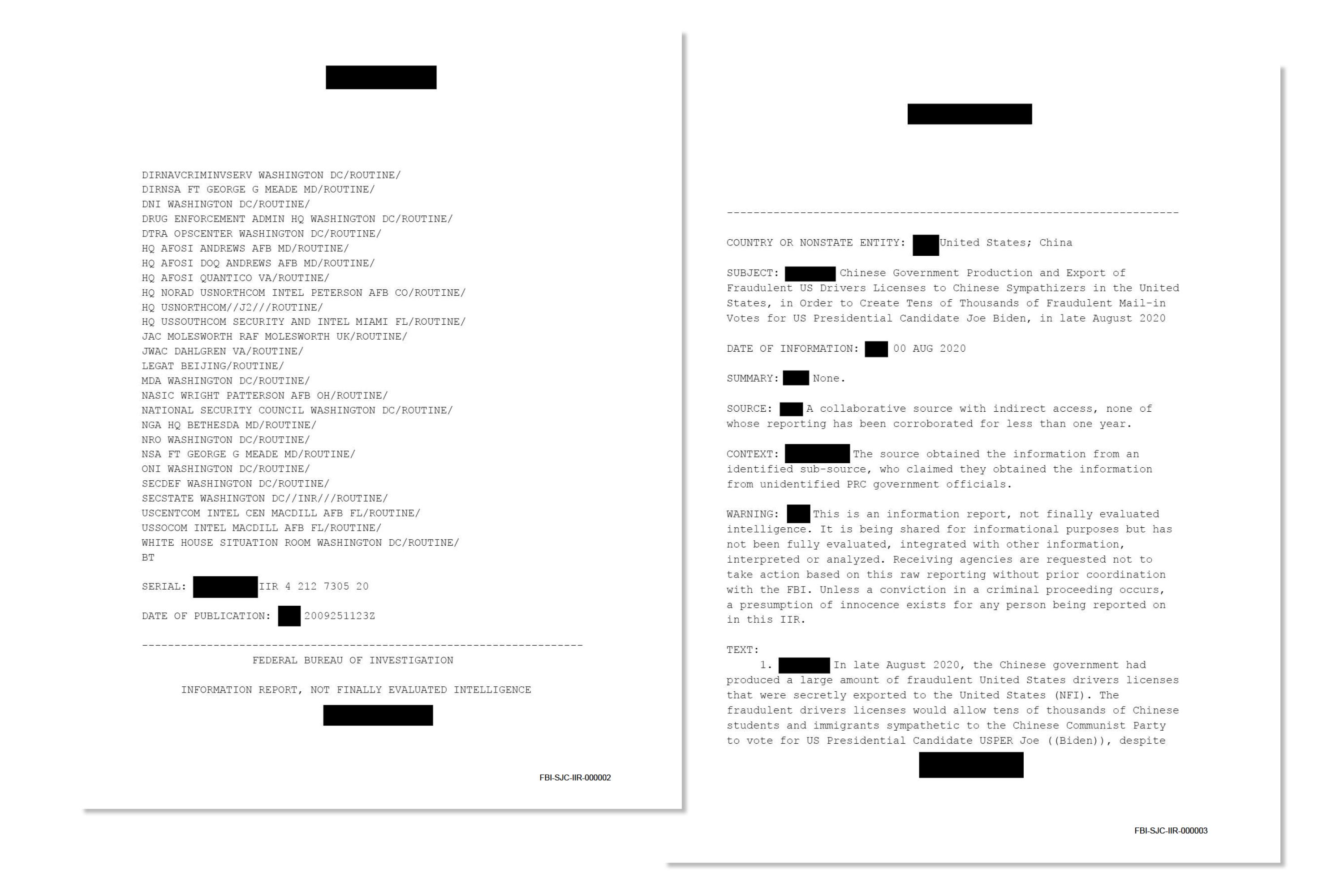
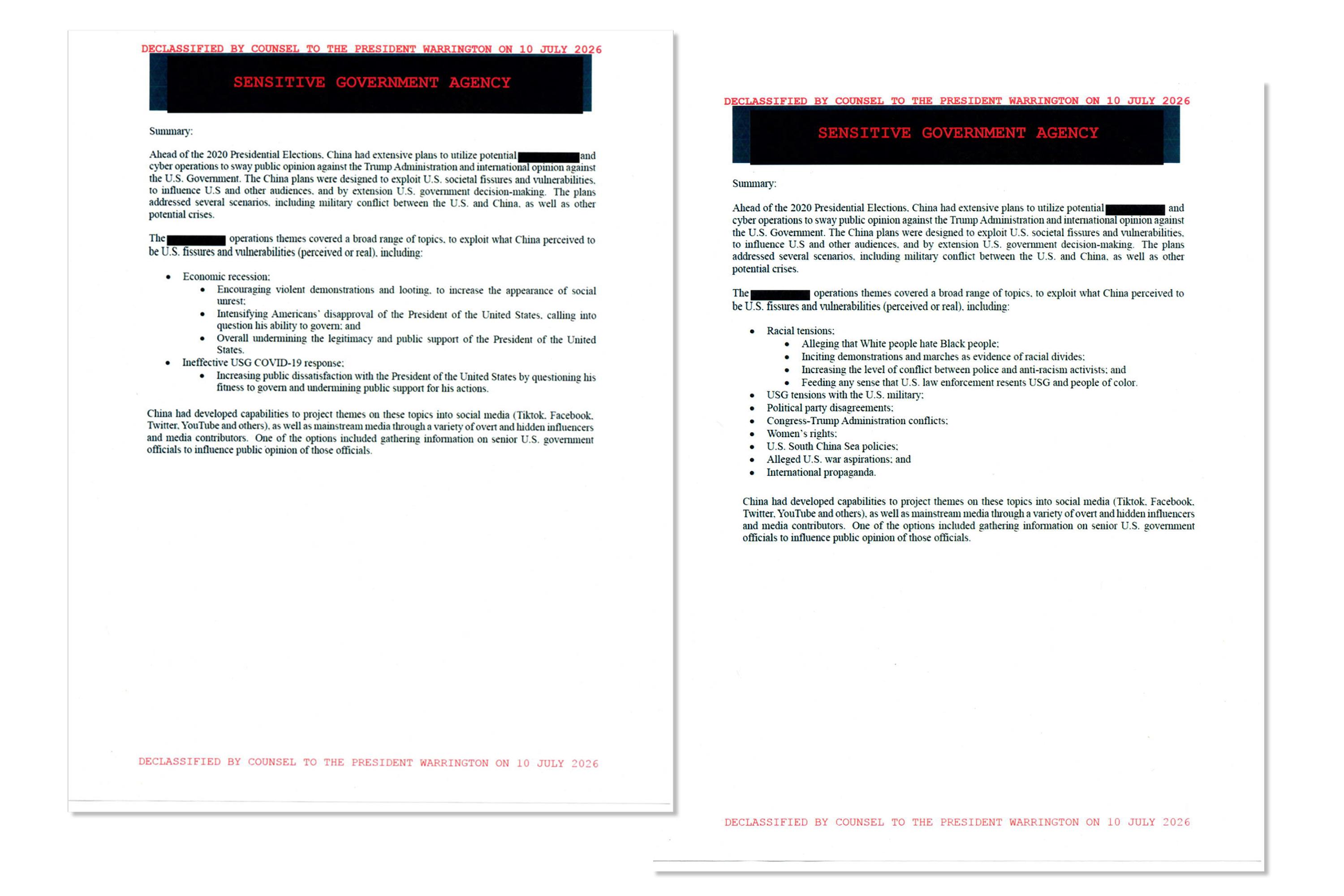
(Top) An FBI information report cites intelligence that China exported tens of thousands of fraudulent driver's licenses to the United States in August 2020. The report is among declassified documents released by the White House on July 16, 2026. (Bottom) A newly declassified report from a “sensitive government agency” analyzes potential Chinese attempts to influence the 2020 election, including using social media to turn public opinion against the Trump administration and exploiting racial tensions. White House
Internal Debates About Messaging
More than 20 pages show the debates between various intelligence agencies about how to communicate reports that the CCP was attempting to influence U.S. elections.
One email, sent Nov. 19, 2020, from an unnamed strategic intelligence analyst, includes references to altering messaging to Trump, who was serving out the last days of his first term in office.
“We have deliberately massaged our one pending [daily briefing to the president] to avoid any direct links to the election,” the analyst wrote.
A subsequent email from an unnamed official at the Office of the Director of National Intelligence on Nov. 23, 2020, challenged the changes to information presented to the president.
“I would be concerned as to why they are ‘deliberately massaging’ analysis away from elections,” the official wrote.
Another analyst repeatedly brought the matter to the attention of colleagues.
“This is a really good example, but far from the only one, of what I’ve been raising since the summer, that the [intelligence community] is deliberately avoiding mentioning a connection to elections for non-substantive reasons,” an unnamed intelligence officer wrote in an email after evidence surfaced that “China has been caught conducting election influence.”
“This is a highly irregular way to do things, especially as someone trying to raise tradecraft and substantive objections to the mainline analysis,” the officer said.
A message sent Oct. 6, 2020, from a redacted official in the Office of the Director of National Intelligence acknowledged the inter-agency debates and analysts’ hesitation to share thoughts at meetings.
“I felt like jumping in to agree with you, but I’ve burned enough political capital arguing with CIA and FBI about this that I thought it might be more productive for me to sit the discussion out,” the analyst wrote.
“The positions are not really that far apart, so I’m not sure why so many in the community want to close down the possibility that China might have done or be doing something. But, hopefully this piece sparks some more thought and discussion.”
The unnamed recipient in the NSA agreed with the assessment in a reply sent the same day.
“I think many were reticent to express them to the group because FBI and CIA seemed so adamant about their stances,” the official wrote. “I’m happy to see that we can have the alternative viewpoint.”
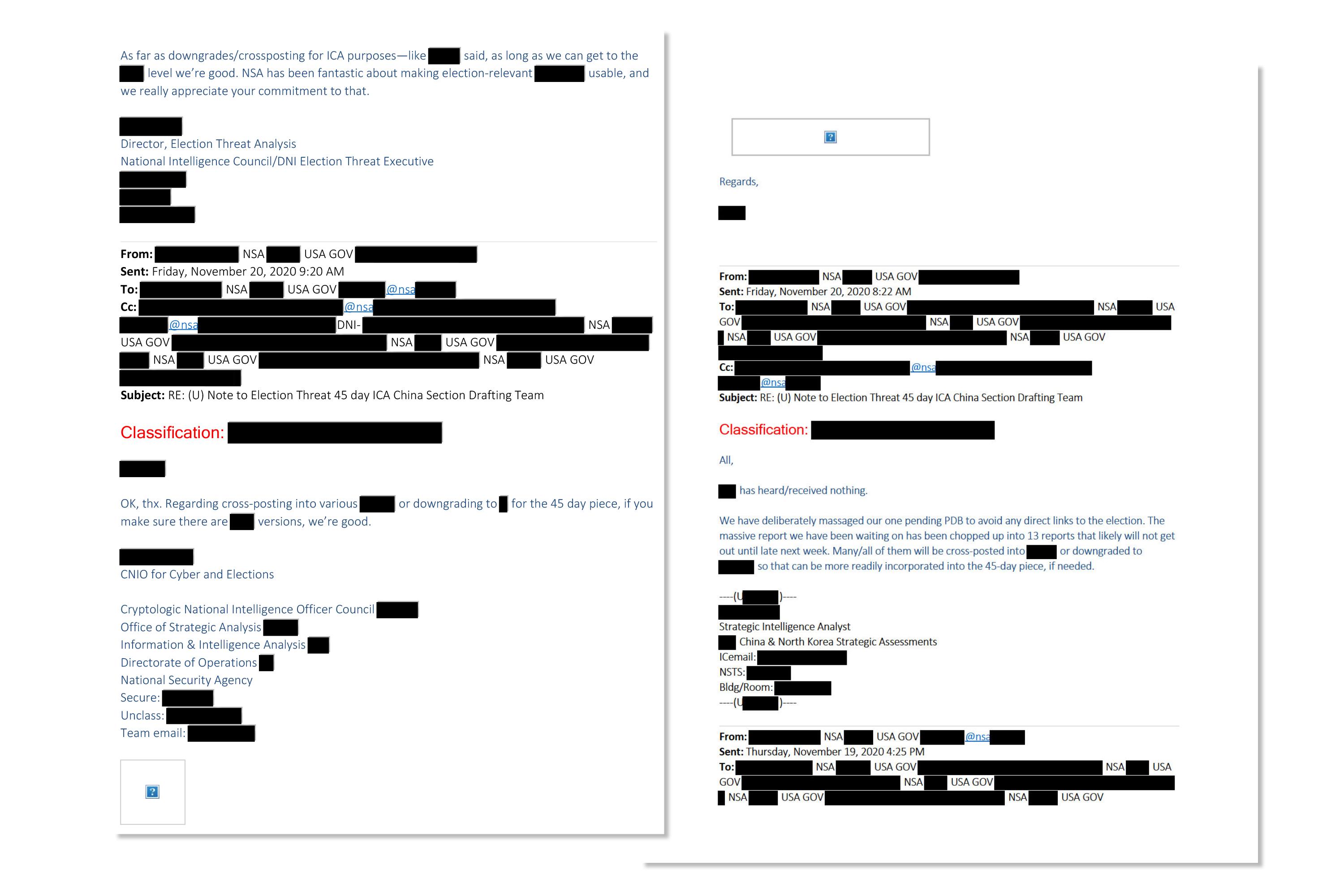
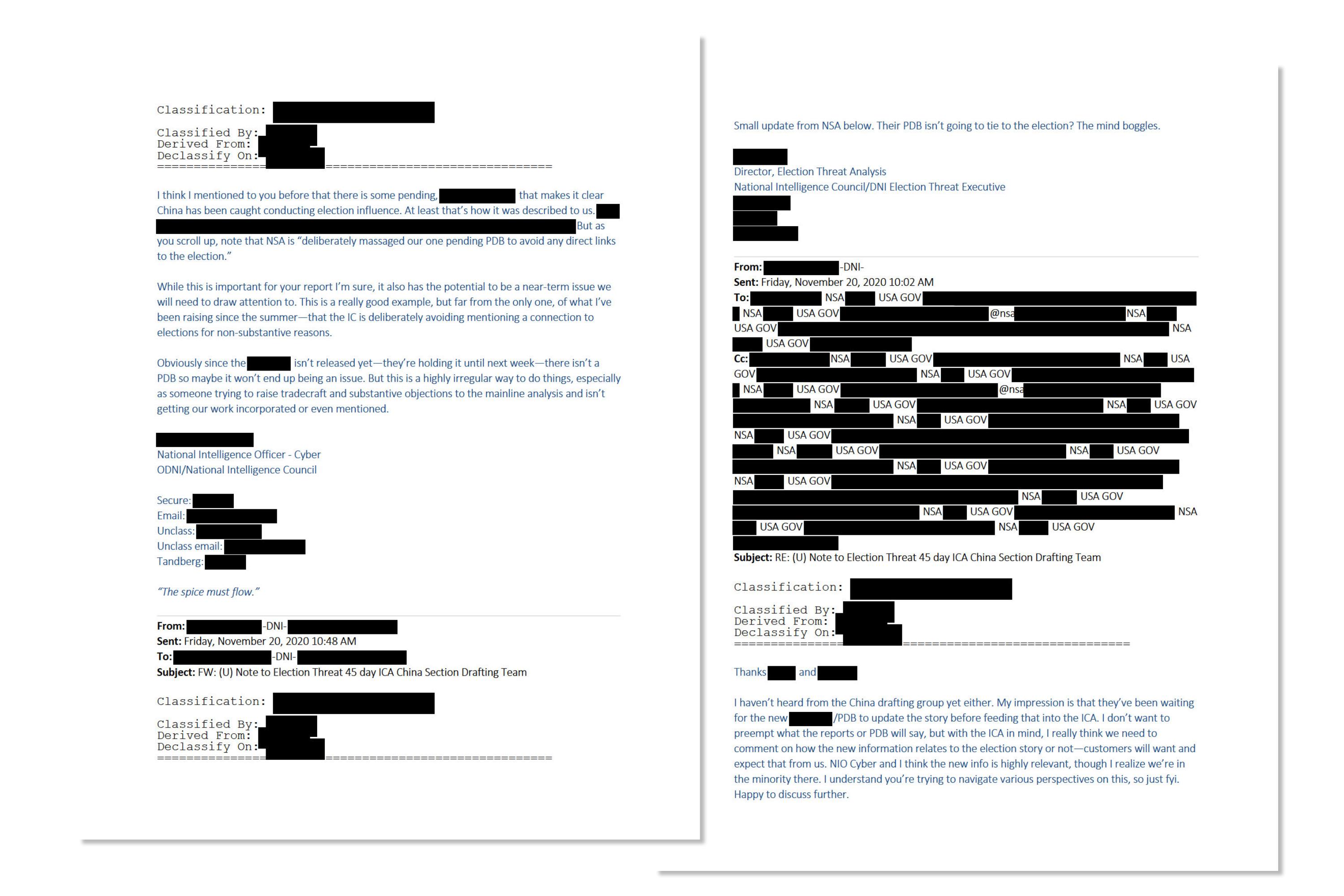
(Top) An email from a strategic intelligence analyst at the National Security Administration notes that the agency “massaged” a report to the president to avoid mentioning potential Chinese election interference. The email is part of a trove of documents declassified and released by the White House on July 16, 2026. (Bottom) An email from an officer at the National Intelligence Council illustrates tensions between agencies surrounding information on potential Chinese election interference. White House
Discussions continued in several message threads, with the director of election threat analysis for the National Intelligence Council, whose name was redacted, proposing a statement that aims to balance the competing sides’ perspectives.
“We assess Beijing uses extensive lobbying, economic measures, information derived from computer network exploitation, and increasingly strident rhetoric to [redacted] press US officials and federal and local candidates to support China’s positions and perspective,” the director wrote.
“We think this is the most notable new information on the China election story and should be addressed up front somehow in our current update. If we can’t compromise on building that into the chapeau, then we'd like to add a separate paragraph with our comment on this.”
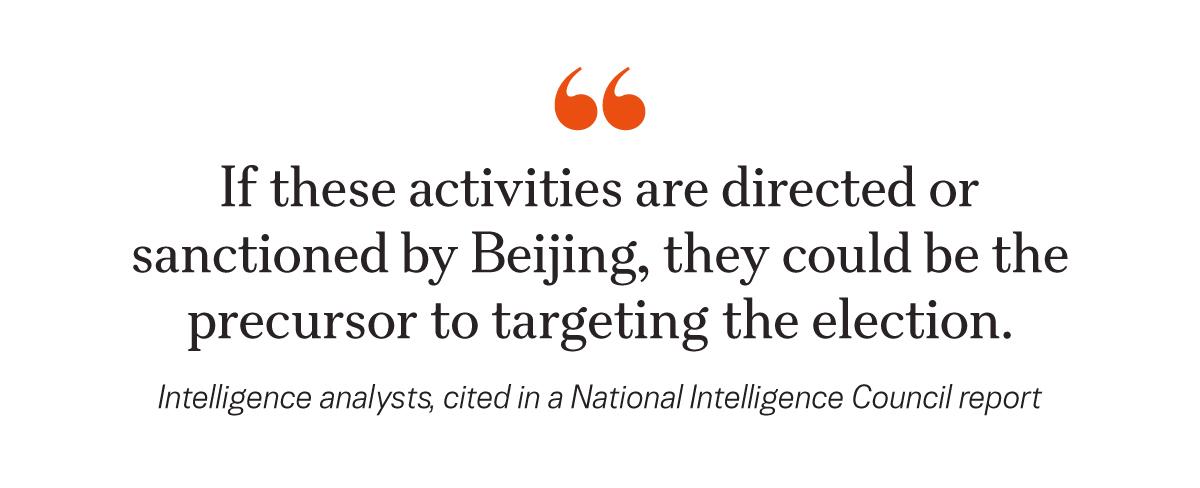
No direct links to the CCP were revealed in the documents, but intelligence analysts concluded that “if these activities are directed or sanctioned by Beijing, they could be the precursor to targeting the election,” and that “elements of the government were, at a minimum, aware of and condoned the campaign, and may have directed or conducted it.”
Intelligence officers expressed their frustration with the arguments in a batch of the newly declassified emails.
“Is it just me, or are they basically saying we should self-censor our assessment on preference because it could be misused?” one officer wrote.
“If we can’t communicate our thinking clearly, maybe we should just quit and go home.”
Another responded in kind with questions about partisan politics potentially impacting intelligence gathering and reporting activities.
“I am concerned about politics seeping into this,” the officer wrote. “I am troubled by CIA’s comments.”
Some in the intelligence community questioned how intelligence was reportedly twisted to fit certain narratives, with similar findings used to corroborate opposing views.
Evidence of election influence was attributed to the CCP’s military by some reports, though others claimed the Chinese regime was attempting to influence policies rather than elections.
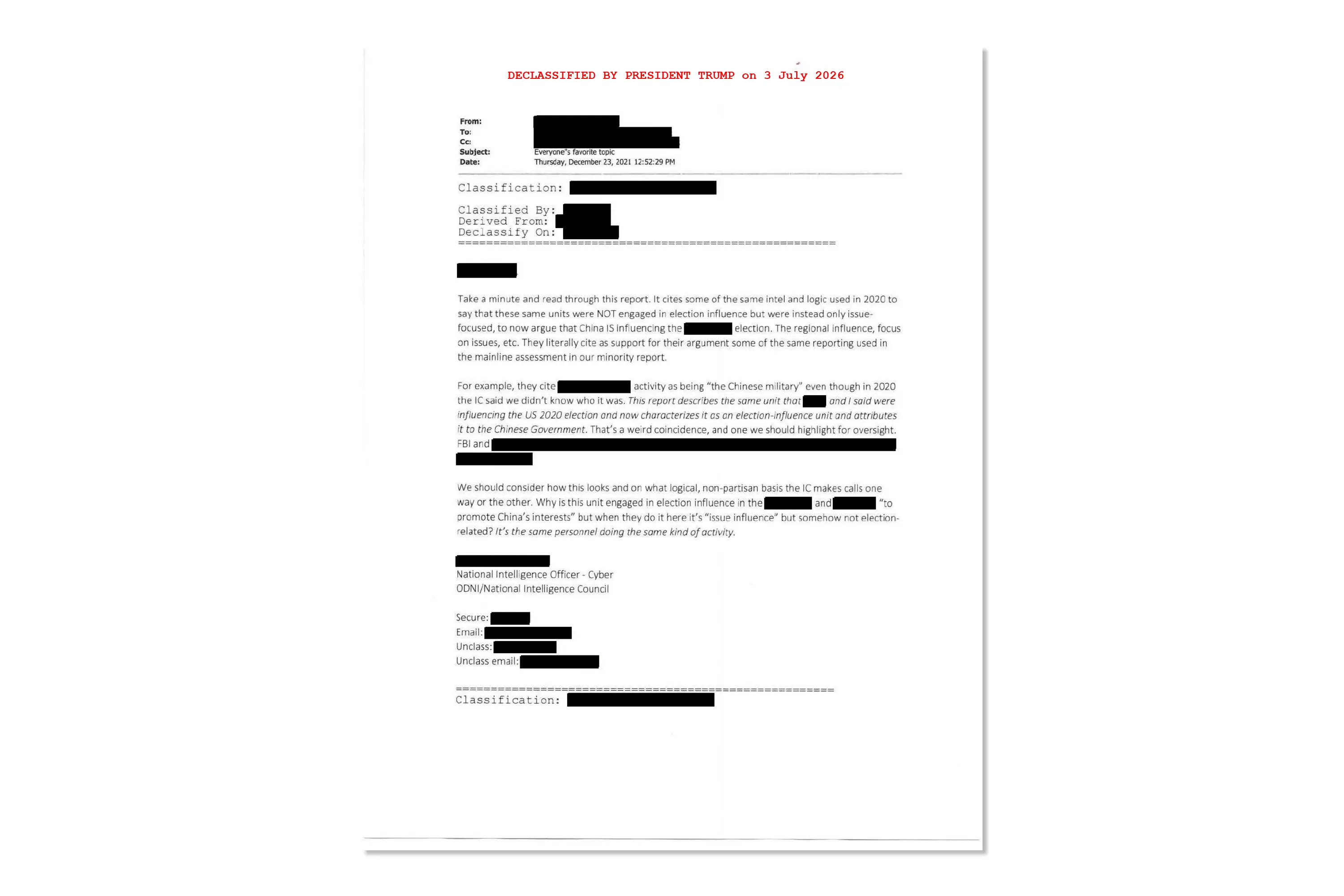
A recently declassified email from an officer at the National Intelligence Council cites “intel and logic” that had been used in 2020 to argue that China was not interfering in U.S. elections, but was cited the following year as evidence of Chinese interference. White House
“We should consider how this looks and on what logical, non-partisan basis the [intelligence community] makes calls one way or the other,” a national intelligence cyber-officer wrote in an email in December 2021.
“Why is this unit engaged in election influence in the [redacted] and [redacted] ‘to promote China’s interests,’ but when they do it here, it’s ‘issue influence’ but somehow not election-related? It’s the same personnel doing the same kind of activity.”
An unnamed person in the FBI sent an email Sept. 29, 2020, alerting others in the agency about discrepancies in reporting from the intelligence community and then-Director Christopher Wray’s testimony to Congress.
While some in the FBI were allegedly manipulating intelligence to align with Wray’s messaging, others were expressing concerns about how information was presented in, or excluded from, collaborative reports.
“Most concerning to me is stating the reporting would contradict Director Wray’s testimony,” an unnamed FBI officer wrote in an email Oct. 1, 2020. “I found this troubling because it implied to me that one of the reasons we aren’t putting this out is for a political reason, which goes directly against our organizations’ mission to remain apolitical and simply state what we know.”
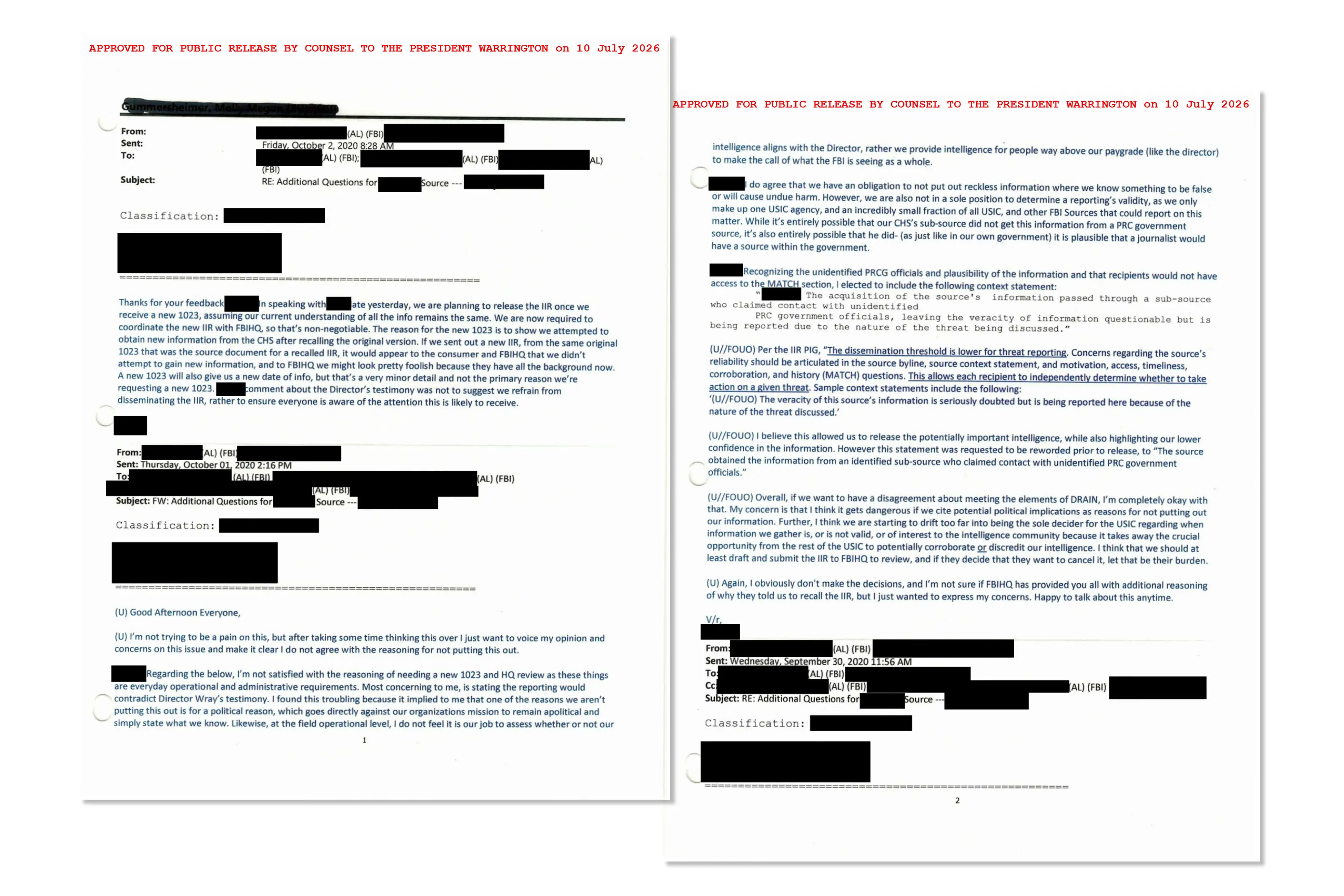
FBI emails illustrate conflicting opinions within the agency on whether to release certain information concerning potential interference in U.S. elections. The emails were part of a trove of documents released by the White House on July 16, 2026. White House
The officer emphasized the need to gather and report intelligence in an objective manner.
“I do agree that we have an obligation to not put out reckless information where we know something to be false or will cause undue harm,” the officer wrote.
“My concern is that I think it gets dangerous if we cite potential political implications as reasons for not putting out our information.”
Foreign Adversaries, Election Fraud
Documents also highlight potential dangers from other foreign adversaries, including Iran, North Korea, Russia, and Venezuela, due to their desire and potential ability to compromise U.S. election systems.
Assessments concluded that widespread manipulation was difficult for foreign actors, but noted that adversaries could cause delays, disruptions, and uncertainty if Americans believed that the elections were not secure.
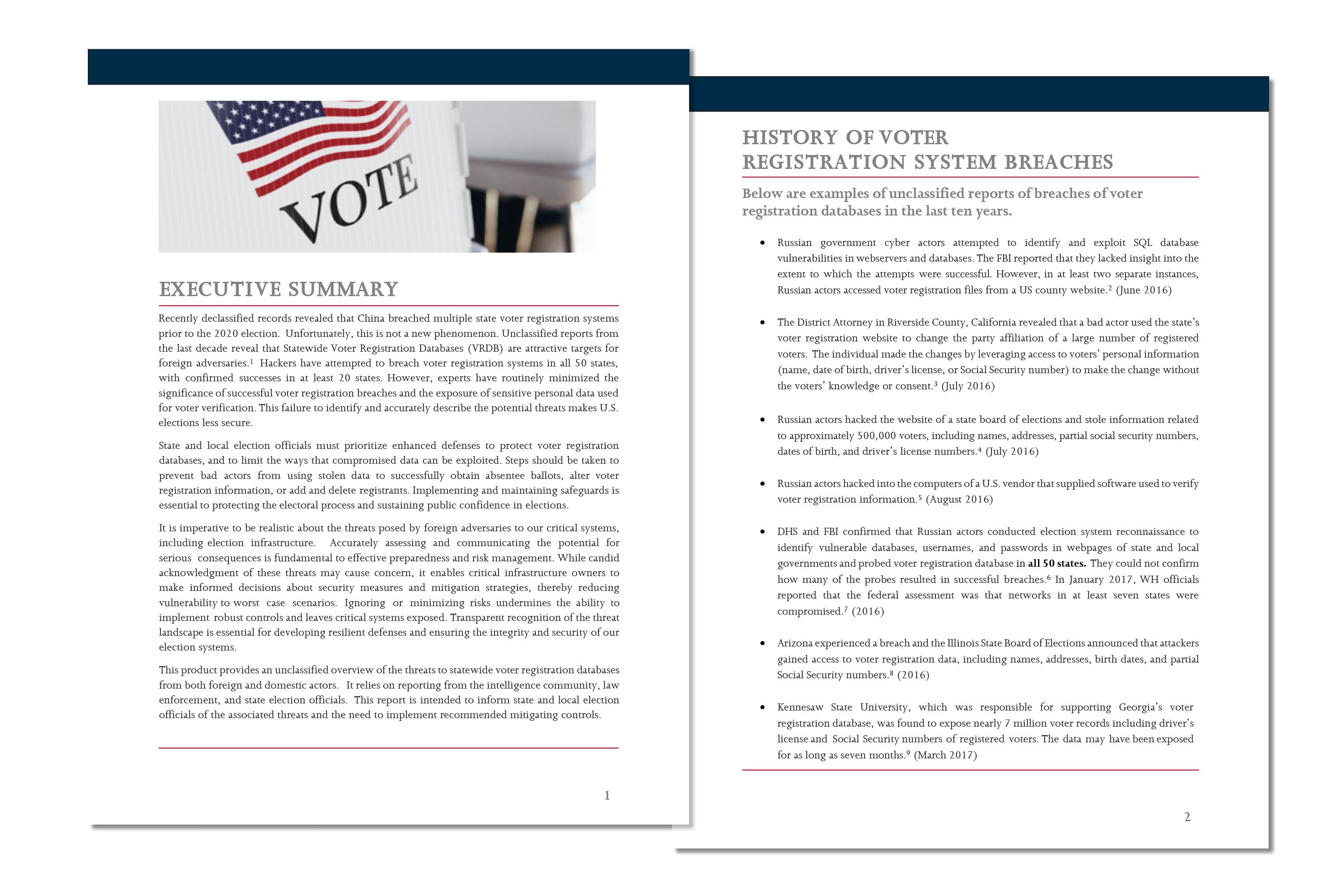
A report from the White House's election integrity project summarizes unclassified reports of breaches of voter registration databases. White House
The president is calling for further investigations in Michigan, after the FBI uncovered evidence of potential election registration fraud in the state during a 2020 raid in Muskegon but closed the investigation after the prior administration failed to pursue criminal charges.
Canvassers allegedly committed election fraud by signing forms in other individuals’ names, registering nonexistent voters, and receiving compensation for their actions.
Meanwhile, an analysis by the Department of Homeland Security found more than 250,000 potential noncitizens on voter rolls, a memo from the department said this month. The number is expected to grow as investigations continue, as some states have refused to provide data to federal authorities.
More than 400,000 deceased individuals were found on voter rolls, evidence the president presented during his address to the nation as proof of election vulnerabilities.
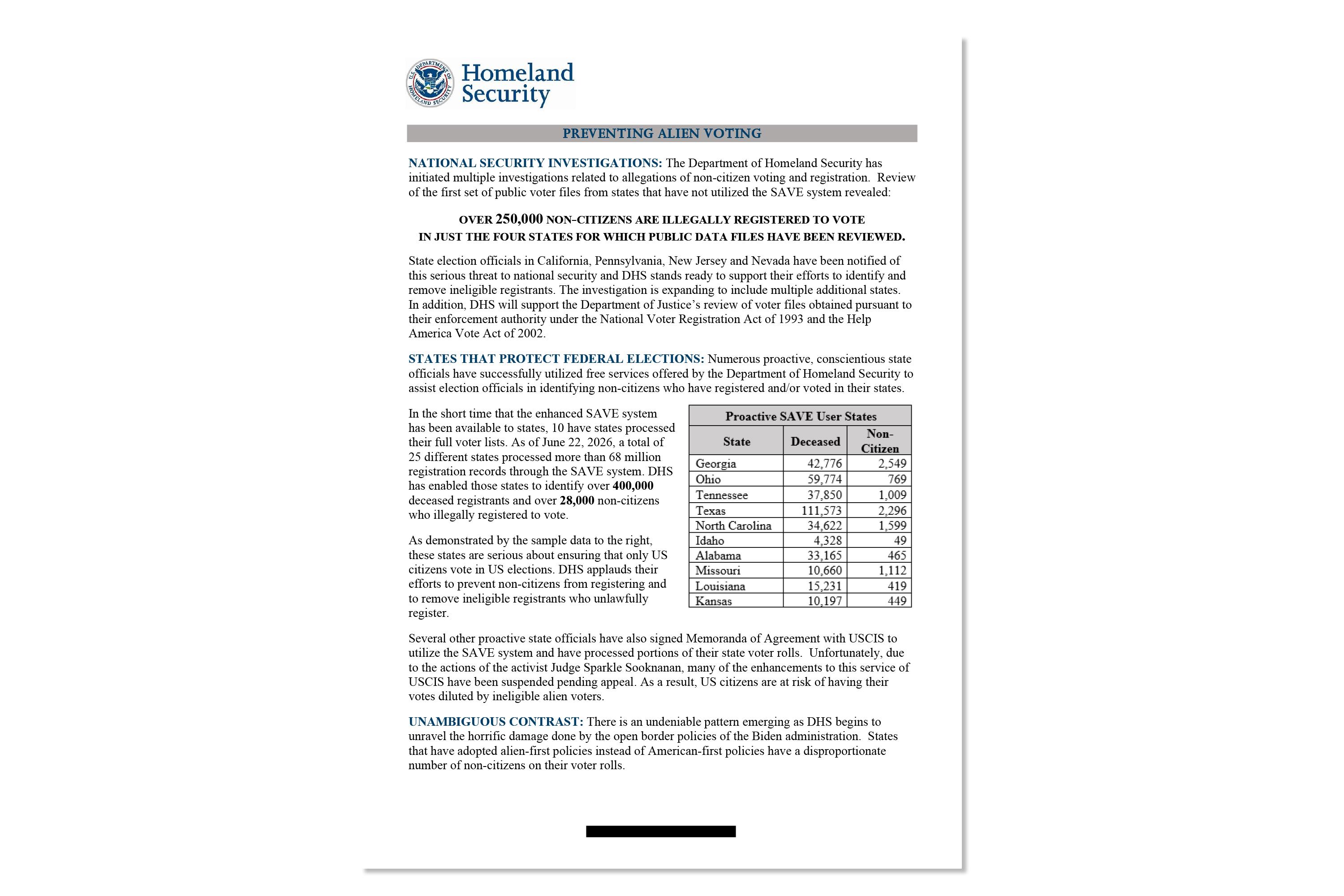
A July 2026 analysis from the Department of Homeland Security alleges that the Biden administration's border policies caused “horrific damage” to election integrity. White House
Homeland Security officials are demanding compliance from officials in California, Pennsylvania, New Jersey, and Nevada, with a warning that federal officials stand prepared to defend against the “serious threat to national security” caused by allowing noncitizens to vote.
“There is an undeniable pattern emerging as [Homeland Security] begins to unravel the horrific damage done by the open border policies of the Biden administration,” the memo said.
“States that have adopted alien-first policies instead of American-first policies have a disproportionate number of non-citizens on their voter rolls.”