By The Straits Times | Created at 2026-10-12 14:46:59 | Updated at 2026-10-12 15:44:54
59 minutes ago
By The Straits Times | Created at 2026-10-12 14:46:59 | Updated at 2026-10-12 15:44:54
59 minutes ago
NEW DELHI - Tens of thousands of protesters from opposition political parties and their supporters converged in New Delhi on Oct 12, bringing parts of the city to a standstill for a third consecutive day as they demanded the removal of India’s top polling officer.
Despite the heavy security presence, as warned, many responded to the call for a “march for democracy” by Congress leader Rahul Gandhi and came to Barakhamba Road, a key office area in New Delhi, carrying banners, vuvuzelas and flags.
Multiple protests have been held in the capital
since Oct 10 demanding the sacking of India’s Chief Election Commissioner (CEC) Gyanesh Kumar, who has overseen a sweeping, controversial revision of electoral rolls that critics say has deleted more than 130 million names, potentially disenfranchising legitimate voters.
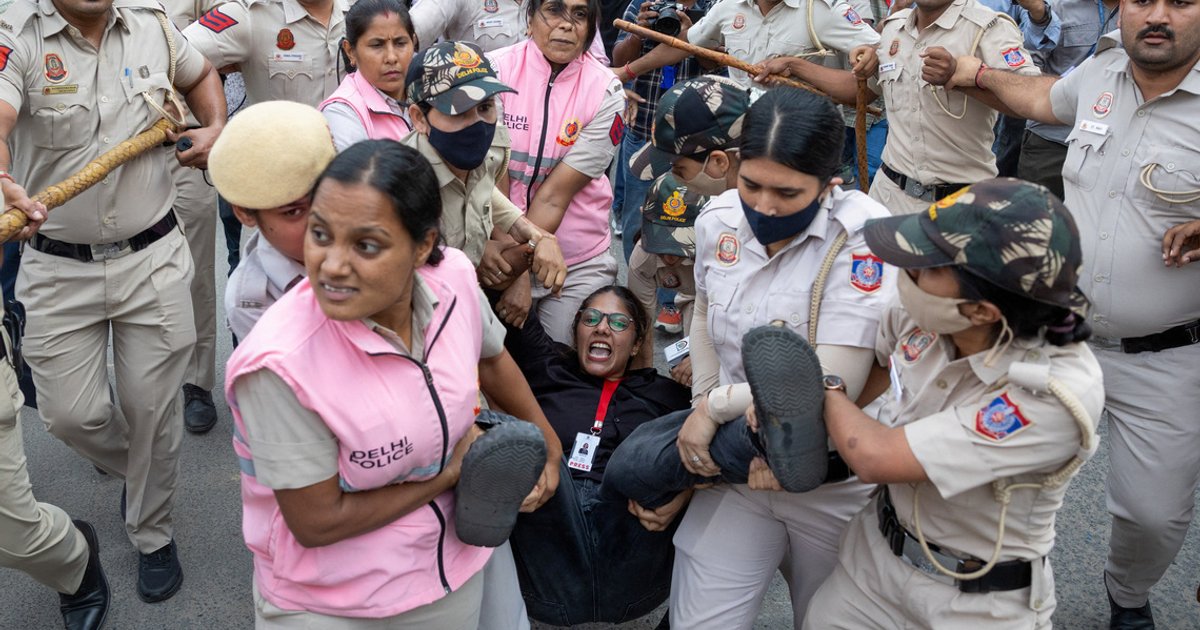
The government denies these charges and has instead cracked down heavily on youth protesters, lawyers and journalists, deploying over 30,000 security personnel and detaining thousands of youths on Oct 10 and 11.
Though most protesters on Oct 12 were core party workers and supporters of Congress and other opposition parties, they were joined by many others, including students, lawyers and representatives of civil society organisations.
Gandhi, the Leader of the Opposition in the Lower House of the Parliament, and other leaders arrived at Barakhamba Road by bus. They then set out in a smaller open-air vehicle to the Supreme Court, about 1km away, where the party's legal team filed a petition against CEC Kumar on behalf of several opposition leaders, alleging large-scale voter deletions and irregularities in the revision of electoral rolls.
Gandhi and other opposition leaders managed to reach the court despite attempts to prevent them from doing so by the large deployment of security personnel, including those armed with tear gas shell launchers.
Among the numerous protesters was Deshraj Ranawat, a 56-year-old Congress party worker from Delhi, who is convinced that the voter roll revision in his constituency of Deoli in the city was a way for the Bharatiya Janata Party (BJP) to delete voters from minority and marginalised groups, who, he added, do not support the BJP.
He claimed that around 100,000 voters had been deleted in his constituency, nearly all of them Congress supporters. “I have come here today to support the truth and in response to my leader Rahul Gandhi’s call,” he said.
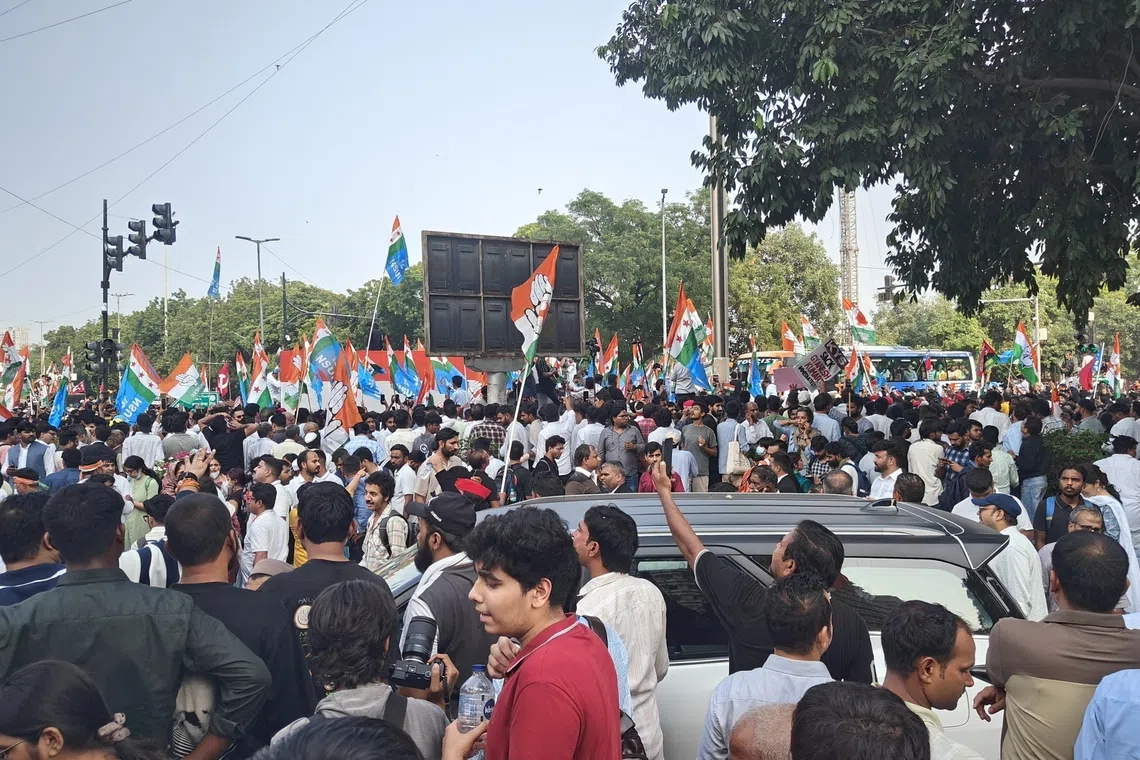
Tens of thousands of protesters gathered on Barakhamba Road in New Delhi on Oct 12.
ST PHOTO: DEBARSHI DASGUPTA
The Indian Express reported on Sept 23 that CEC Kumar had pushed through decisions in the Special Intensive Revision (SIR), the Election Commission of India’s controversial voter-roll revision exercise, that disadvantaged voters and disempowered local election officers, despite opposition from two election commissioners.
Slogans such as “Vote Chor, Gaddi Chhod (’Vote thief, leave the throne") rang out
as
protesters,
carrying the flags of different parties as well as the Indian tricolour
,
gathered at the police barricades. Curious onlookers from nearby high-rise offices added to the crowd.
High drama ensued
when some Aam Aadmi Party (AAP) protesters managed to open the door of a
moving
police van they
were
detained in while sloganeering and marching to Jantar Mantar and
escaped at
the protest venue.
“If we are not going to be allowed to speak… or walk on the roads, how are we going to create pressure on the top (leadership)?” Surender Jaglan, one of the AAP
escapees
, told ST.
Many students and civil society representatives not affiliated with any political party also joined the protest.
One of them, Ashwin (who gave only his first name), a 22-year-old law student from Delhi,
said he was there
because “the democracy of this country is in danger”.
“The process through which the sanctity of the Election Commission was modified by (PM Narendra) Modi and (Home Minister Amit) Shah makes me wonder whether there will be democracy for my future, and all of us are here,” he added.
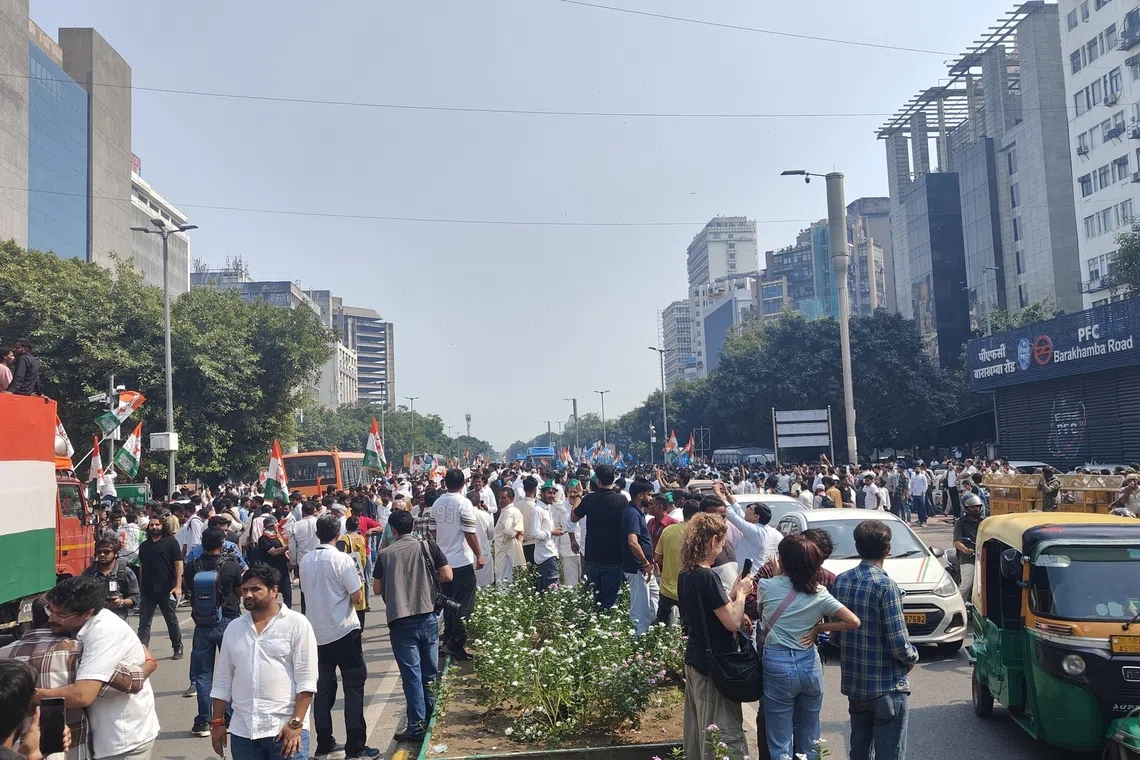
Despite the heavy security presence, many responded to the call for a “march for democracy” by Congress leader Rahul Gandhi and came to Barakhamba Road.
ST PHOTO: DEBARSHI DASGUPTA
Ashwin came with a group of friends and said he had no problem joining an opposition-led protest. “I don’t see a problem in allying with the truth. I don’t see a problem in allying when the opposition is marching for a cause,” he added, noting that the opposition is not something “illegitimate” or “something to be vilified”.
Rakhi (not her real name), another student who turned up to show her support, said she was there to oppose the “brutality” unleashed on protesters in recent days as well the way in which the Election Commission of India’s independence had been compromised.
“The Election Commission is being corrupted, and that’s not how democracy should work,” said the 21-year-old English literature student from Delhi who was carrying a large Indian flag. “It’s supposed to be an independent body and there’s supposed to be transparency in the SIR.”
The BJP has denounced
the Congress-led protests. BJP leader and Assam chief minister Himanta Biswa Sarma said Gandhi and his Congress party “are mounting an attack on the very foundations of India’s vibrant democracy”.
“Their double standard is plain to see… Democracy, for the Congress, is valid only when it delivers victory for the Congress,” he posted on X on Oct 12.
“Now, by marching to the Supreme Court despite the Hon’ble Chief Justice of India declining a meeting, Rahul Gandhi seeks to turn political pressure on the highest court of our land. Constitutional institutions cannot be made answerable to a party’s electoral frustrations,” he added.
Nilanjan Mukhopadhyay, a senior political commentator and a Modi biographer, said the ongoing protests reflect the Modi government’s continuing failure to come up with a narrative to counter opposition voices since the Cockroach Janta Party (CJP)-led protests
resulted in
the resignation of India’s education minister Dharmendra Pradhan in July.
“He’s just marshalling policemen and other security forces and passing one executive order after another instead of coming up with a comprehensive political strategy,” Mukhopadhyay told The Straits Times.
Now, he noted, was a time for Modi to be a “skilled negotiator” and talk to the protesters instead of cracking down on them. “It is up to him what he wants to do, including sacking Gyanesh Kumar.”
On Tuesday, the Modi government derecognised Jantar Mantar as a designated protest site. This venue – less than 2km from the Indian Parliament – has long been the epicentre of key protests in Delhi, including those led by CJP as well as the BJP in the past.
Instead, the government allotted alternative sites for protests that are far away from the city centre, a decision criticised by opposition groups.
Mukhopadhyay said it was difficult to foresee the political trajectory between here and the next parliamentary elections in 2029, but added that Modi seems to be “running out of ideas”.
“Ironically, in his moment of celebrating his silver jubilee in public office (since first becoming the chief minister of Gujarat in 2001), he has been politically at his weakest despite having complete electoral hegemony and absolute control of state institutions,” he added.