By The Rio Times | Created at 2026-10-10 20:06:49 | Updated at 2026-10-10 21:40:46
2 hours ago
By The Rio Times | Created at 2026-10-10 20:06:49 | Updated at 2026-10-10 21:40:46
2 hours ago
HUMAN RIGHTS · PARAGUAY
Key Facts
- —The country Paraguay, a landlocked South American farm exporter between Argentina, Brazil and Bolivia, and a close US security partner.
- —Why it matters The US grade shapes aid decisions and flags forced-labour risk in supply chains that reach American buyers.
- —Why now The State Department released its 2026 Trafficking in Persons Report on Thursday 8 October. Paraguay’s press picked up its chapter on Friday 9 October.
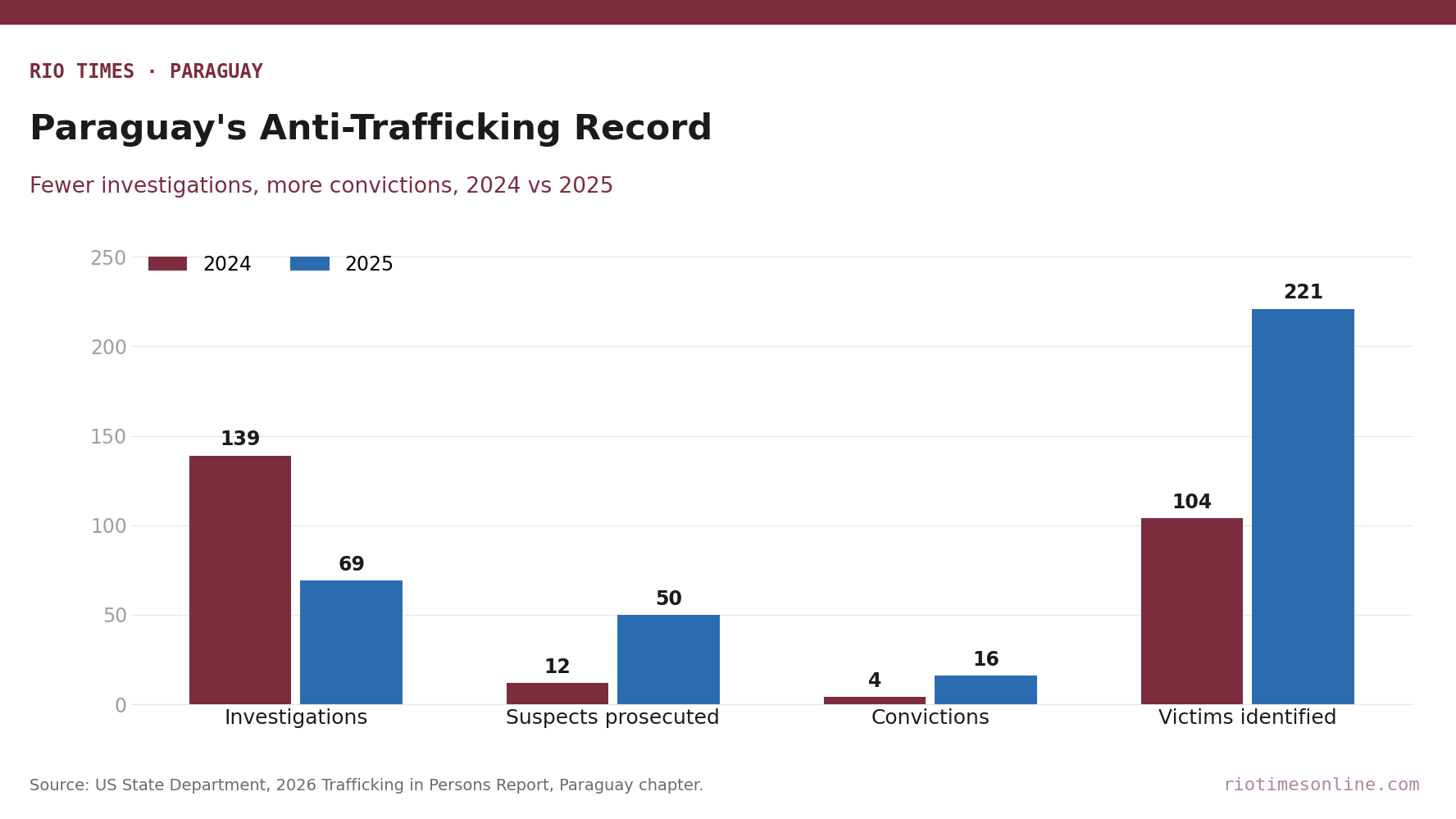
- —What happened Paraguay stayed on Tier 2. Investigations fell to 69 in 2025 from 139 in 2024.
- —The numbers Convictions rose to 16 from 4, prosecutions to 50 suspects from 12, identified victims to 221 from 104.
- —What it means for you US importers sourcing Paraguayan farm goods should note the report’s forced-labour findings in agriculture.
- —Still open Why investigations halved, and whether the government will fund its anti-trafficking programme as the law requires.
Paraguay trafficking investigations fell by half last year, even as convictions quadrupled, the US State Department says in its new annual report. Washington kept the South American country on Tier 2, the middle grade. For US readers, the grade matters because it shapes aid decisions and flags forced-labour risk in farm supply chains.
The 2026 Trafficking in Persons Report was released on Thursday 8 October. Its Paraguay trafficking chapter says the government “does not fully meet the minimum standards for the elimination of trafficking” but is making significant efforts.
Asunción daily Última Hora reported the findings on Friday 9 October. It highlighted the Paraguay trafficking gaps the report lists in shelter, funding and child domestic labour.
What the US Report Says About Paraguay
The State Department grades every government each year under the Trafficking Victims Protection Act of 2000. Tier 1 is for countries that fully meet its minimum standards. Tier 3 is for those that do not and are not making significant efforts.
Paraguay sits in between. The report credits “overall increasing efforts” compared with the previous year, which is why the grade held.
It lists the gains. Authorities prosecuted and convicted more traffickers and identified more victims. Agencies coordinated better on victim care, and the government updated procedures to help Paraguayans exploited abroad.
It also lists the failures. Investigations fell, officials screened vulnerable groups inconsistently, and adult male victims had no shelter. The national anti-trafficking programme was underfunded and still lacked the dedicated funding stream that the law requires.
Paraguay’s 2012 anti-trafficking law, Law 4788, sets prison terms of up to eight years for sex and labour trafficking involving adults, the report says. Cases involving children carry two to 20 years.
The State Department has a technical objection to that law. It treats force, fraud and coercion as aggravating factors rather than core elements of the crime. The report calls this inconsistent with the international definition.
Follow this story
Get an email when there’s news on Paraguay
Free. One email a day at most, and only when there is news. This also signs you up to our weekday newsletter, The LatAm Brief. Nothing arrives until you click the confirmation link, and you can stop either with one click. Privacy policy.
Fewer Cases, More Convictions
Authorities opened 69 Paraguay trafficking investigations in 2025, down from 139 in 2024. Of the new cases, 24 concerned sex trafficking, 32 forced labour and 13 were unspecified.
Prosecutions moved the other way. Prosecutors charged 50 suspects, up from 12 the year before. Courts convicted 16 traffickers, up from four, of whom 13 were convicted of sex trafficking and three of forced labour.
The government did not report sentences. It reported no investigations, prosecutions or convictions of officials for complicity, and cited a lack of resources and capacity.
Victim identification more than doubled. The report counts 221 victims in 2025, against 104 in 2024. Of those, 51 were sex trafficking victims, 108 labour trafficking victims and 62 unspecified. The government assisted 90 of them.
Support remained thin. Victims had to be formally certified before they could get health care, legal help or repatriation. The government reported no residence permits for foreign victims, and no victims chose to take part in criminal proceedings.
Criadazgo and Recruitment Online
The report singles out criadazgo. Under this custom, poor rural families send children to live with wealthier households, where they work in exchange for board and schooling. The report says it can lead to trafficking.
Paraguay’s Senate rejected a bill to criminalise the practice in May 2025. Última Hora reported that senators Gustavo Leite and Dionisio Amarilla defended criadazgo during the debate as part of Paraguayan culture. Nobody knows how many children live in it today, the paper said.
Recruitment has moved online. Traffickers use social media to post deceptive job offers, the report says, or threaten to share intimate images. Paraguayan victims have been found in Argentina, Brazil, Cambodia and Europe.
Inside the country, the report describes sex trafficking aboard river vessels, and says child sex trafficking cases often involve a family member. It documents forced labour in agriculture and aquaculture. Children in street vending, begging, mining, brick making and ranching are vulnerable, and traffickers force children to grow and sell illicit drugs. Indigenous and rural Paraguayans are the most exposed.
The grade puts Paraguay alongside the Dominican Republic, covered in Dominican Republic Stays Tier 2 on US Trafficking List. Its neighbour fared worse, as reported in Brazil Stays on US Trafficking Watch List on 8 October.
What It Means for You
For US companies, the forced-labour findings are the practical point. Section 307 of the US Tariff Act bars imports made with forced labour. Buyers of Paraguayan farm and fish products may face more due-diligence questions.
For policy watchers, Tier 2 keeps Paraguay clear of the aid restrictions that can follow a Tier 3 grade. President Santiago Peña, in office since August 2023, leads one of Washington’s closest partners in South America.
For travellers and families, the report is a reminder about online job offers abroad. It names social media as the main recruiting channel. The stabiliser: Paraguay runs an anti-trafficking hotline and regulates labour recruiters, the report says.
The Cambodia mention stands out. Washington has sanctioned operators of Southeast Asian scam compounds that use trafficked workers. The report does not say what work the Paraguayan victims there were forced to do.
What Is Not Known
The report does not explain why Paraguay trafficking investigations halved while prosecutions rose. It does not give budget figures, only that resources were insufficient.
Paraguay’s government had not publicly responded to the chapter by Saturday 10 October, as far as Rio Times could find. It is also unclear whether lawmakers will revisit criadazgo before the extended national action plan runs out in 2026.
Frequently Asked Questions
What tier is Paraguay in the 2026 US trafficking report?
Paraguay is on Tier 2. The State Department says it does not fully meet the minimum standards to eliminate trafficking but is making significant efforts, which increased compared with the previous year.
How many trafficking cases did Paraguay investigate in 2025?
Authorities opened 69 investigations in 2025, down from 139 in 2024. They prosecuted 50 suspects and convicted 16 traffickers, against 12 and four the year before.
What is criadazgo in Paraguay?
Criadazgo is a custom in which children from poor families live and work in other households in exchange for board and schooling. The US report says it can lead to trafficking. The Senate rejected a bill to ban it in May 2025.
Sources: US Department of State, 2026 Trafficking in Persons Report: Paraguay; Última Hora, EEUU advierte que Paraguay no cumple estándares para erradicar la trata de personas.
Editorial responsibility: Matthias Camenzind, Editor-in-Chief · Editorial standards · Report an error
The Rio Times · Power Map
See who really holds power in Latin America
Click to open the Power Map →