By The Straits Times | Created at 2026-10-05 11:47:07 | Updated at 2026-10-06 14:00:24
1 day ago
By The Straits Times | Created at 2026-10-05 11:47:07 | Updated at 2026-10-06 14:00:24
1 day ago
TOKYO – Under clear blue skies with the autumn sun out on Oct 3, snapping a 37-day record streak of rainy weather, I joined thousands of others in lacing up for a casual run around the Imperial Palace.
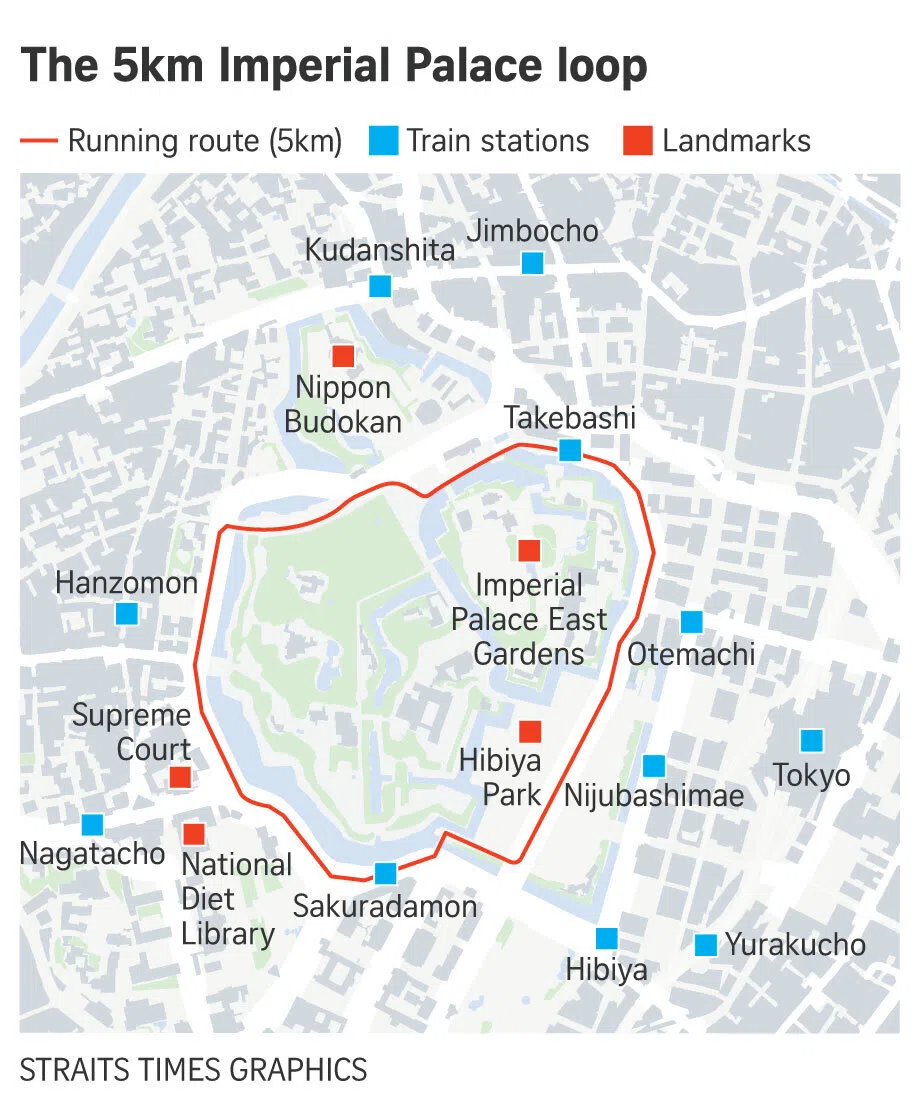
The 5km perimeter encircling the royal residence, sitting on 340ha of land famously valued at more than the real estate value of the entire California state around the peak of Japan’s 1989 bubble economy, is widely revered today as Tokyo’s “holy grail” of urban running.
With zero traffic lights, gentle elevation changes, and central proximity to the Marunouchi and Otemachi financial districts, the scenic route is a haven for everyone from casual to competitive runners.
Yet, the clock may be ticking on what is colloquially known as the kokyo run (Imperial Palace run), where there are said to be at least 10,000 runners on peak days such as weekends, causing overcrowding and raising safety concerns.
Calls for a complete ban on runners along these shared pathways are reaching a crescendo online. Certain segments are so narrow that two people walking shoulder-to-shoulder leave no room to pass; heavy tourist traffic near the Imperial Palace East Gardens, a popular attraction, also turns part of the route into a bottleneck.
Japanese users of social media platform X have aired their grievances. Pedestrians recount runners rudely barking “do-ke!” (“Get out of the way!”) or brushing past young children and the elderly without so much as a backward glance. Critics argue that pavements are built for walking and accuse runners of treating these public thoroughfares as their private tracks.
“Given that some runners sweat profusely, spit and intimidate pedestrians, I have long advocated for a complete ban on what feels like a sacrilegious act around the palace grounds,” one user said.
Another added: “As a pedestrian, it is genuinely terrifying when a runner whizzes past at high speed. You can’t even enjoy the beautiful scenery because you’re constantly afraid of impact.”
But defenders are pushing back against a blanket ban, saying the actions of an inconsiderate few is excessive and cautioning against snuffing out an established piece of Tokyo’s modern urban culture.
One advocate noted on X: “Rather than banning the activity, cultivating mutual awareness and respect is key. We ought to preserve running spaces that are characteristic and unique to Tokyo.”
In response to the outcry, Chiyoda Ward, which has jurisdiction over the area, announced on Oct 1 that it will launch a comprehensive field survey during the fiscal year ending in March 2027.
It will evaluate runner behaviour, examine acts of intimidation, collisions or near-misses, and users who go against the established counterclockwise flow. It will also gather pedestrian volume data and conduct user interviews.
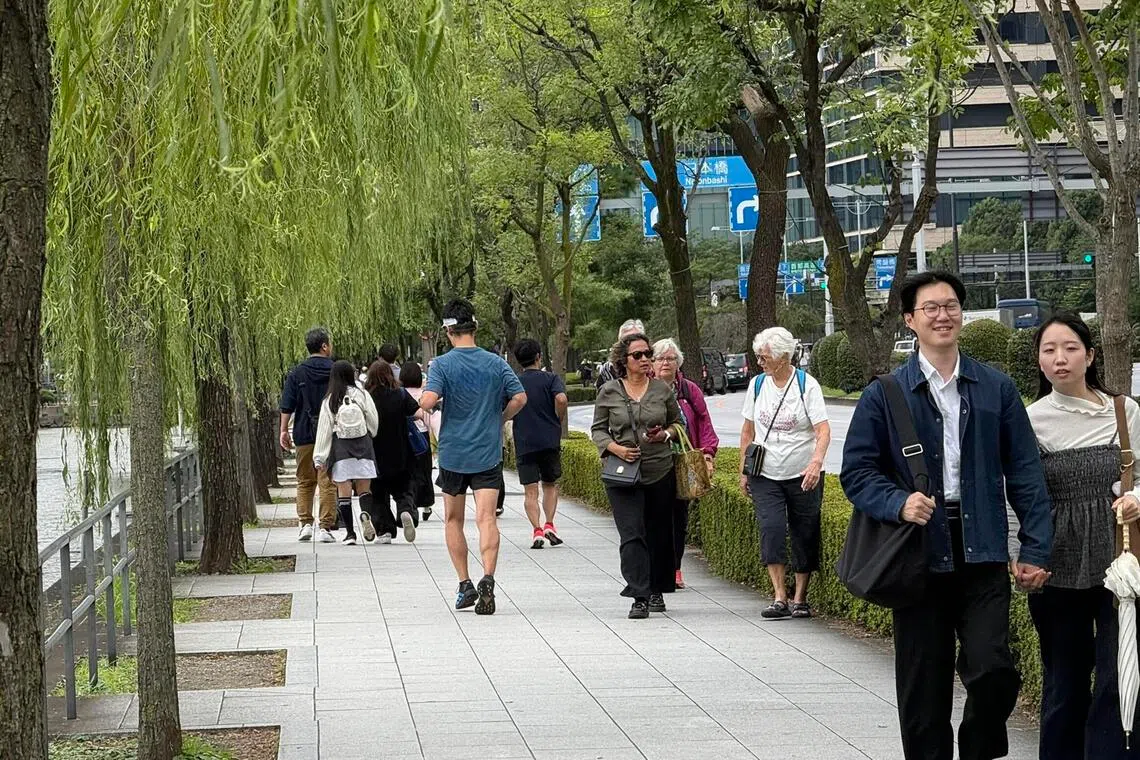
Runners and pedestrians using the 5km perimeter encircling Tokyo's Imperial Palace on Oct 3.
ST PHOTO: WALTER SIM
Chiyoda Ward Mayor Takaaki Higuchi had earlier acknowledged the mounting complaints, but appealed for empathy over enforcement.
In a post on X on Aug 29, he said: “Despite sitting in the heart of the city, the Imperial Palace perimeter offers a vast, dignified space of history, greenery and water, one that is enjoyed by residents, tourists, the elderly and families with young children alike.”
He added: “It is also a premier running spot, but we hope runners will enjoy it with a polite ‘sumimasen’ (excuse me) rather than a rude ‘do-ke’.”
Finding solutions
Much like the 3km Marina Bay loop for office workers in Singapore, the Imperial Palace route is an everyday sanctuary for Tokyo’s corporate workforce.
Add to that the scenic backdrop, with centuries-old stone ramparts juxtaposed against glistening skyscrapers, and the appeal is obvious.
Its prestige spans royalty, literature and politics. Emperor Naruhito ran here during his time as Crown Prince, while author Haruki Murakami used to frequent the path.
Foreign visitors, including Singaporean politicians like Trade and Industry Minister Tan See Leng and MP Jamus Lim, have documented their runs here on social media.
The route surged in popularity after the first Tokyo Marathon in 2007, which finishes just steps away and sparked a fitness boom. In response, an entire support ecosystem sprang up: Running clubs flourished, while specialised “running stations” opened nearby, offering paid lockers, showers and shoe or clothing rentals.
By 2013, growing congestion forced Chiyoda Ward to publish nine rules of etiquette, noting that pedestrians have priority while reminding runners to moderate their speed and urging groups not to block pathways. Users were also asked to avoid using smartphones and listening to music while running or walking.
Yet structural remedies remain elusive.
Widening pavements, as seen at Singapore’s Marina Bay boardwalks and Seoul’s dedicated Han River trails, is a bureaucratic challenge for the ward as jurisdiction of the roads around the palace is fragmented across the ward, the Tokyo Metropolitan Governmen, and national authorities.
Meanwhile, police officers posted at palace sentinels are tasked with security, not traffic control.
As a casual runner around the palace, I believe an outright ban would be a mistake.
The 5km circuit is an extraordinarily rare sanctuary where corporate executives, elite marathoners and international visitors can share the same pavement beneath the shadow of glass towers and ancient palace walls. And I hope this can be preserved without resorting to heavy-handed prohibitions.
My own Oct 3 run was predictably chaotic, navigating tourist groups, dog walkers and even pausing to answer a curious traveller asking questions about the loop.
And to be sure, oblivious pedestrians who freeze mid-stride or walk while glued to their phones pose hazards to everyone – not only to runners.
Yet what makes the Imperial Palace run special is its collective energy and unspoken camaraderie.
While running solo, I found distinct comfort in falling into rhythm behind a pair of strangers ahead, matching their stride to keep pace, while also taking in the scenery.
And this is, arguably, one plus point of the comparatively higher concentration of runners around the palace as compared with elsewhere in Tokyo.
In a 2025 letter to the Mainichi newspaper, Nihon University student Kota Tano recalled that his initial motivation to start running around the palace was superficial: “Runners who pushed themselves looked cool, and I wanted to be like them.”
But over time, logging kilometres alongside friends transformed that impulse into routine, confidence and genuine pleasure, Tano said.
His journey reflects a broader reality, that the overwhelming majority of people running around the Imperial Palace are not looking to cause friction.
Ultimately, peace on the pavement relies on a truth as simple as it is universal, that urban spaces require a shared commitment to basic empathy and mutual respect.