By crypto.news | Created at 2026-06-18 19:23:25 | Updated at 2026-06-18 21:17:31
2 hours ago
By crypto.news | Created at 2026-06-18 19:23:25 | Updated at 2026-06-18 21:17:31
2 hours ago
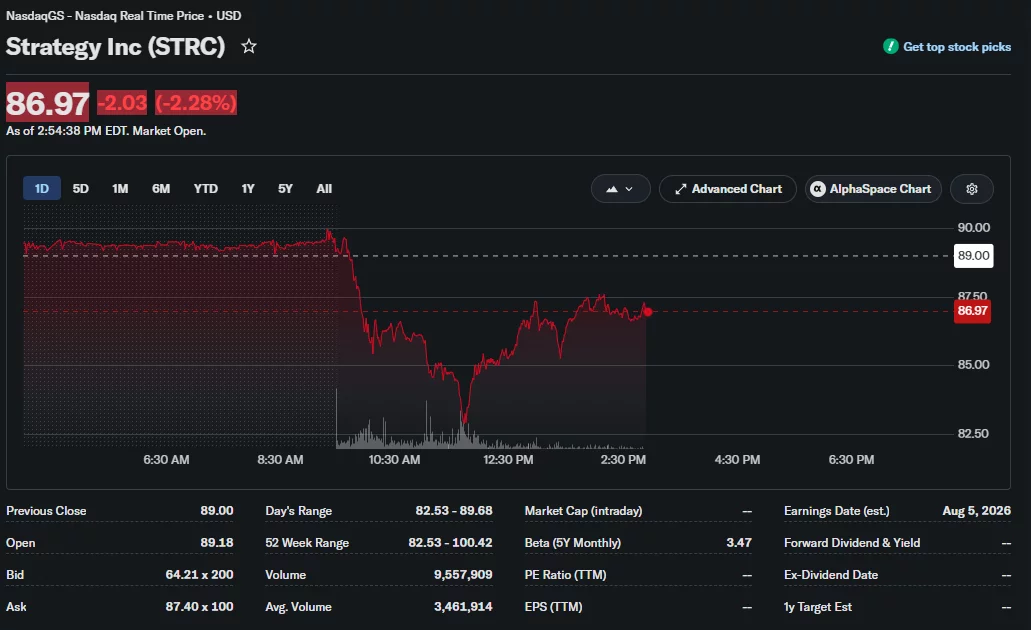
Peter Schiff has accused Michael Saylor of misleading investors in Strategy’s STRC preferred stock, as the security has fallen roughly 15% below its $100 par value.
Summary
- Peter Schiff claimed STRC investors may have legal grounds against Michael Saylor if risks were not properly disclosed.
- STRC fell to a record low of $82.53, intensifying concerns over Strategy’s dividend obligations and funding model.
- QCP warned Strategy’s liquidity may support dividends for only 7.5 months, while insider sales added to investor scrutiny.
In a series of X posts on June 18, the longtime Bitcoin critic argued that some retirees and income-focused investors who purchased STRC after Saylor promoted its yield could have grounds for legal action if they were not adequately informed about the risks associated with the investment.
If you are a retiree who bought $STRC last month and you have already lost 15% of your principal, don't worry. You likely have an ironclad lawsuit against $MSTR, so long as you purchased based on @Saylor's promotion that touted the yield without properly disclosing the high risk.
— Peter Schiff (@PeterSchiff) June 18, 2026STRC fell to a record low of $82.53 on Thursday before rebounding to $86.97 at press time, according to Yahoo Finance data, extending its decline well below the stock’s $100 par value. The drop has intensified debate around Strategy’s capital structure and its ability to support dividend obligations tied to its growing lineup of preferred securities.
 Source: Yahoo Finance
Schiff claimed investors who bought STRC based on yield-focused marketing may have an “ironclad” case against Strategy and its co-founder if risk disclosures were insufficient. He further alleged that Saylor may have violated securities marketing rules, although he did not provide evidence that regulators had opened any investigation or taken enforcement action.
According to Schiff, the stock’s decline creates a problem for future fundraising because new investors may demand higher yields before buying additional STRC shares. He argued that if Strategy wants to return the preferred stock to its $100 par value while continuing to issue new shares, dividend costs could increase significantly.
Dividend concerns have moved into focus
Attention on Strategy’s funding model has increased after market maker QCP estimated that the company’s current liquidity could support dividend payments for about seven and a half months.
According to QCP, Strategy recently repurchased nearly $1.5 billion of convertible notes due in 2029 while raising approximately $200 million through MSTR share sales. The firm also used part of those proceeds to acquire another $100 million worth of Bitcoin, continuing its long-running accumulation strategy.
Based on its analysis, QCP suggested that Strategy could eventually face pressure to find additional sources of capital if current funding channels become less attractive. The market maker noted that future Bitcoin sales could become one option should liquidity conditions tighten.
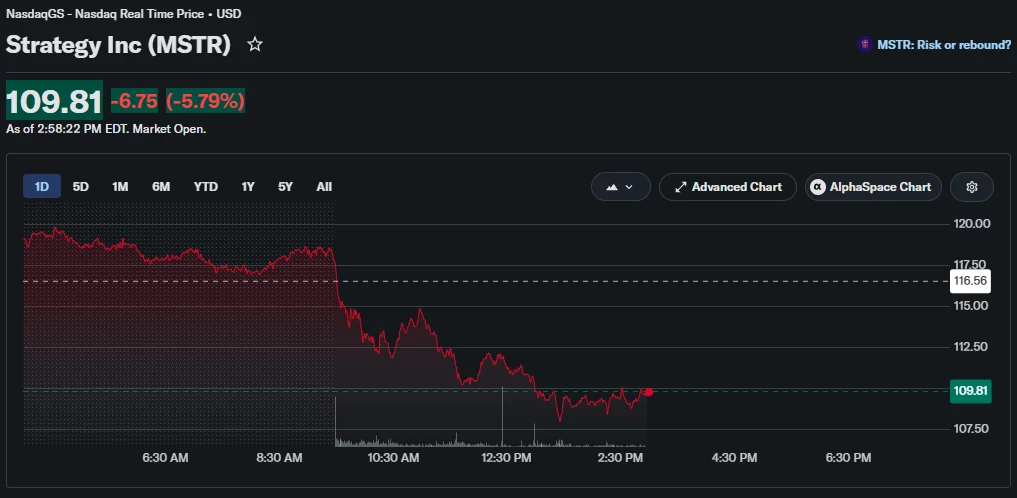
Those concerns have emerged alongside weakness in both Strategy’s common and preferred securities. MSTR was trading near $109 on Thursday, down nearly 6% on the day and over 7% during the past five sessions.
 Source: Yahoo Finance
Critics question whether Bitcoin purchases still benefit shareholders
Recent criticism from Schiff has extended beyond STRC to Strategy’s broader Bitcoin acquisition strategy.
Earlier this week, he argued that the company’s approach worked more effectively when MSTR traded at a large premium to the value of its Bitcoin holdings. According to Schiff, issuing stock above net asset value previously helped increase Bitcoin exposure on a per-share basis.
Following Strategy’s purchase of 1,550 BTC for roughly $101 million in early June, Schiff claimed the transaction reduced shareholder value because the company issued more equity than the Bitcoin it added on a per-share basis. He described the outcome as a “negative Bitcoin yield.”
Meanwhile, insider transactions have added another layer to the discussion. A recent filing with the U.S. Securities and Exchange Commission showed Strategy director Jarrod Patten exercised options to acquire 1,500 Class A shares before selling them on the open market. SEC filings indicate Patten has sold 55,750 MSTR shares over the last three months, generating proceeds approaching $9 million.
As STRC continues to trade well below par value, Schiff maintains that investors face increasing risks. Strategy and Saylor have not publicly responded to his latest allegations as of press time.