By The Straits Times | Created at 2026-07-27 13:36:43 | Updated at 2026-08-03 17:14:27
1 week ago
By The Straits Times | Created at 2026-07-27 13:36:43 | Updated at 2026-08-03 17:14:27
1 week ago
PORT DICKSON – Singaporean healthcare administrator Juita Mohamed visited Port Dickson once in 2010. She never returned.
“There is nothing much there,” she said. “It’s the kind of place where you go once and you’ve already seen what they’re known for.”
Her verdict sums up a persistent problem for a seaside town that has, ironically, attracted much political star power over the years.
This was where Prime Minister Anwar Ibrahim staged his return to Parliament in 2018, following his royal pardon. Today, the federal constituency is represented by Negeri Sembilan caretaker menteri besar Aminuddin Harun – who has led the state government since Pakatan Harapan (PH) took power in 2018.
Yet the sleepy coastal town still bears the marks of stalled development, from abandoned buildings to a tourism industry struggling to compete with Penang and Desaru, even as budget airlines make overseas holidays ever more accessible.
Meanwhile, Aminuddin, having spent nearly two decades in the Sikamat state seat, is making a high-stakes move to contest in Linggi at the Aug 1 state election.
Located within the Port Dickson parliamentary constituency, Linggi is historically an UMNO stronghold and remains under the party’s control today.
A key initiative under Aminuddin’s administration is the RM103.1 billion (S$32.6 billion) Malaysia Vision Valley 2.0 (MVV 2.0) project, an ambitious economic growth corridor stretching from Nilai to Port Dickson that could turn around the fortunes of the town.
The project seeks to transform the district into a regional hub for tourism, logistics and trade through flagship projects including a free trade zone and an AI-powered smart container port.
With the MVV 2.0 finally breaking ground as the PH government marks eight years into its term, the question voters in Port Dickson are asking is this: Will this time be different?
A tale of two towns
Just over an hour’s drive south from Kuala Lumpur, Port Dickson’s 18km coastline helped establish it as one of Malaysia’s earliest beach holiday destinations.
According to Malaysian Association of Hotels’ Negeri Sembilan chapter chairman Haziz Hassan, hotels continue to enjoy strong occupancy during peak periods, with Singaporeans making up some 10 per cent of visitors.
“On weekends and holidays, occupancy is usually above 80 per cent,” he told The Straits Times.
Weekday occupancy, however, falls to between 40 and 50 per cent. Haziz believes Port Dickson’s tourism industry still has considerable room to grow: “There is a lot of untapped potential.”
Several hotels have recently undergone refurbishment, while others, including Corus Paradise Resort and The Grand Beach Resort, are currently being renovated.
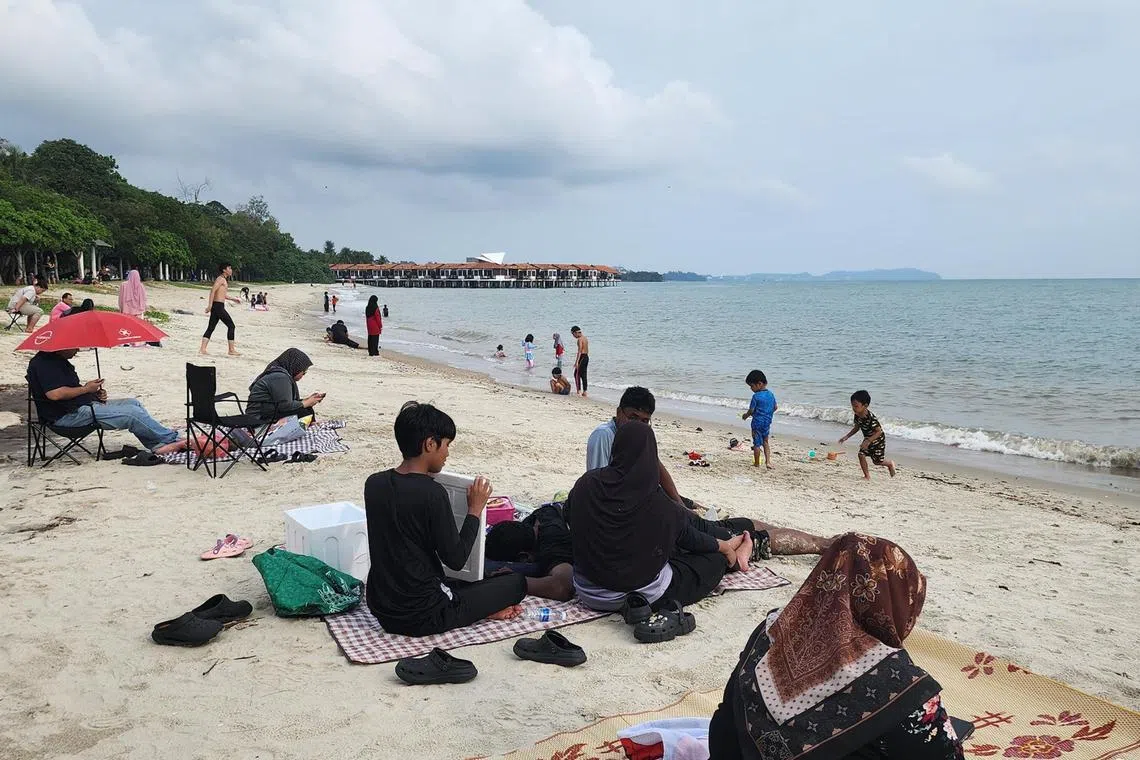
Along the coastline, beachfront resorts bustle with holidaymakers. Families fill the beaches, children play and seafood restaurants fill up after sunset.
ST PHOTO: HAZLIN HASSAN
“The beaches and the water are clean, and there is no traffic congestion. It’s a place to relax,” said Haziz.
But perhaps that laidback vibe is also part of the challenge, with a walk through Port Dickson revealing two contrasting realities.
Along the coastline, beachfront resorts bustle with holidaymakers. Families fill the beaches, children play and seafood restaurants fill up after sunset.
Just a few streets inland, however, the atmosphere changes.
Apart from the PD Waterfront, a commercial development with cafes, restaurants and bubble tea outlets, many older shop lots appear quiet.
Ika Adnan, 34, a clothing shop employee, described parts of Port Dickson as resembling a “zombie beach”, where there is hardly any activity and businesses appear lifeless.
Residents said youth often leave for Kuala Lumpur, Singapore and elsewhere in search of better-paying jobs.
“I want to work in Singapore after I finish my studies,” said 17-year-old student Lisha Lini. Her sister has already crossed the Causeway for work.
The lack of amenities in Port Dickson is also a source of frustration for many residents.
“There should be a proper shopping mall so we don’t have to go all the way to Seremban which is about half an hour away,” said cafe owner Rabitah Azenam, 50.
Ika said the neighbourhood mall offers only limited retail choices and does not have a cinema.
“If I want to watch a movie, I have to take a bus to Seremban,” she said.
At the same time, everyday expenses have become a growing burden, said the single mother. “Everything has become more expensive. My electricity bill has gone up.”
Rabita also said she hopes the state government will provide greater financial support for small business owners like her.
Betting on MVV 2.0
These frustrations are what the state government hopes its next big gamble can finally address.
The long-term development corridor aims to diversify the state’s economy beyond tourism by attracting manufacturing, logistics, technology and investment.
The government’s ambitions took a significant step forward on July 14, when Anwar officiated the groundbreaking ceremony for the Midport Smart AI Container Port, describing it as the start of a new chapter in Port Dickson’s economic growth.
The RM3.4 billion first phase will cover about 72.84ha and is expected to take around three years to complete.
It will be integrated with the proposed 566.5ha Port Dickson Free Zone, an industrial development forming the centrepiece of the state’s broader plan to position the district as a regional logistics and trade hub.
At the groundbreaking ceremony, Aminuddin said: “Port Dickson has been known as a tourism destination all this while. Now with this project, Port Dickson will enter a new phase as a gateway for trade, logistics, investment and modern maritime technology.”
This will create about 5,000 new jobs, he said, adding: “We don’t want Negeri Sembilan youths to migrate just to get better jobs.”
Some residents told ST they are hopeful the plans could help Port Dickson turn its fortune around this time.
A company manager who wished to be identified only as Jeevan told ST he believes the Vision Valley and AI port projects are good for Port Dickson because they will create more job opportunities.
“Hopefully, local people will be given priority so they can benefit from the new jobs instead of having to look for work elsewhere,” he added.
Hardware store manager N.S. Chong, 56, believes patience is required for Port Dickson to repair its reputation.
“The AI port development will be good for the economy. We need to give it time,” he said, and Aug 1 will show whether Negeri Sembilan voters agree with him.
Sign up for our weekly Asian Insider Malaysia Edition newsletter to make sense of the big stories in Malaysia.