By The Rio Times | Created at 2026-10-06 15:31:31 | Updated at 2026-10-06 16:28:11
1 hour ago
By The Rio Times | Created at 2026-10-06 15:31:31 | Updated at 2026-10-06 16:28:11
1 hour ago
LITHIUM · ARGENTINA
Key Facts
- —The country Argentina is a major lithium producer, with brine deposits in high Andean salt flats in Salta, Catamarca and Jujuy provinces.
- —Why it matters Lithium goes into electric-vehicle batteries. A new plant run by South Korea’s POSCO adds supply produced outside China.
- —Why now Construction is finished. The project entered the RIGI, Argentina’s tax and currency regime for large investments, by a ministry resolution published in July.
- —What happened On Tuesday 6 October, POSCO formally inaugurated Plant II of its Sal de Oro project, built for about 23,000 tonnes of lithium carbonate a year, with Karina Milei and Cabinet Chief Diego Santilli present.
- —The numbers The Economy Ministry approved US$207.9 million of qualifying investment. A memorandum on raising Sal de Oro to 100,000 tonnes a year was on the programme.
- —What it means for you More lithium from outside China for US and Asian battery makers; POSCO Holdings shares also trade in New York.
- —Still open Whether the 100,000-tonne memorandum was signed, its timeline and cost, and who buys the carbonate. Output only ramps up gradually through 2027.
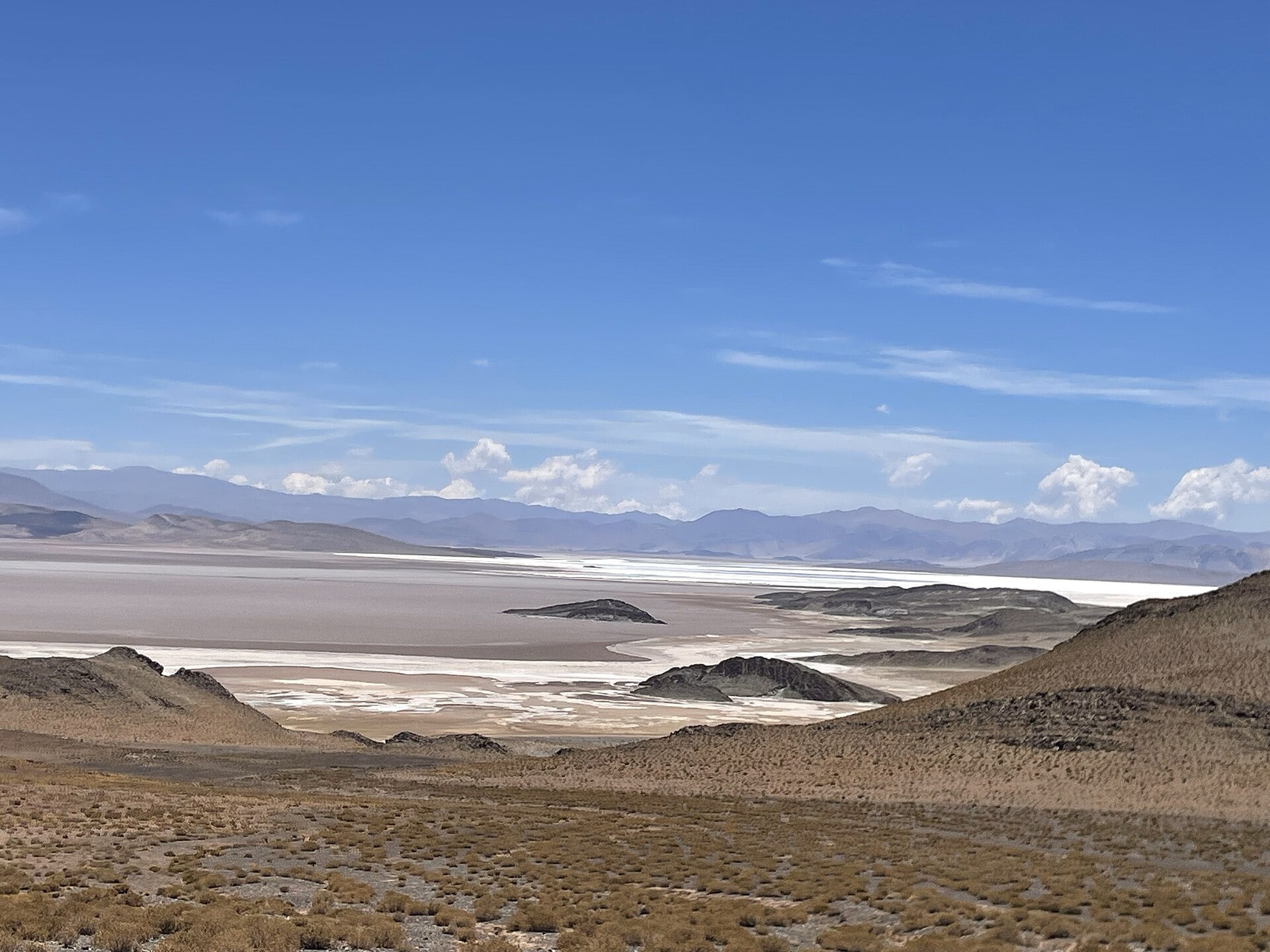
South Korea’s POSCO opened a new lithium plant on the Salar del Hombre Muerto, a salt flat high in the Andes on the border of Salta and Catamarca provinces, on Tuesday 6 October, with Argentina’s most senior political officials on hand. The plant is designed to make about 23,000 tonnes of lithium carbonate a year, all of it for export. For American readers, it is a little more battery metal from outside China, produced by a company whose shares also trade on the New York Stock Exchange.
The steel and battery-materials group is the operator. Plant II is the second stage of its Sal de Oro project. According to the official schedule reported by C5N, the national delegation was due at 9:20 a.m. local time, the ceremony at 9:30 a.m. (8:30 a.m. ET) and the formal opening at 10:00.
After the event, the Catamarca daily El Esquiu reported that POSCO “formalised the inauguration” of Plant II, the second POSCO lithium plant in Argentina after the Güemes hydroxide unit. At the same time, from 9:30 a.m., the company held a technical briefing for businesspeople, local suppliers and officials at a hotel in San Fernando del Valle de Catamarca, the provincial capital. The opening has not yet been independently confirmed by a second post-event report or an official release.
The visit was political as well as industrial. The government postponed its weekly Tuesday political strategy meeting at the Casa Rosada so that its senior figures could travel to the Puna, C5N reported. Local press noted that the trip came as the government negotiates with governors over suspending the PASO primary elections.
Who Was There
The national delegation was led by Karina Milei, secretary-general of the presidency. She is the sister of President Javier Milei, a libertarian economist who took office in December 2023 promising to shrink the state and open the economy.
With her was Diego Santilli, the cabinet chief, who coordinates the ministries and the government’s dealings with Congress and the provinces. His deputy, Ignacio Devitt, was also due to travel, El Tribuno reported.
According to El Esquiu, the ceremony in the Puna was headed by the two provincial governors, Gustavo Sáenz of Salta and Raúl Jalil of Catamarca, alongside the national delegation and senior POSCO executives. The salt flat lies on the border between their two provinces.
The official programme listed speeches by Chang In-hwa, the head of POSCO Holdings, according to C5N, and by South Korea’s ambassador in Buenos Aires, Lee Chong Hwa, followed by the two governors, Santilli and Karina Milei. No account of what any of them said had been published by midday local time.
Follow this story
Get an email when there’s news on Argentina markets
Free. One email a day at most, and only when there is news. This also signs you up to our weekday newsletter, The LatAm Brief. Nothing arrives until you click the confirmation link, and you can stop either with one click. Privacy policy.
What the New Plant Adds
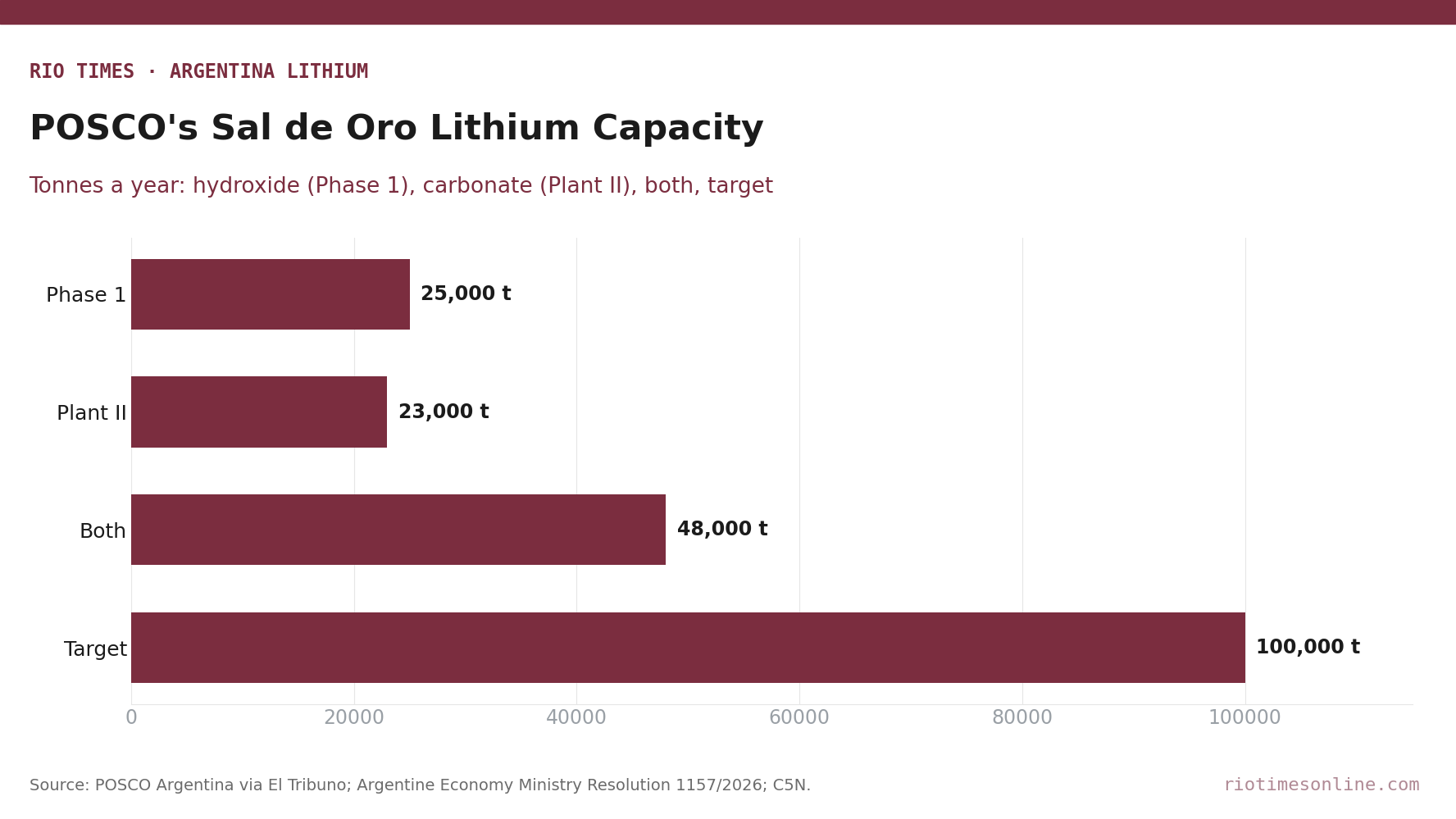
Sal de Oro already produces. Its first phase is a lithium hydroxide plant in the industrial park at General Güemes, in the Salta lowlands. It opened in October 2024 with a design capacity of 25,000 tonnes a year. The company says it now runs at about 85 percent of that.
Plant II sits up on the salt flat itself and makes lithium carbonate, a different battery-grade product. Together the two plants come to about 48,000 tonnes a year, El Tribuno calculated from company figures. Production at the new site is due to rise gradually through 2027, the company said at Tuesday’s briefing, so real volumes will lag the headline capacity for some time.
At a press briefing in Salta on Monday 28 September, POSCO Argentina said its exports in September came to 8,526 tonnes worth US$138 million. It also reported more than 600 direct employees and more than 270 local suppliers. These are company figures and have not been independently audited.
The Money Behind It
The legal backbone is Resolution 1157/2026 of the Economy Ministry. It was signed on Wednesday 29 July and published in the Official Gazette on Friday 31 July. It admits “Sal de Oro II” to the RIGI, the incentive regime for large investments.
The RIGI is President Milei’s flagship tool for foreign capital. It offers projects long-term tax, customs and currency stability in return for minimum investment commitments.
In the resolution, POSCO declared US$207.9 million in qualifying assets. It committed US$98 million within the first two years, and must meet the minimum investment by Tuesday 31 July 2029. The ministry dates the project’s entry into the regime to Friday 12 June 2026.
Local press, citing company figures, gives larger totals. El Tribuno reports about US$633 million in total spending on this phase and more than US$2 billion across the whole project. The resolution counts only qualifying assets, and the gap has not been explained publicly.
When the approval was announced in June, Economy Minister Luis Caputo estimated the new plant could generate more than US$300 million a year in exports. POSCO Argentina also says it expects up to US$700 million in financing from the Inter-American Development Bank for working capital at both plants.
What It Means for You
For investors, the POSCO lithium plant is one more sign that Argentina’s lithium pipeline is moving from promises to plants. The same salt flat hosts projects by Rio Tinto and Australia’s Galan Lithium. Rio Tinto’s plans nearby were covered in Rio Tinto Plans US$2.7 Billion Lithium Project in Salta.
For carmakers and battery buyers in the United States, more carbonate from South America widens the choice of suppliers outside China. The volumes are still modest against global demand, and they depend on prices that have swung hard in recent years.
For Argentina, each new plant adds export income. Earlier figures are in Argentina Mining Exports Top US$6 Billion in Eight Months as Lithium Jumps 190%. The risk is concentration: a handful of foreign operators now carry much of that growth.
What Is Not Known
The programme included the signing of a memorandum of understanding with the national government on Stages III and IV, aiming for 100,000 tonnes of lithium a year, C5N reported. No post-event report has yet confirmed that it was signed. POSCO said only that it plans further expansion stages and has given no timeline, phases or investment figure.
The buyers of the new carbonate have not been named. Nor is it clear how fast the new POSCO lithium plant will ramp up in 2027, or what lithium prices will be when full volumes arrive.
The text of the memorandum, the speeches and any new investment pledges made at the ceremony have not been published.
Frequently Asked Questions
What is the POSCO lithium plant in Argentina?
It is Plant II of the Sal de Oro project on the Salar del Hombre Muerto, between Salta and Catamarca provinces. It is designed to produce about 23,000 tonnes of lithium carbonate a year for export.
How much is POSCO investing?
Economy Ministry Resolution 1157/2026 lists US$207.9 million in qualifying assets for this phase, with US$98 million due in the first two years. Company figures cited by local press are higher.
When will the plant reach full output?
Not right away. Production is due to rise gradually during 2027. A separate plan to lift Sal de Oro to 100,000 tonnes a year, the subject of a memorandum on the inauguration programme, has no published timeline.
Sources: Argentine Economy Ministry, Resolution 1157/2026, Official Gazette, 31 July 2026 and Infoleg summary; El Tribuno, 5 October 2026 and 28 September 2026; C5N, 5 October 2026; El Esquiu, 6 October 2026; BAE Negocios, 6 October 2026.
Editorial responsibility: Matthias Camenzind, Editor-in-Chief · Editorial standards · Report an error
LatAm Markets: Live Signals → — real-time movers, turnover leaders and FX across Latin America.