By The Straits Times | Created at 2026-09-03 12:06:44 | Updated at 2026-09-03 12:37:14
37 minutes ago
By The Straits Times | Created at 2026-09-03 12:06:44 | Updated at 2026-09-03 12:37:14
37 minutes ago
JAKARTA - Indonesian President Prabowo Subianto pitched his country as Russia’s gateway to Southeast Asia on Sept 3, saying the Pacific should become a “highway between our two economies” as he pushed for closer trade, investment and transport links.
Speaking at the Eastern Economic Forum (EEF) in Vladivostok, Prabowo urged Russian businesses to use Indonesia to tap ASEAN’s market of about 680 million people.
“For Eurasian businesses, Indonesia is a natural entry point to ASEAN,” Prabowo said.
Russian President Vladimir Putin, speaking at the same plenary session, said the Asia-Pacific “is a powerful centre of growth and sets the pace for the development of the entire global economy”.
“Russia is an active participant in investment and trade cooperation in the Asia-Pacific region. We interact as equals with our partners and with the region’s leading integration groupings,” he said.
The push comes as Russia has increasingly redirected its energy trade towards Asia, following its invasion of Ukraine in 2022 and subsequent Western sanctions, with China and India becoming major buyers of Russian oil.
Russia looks to Asia
The EEF, now in its 11th year, was established by Russia to attract investment into the resource-rich Russian Far East and deepen its economic links with Asia. In 2024, Malaysian Prime Minister Anwar Ibrahim was a keynote speaker at the forum.
This year, Prabowo is the forum’s main guest of honour, a year after he was also a guest of honour at the St Petersburg International Economic Forum. Myanmar Vice-President Nyo Saw was also present at the plenary.
Putin said about 25 trillion roubles (S$365.02 billion) in investment had flowed into the Russian Far East over the past 11 years, while its gross regional product had more than tripled.
Much of his pitch focused on connecting the region more closely with Asian markets. He outlined plans to expand major railways and modernise ports and cross-border infrastructure.
Putin also promoted the Trans-Arctic Transport Corridor, which would connect Russia’s western ports to Vladivostok by sea and to the Asia-Pacific through the Northern Sea Route. Russia wants year-round navigation along the route, which Putin said would provide greater flexibility and security for international shipments amid risks to global shipping and trade.
During a bilateral meeting between the two leaders ahead of the plenary, Putin called Indonesia “one of Russia’s key partners in the Asia-Pacific region” and a trusted friend within ASEAN.
Putin highlighted cooperation in agriculture, shipbuilding, digital technology and energy, particularly nuclear power.
The Vladivostok meeting is the latest sign of increasingly close ties between Jakarta and Moscow, which elevated their relationship to a strategic partnership in 2025. It was Prabowo and Putin’s second meeting in 2026, as the two countries step up high-level contacts.
“Our personal contacts reflect the strategic nature of bilateral relations between Russia and Indonesia,” Putin told Prabowo.
Prabowo said the EEF had “great potential to become a bridge for cooperation and connectivity in this region”.
“For us as an archipelagic country, connectivity and maritime cooperation are very important,” he said.
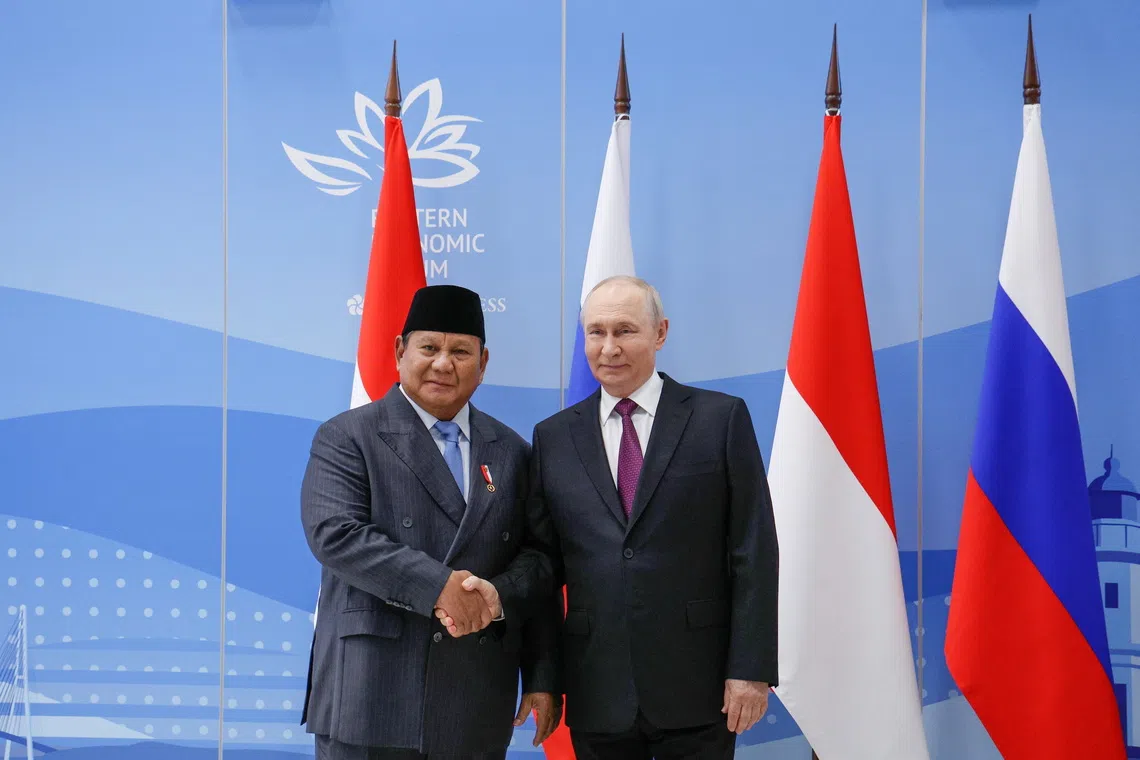
Indonesian President Prabowo Subianto and Russian President Vladimir Putin met on the sidelines of the Eastern Economic Forum on Sept 3.
PHOTO: EPA
Trade and connectivity push
Prabowo said the Pacific should be seen as a link between Indonesia and Russia’s Far East.
“The Pacific Ocean does not separate us. The Pacific Ocean connects us. It is not a wall between us,” he said.
He described the two economies as complementary: Russia could provide wheat, fertiliser, energy, science and advanced engineering, while Indonesia could supply products including palm oil, fisheries, coffee, rubber, textiles and furniture.
Bilateral trade reached US$4.8 billion (S$6.1 billion) in 2025, up 21.7 per cent from a year earlier, according to Indonesia’s Trade Ministry.
In December 2025, Indonesia inked a free trade agreement (FTA) with the Eurasian Economic Union (EAEU), a grouping consisting of Russia, Armenia, Belarus, Kazakhstan and Kyrgyzstan.
Prabowo proposed doubling trade during the first review period given the lower trade barriers, closer business ties and improved shipping and logistics.
He said the FTA would eliminate or reduce tariffs on 11,882 tariff lines, covering more than 90 per cent of the EAEU’s total tariff lines.
The agreement was now expected to enter into force in early 2027, he added, urging EAEU members to complete their domestic procedures quickly.
Prabowo also called for direct shipping between Indonesia and the Russian Far East and more direct air links between the two countries.
“Ships move goods. Aircraft move friendship,” he said.
Energy was another focus, with Prabowo inviting Russian cooperation in oil and gas exploration, production and processing, as well as renewable energy, smart grids and civilian nuclear power.
“We seek knowledge and investment in renewable energy, smart grids and peaceful nuclear power, including modular and full-scale technologies under the highest safety standards and international safeguards,” he said.
He also proposed that Indonesia’s sovereign wealth fund Danantara and the Russian Direct Investment Fund finance projects together.
“Come to Indonesia, work with us, produce with us. Let us build industries together. Let us create value together,” Prabowo said.
“And from Indonesia, let us reach the wider markets of ASEAN and the Indo-Pacific together,” he added.
Economic, not military alliances
Prabowo presented closer economic ties with Russia as consistent with Indonesia’s longstanding policy of avoiding military alliances.
Indonesia has long followed a “free and active” foreign policy, under which it seeks to maintain an independent position while engaging with major powers.
“Indonesia works to the east, west, north and south as a sovereign and equal partner,” Prabowo said.
He framed the FTA with EAEU as an example of the kind of relationship Indonesia wanted.
“Indonesia does not want to join any military alliance, but we seek to join economic alliances,” he said.
“Our FTA within the Eurasian Economic Union is exactly that – not an alliance against anyone, but a partnership for the prosperity of everyone.”
Prabowo also rejected the idea that closer cooperation among developing economies would produce another geopolitical bloc.
“The Global South is not a new bloc,” he said. “It is a constituency for fairness, for a fair share of prosperity, and a fair voice in writing global rules.”
He added: “We came to St Petersburg to make friends, and now we come to Vladivostok to turn the friendship into pragmatic results.”