By Engadget | Created at 2026-08-07 13:41:40 | Updated at 2026-08-07 15:30:28
3 hours ago
By Engadget | Created at 2026-08-07 13:41:40 | Updated at 2026-08-07 15:30:28
3 hours ago
A great app experience turns this wireless stereo setup into a capable hub for your home audio.
James Trew for Engadget
RATING : 8 / 10
- Confident, spacious stereo sound
- HDMI eARC and phono connectivity
- Wireless stereo setup for flexible placement
- Polished app experience
- Premium price
- Underwhelming phono performance
We may receive a commission on purchases made from links.
For the past decade, multi-room smart speakers have been dominated by the same companies that sell us our phones, tablets and cloud services. Somewhere along the way, music became a secondary feature rather than the focus of the device playing it. Traditional hi-fi brands have struggled to compete, usually leaning on sound quality alone as their advantage with limited mainstream success.
There's an emerging trend of hi-fi speakers combining the convenience of streaming and multi-room connectivity with their premium audio performance and physical connectivity. The iQ2 from PSB ($1,399) is one such product. It promises the acoustic benefits of bookshelf speakers, packs in almost every input you could need and stirs in many of the everyday conveniences listeners now expect. The emphasis is less on "smart" and more on "speaker," positioning the absence of voice assistants and daily briefings as a feature, not a compromise. At least, that's the idea.
Design
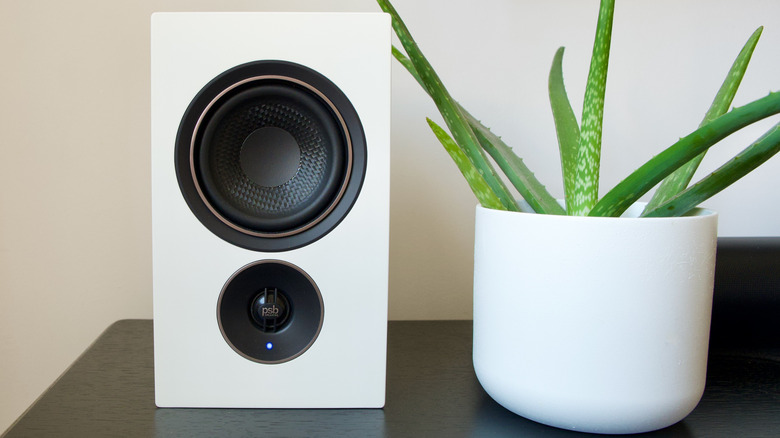
Make no mistake, the iQ2 looks like a pair of conventional shelf speakers, albeit modern, minimalist ones. They have a sleek aesthetic that doesn't call your attention, that adds a gentle stylish detail to a room. At about 9 x 6 inches, they're on the smaller side for speakers and should fit neatly on most TV stands or even desks. The units I tested came in white, but there's a total of seven hues to choose from — ranging from cautious beige to bold red. Personally, I love how they look and I think there's a good balance of grown-up style, without tipping over into serious hi-fi territory.
The design makes it clear that they're "here to play music" rather than the "I might be an air purifier" vibe of some home assistant-style smart speakers. Though it's fair to say that the form-factor isn't suitable for all parts of the home. In smaller rooms, and in practical spaces like a kitchen, these speakers might feel a little out of place.
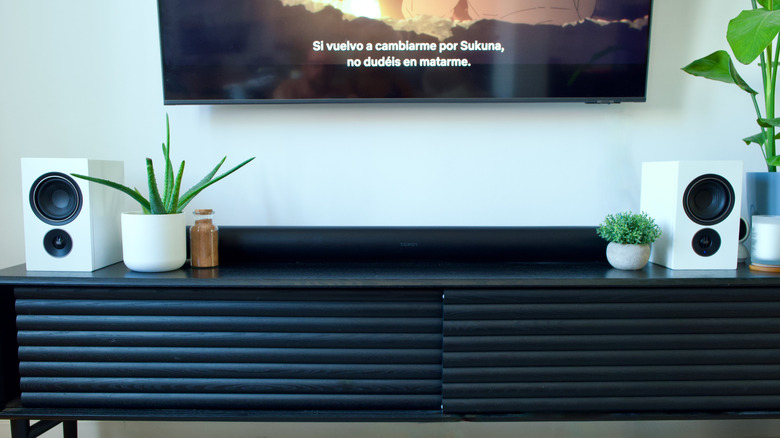
Never say never, though. The iQ2 speakers don't need a cable to join them together, even though they're a stereo pair. This makes room placement much tidier and easier. Both speakers will, however, need a wall outlet for power. One of the speakers acts as a primary with all the input ports, so it doesn't matter, for example, which side of the TV your HDMI port is on — your speakers can match. The primary also has touch-sensitive buttons on top for basic media and volume controls.
Inputs and connectivity
James Trew for Engadget
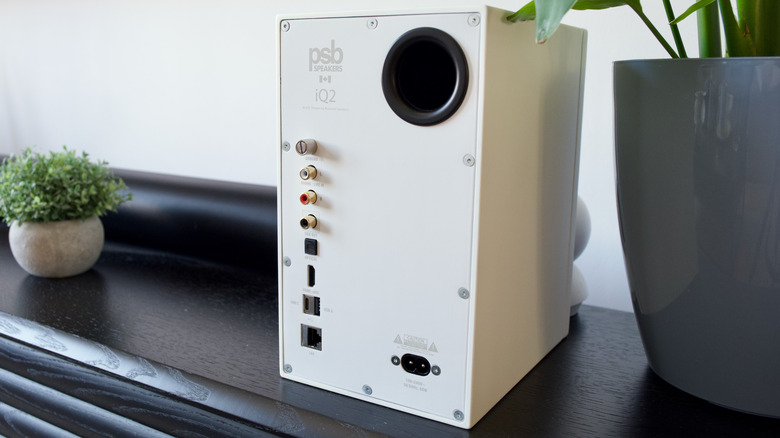
I already gave you a hint, but there's a comprehensive selection of inputs available on the iQ2. There are physical connections for HDMI (with eARC), phono/line, optical and two USB ports (Type-A and Type-C). For wireless connectivity, there's Bluetooth (aptX Adaptive) and AirPlay. You can also configure network sharing, if that's your thing. Wherever your music lives — on disc or as data — there's likely a way to play it through the iQ2 with little effort. I say little, as there's no 3.5mm connection, so you might need an RCA adapter for an old phone or portable CD player. But that's the only friction point for adding music sources.
BluOS controller app
As Sonos learned at great expense, users won't tolerate a bad app experience for long — no matter how good the hardware or sound. PSB has a quiet strength here, as it's part of the same family of companies that makes the BluOS controller app. The app is compatible with a number of streaming speakers from different brands, but the iQ2 benefits from what feels like near native integration.
Setup involves little more than plugging the speakers in, searching for them in the app and then a few basic configuration steps (like deciding which side the primary is on). In less than two minutes, I was streaming my Spotify playlists.
It's here in the app that you swap music sources, add any local libraries and control any playing media. For these essential tasks, BluOS is intuitive and easy to navigate. Scratch a little bit deeper and you'll find plenty of customization and advanced configuration options so that your preferred inputs, services and listening preferences are within reach. If you own multiple BluOS-compatible speakers, you can group them in the app for multi-room listening and control.
If you plan on using these speakers in place of a soundbar, be sure to find the Auto Sense option. Each input has its own settings outside of the global configuration, so if you want sound to automatically switch to the TV when you turn it on, you'll need to set that manually in the app. The only minor complaint I have with BluOS is that the sources you use the most show-up on the home screen. That itself is fine, but I spent a while looking for the way to toggle from Line input to phono, without any luck. It was because the phono input didn't immediately show up in the "Most Used" section. When it did, I finally found the way to enter specific settings for that input. It didn't take long, but long enough for me to start Googling around for a solution.
Sound quality
James Trew for Engadget
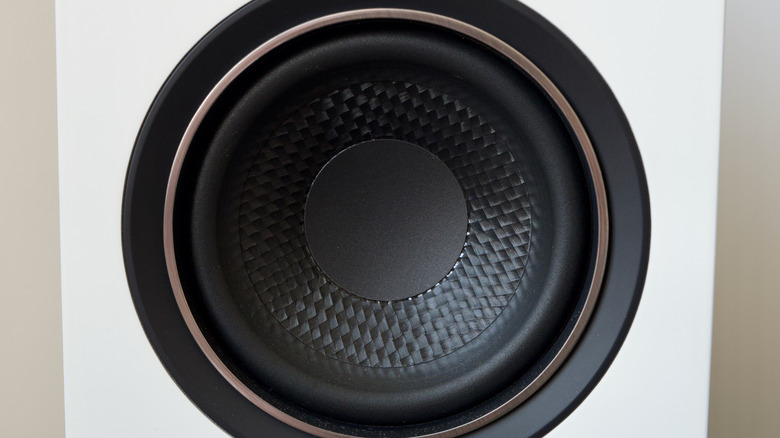
My current living room setup has a Sonos Arc pulling double duty as a soundbar and primary music player. Switching to the iQ2 revealed an immediate sonic difference: Things sounded relaxed, in a good way. I enjoy the Sonos, but I didn't realize how dominant it was, even at lower volumes. For TV and movies, the iQ2 speakers deliver a natural sound with a present but controlled low end. It passed my preferred boomy-bass test — watching a few trailers for Michael Bay movies — with flying colors. It's clear that PSB has tuned the iQ2 in a way that avoids sounding thin, but without calling attention to itself, even during high-action climatic scenes that usually have me reaching to lower the volume.
For music, the experience is similar. With electronic music in particular, the benefit of true, separate stereo speakers becomes clear, with even frantic hard techno and other "dense" genres sounding more open. Acoustic and rock genres are easy listens with pleasant mid-high frequencies that don't sound too sharp or exaggerated.
The only audio source that sounded notably different was vinyl via the phono input. As the only non-digital source, it makes sense that it shows the most variation. The built-in preamp is perfectly capable of raising my 50-year-old turntable to enjoyable audio levels, but there's a slightly narrower sound. It's still an enjoyable listen, and allows me to remove my current preamp from my living room. As it happens, PSB issued a statement during this review that it would be making changes to the phono preamp "after early feedback on that feature," so things may well improve soon.
It's worth mentioning that the iQ2 speakers are fairly compact. This makes them fit well in smaller living spaces and/or busy media centers, but it also means they're not wall-shakingly loud. I never found myself mashing the volume button for more, but if you are looking to fill larger spaces with party-level sound, then the iQ2 might not scratch that itch.
The competition
For multi-room audio, you can take your pick from multiple options, most of which will cost less than the $1,399 iQ2. Few, if any, come with the range of inputs here though, and luxuries like HDMI are rare. Phono/line in support is basically non-existent. Sonos has a few models such as the Arc Ultra and Beam that have HDMI, but you'll have to upgrade to the company's Amp if you want a line in and a phono preamp.
PSB isn't alone in the smart hi-fi space, though. KEF's LSX II is a direct rival with near-identical inputs, a more striking design and, at $1,500, a slightly higher entry point. It also doesn't have a phono preamp, but does offer a 3.5mm input. If you already have a set of speakers or don't mind adding an extra link in the chain, the Wiim Ultra audio streamer matches the iQ2's connectivity for just $329. That's obviously just for the hub, though, so you'll have to add in the cost of your speakers for a true comparison.
Wrap-up
James Trew for Engadget
The decision here is simple. Do you need more connectivity and wider , hi-fi sound? Or are streaming services and Bluetooth enough? If it's the former, there's another hurdle to pass: your budget. The iQ2 is competent at everything it claims to do. It modernizes your home hi-fi and theater easily and elegantly. BluOS does a good job at combining multiple inputs into a modern hub, but if extra bells and whistles, like smart assistants, alarms and briefings matter, you might find it restrictive. Not least of all, $1,399 is not a casual purchase. But if you've already accepted that great sound costs money, the iQ2 makes a compelling case for its place in your media center.