By The Straits Times | Created at 2026-10-08 12:17:10 | Updated at 2026-10-09 14:52:23
1 day ago
By The Straits Times | Created at 2026-10-08 12:17:10 | Updated at 2026-10-09 14:52:23
1 day ago
TAIPEI - A political “ocean current” sweeping across Taipei city is pushing the ruling party’s mayoral candidate to greater prominence, but has also engulfed a Taiwanese celebrity popular on both sides of the Taiwan Strait in controversy.
Taipei City mayor candidate Puma Shen, 44, from the Democratic Progressive Party (DPP), attracted much cheers and wave of campaign flags in his support when he appeared onstage to launch his election campaign office on Oct 4. Shen’s campaign has been unofficially dubbed “yang liu” or “ocean current” – a pun on his name, Shen Pao-yang.
Offstage, TV host and writer Kevin Tsai was in the VIP area of the event, donning a hat, a black face mask and an orange shirt – the colour of Shen’s official campaign colour.
When asked by journalists, Tsai clarified that he was there to suss out potential interviews with the Taipei mayoral candidates, including incumbent Chiang Wan-an, 47, from the China-friendly Kuomintang (KMT).
But the damage has been done.
Chinese electric vehicle maker Leapmotor swiftly removed all promotional content featuring Tsai, and fashion magazine Harper’s Bazaar China deleted an interview with him published in September.
On Oct 6, social media account “Jun Zhengping”, affiliated with the People’s Liberation Army Daily, said in a commentary, without naming Tsai, that “those who profit from opportunities on the Chinese mainland while cozying up to ‘Taiwan independence’ forces” will eventually “pay a price they can ill afford”.
According to news reports, Tsai’s Chinese social media account Weibo was flooded with negative comments criticising him for being “two-faced” and calling for a boycott against those who lend their support to Taiwan independence.
China views Taiwan as its own territory and has never renounced the use of force to “reunify” it one day, but Taiwan rejects the claim.
While Tsai is the latest casualty of cross-strait tensions, other Taiwanese celebrities before him, especially those who have pivoted their careers to China, have come under scrutiny for where they stand on Taiwan independence.
Wave or tsunami?
Shen himself is no less a lightning rod across the Taiwan Strait. He is one of 14 individuals designated by China’s Taiwan Affairs Office as a “diehard separatist” – a public blacklist that Beijing reserves for those in Taiwan’s pro-independence movement it considers the most extreme.
Sanctioned in 2024, Shen was accused of “spreading the seeds of violent conflict across the Taiwan Strait” through the Kuma Academy, a non-profit organisation that runs civil defence training. A trained criminologist, the academic also helped raise awareness of Chinese influence operations.
China’s actions against Shen escalated in October 2025, when Chongqing’s Public Security Bureau launched an investigation into him, marking the first time a formal criminal probe was opened by Chinese authorities against a sitting Taiwanese lawmaker for suspected secession offences.
If Shen wins the mayoral race on Nov 28, it will affect cross-Strait relations, said Huang Kwei-bo, a professor at the College of International Affairs, National ChengChi University.
“An immediate impact will be a likely cessation of the annual Twin Cities Forum between Taipei and Shanghai, which has been constantly held for 16 years… Such a cessation will mark an obvious setback in cross-Strait relations beyond a doubt,” Huang told The Straits Times.
Chen Fang-yu, associate professor at Taiwan’s Soochow University, however, does not see any significant impact.
“Beijing has consistently refused to truly understand Taiwanese society, labelling everything – moderates, opinions, or stances – as pro-independence. For Beijing, the loss is the inability to win over the hearts and minds of the Taiwanese people,” he told ST.
Taiwan’s Mainland Affairs Council deputy minister Liang Wen-chieh said on Oct 8 that people in Taiwan have the freedom to support the candidate they prefer without coercion.
“I believe no one wants Taiwan’s elections to be decided by the Chinese Communist Party,” said Liang.
Both Chiang and Shen have also expressed support for Tsai. Chiang said he respects Tsai’s right to express his own views, while Shen said that it is unfair for Tsai to be hit with backlash for wanting to understand the views of the candidates.
The race for Taipei mayorship attracts much attention as those elected have a track record of going on to become president – from DPP’s Chen Shui-bian to KMT’s Lee Teng-hui and Ma Ying-jeou – whose party background will then have an impact on Taiwan’s relations with China.
Shen’s rise from a criminologist known for his unruly mop of curly hair to serious contender for mayor of Taiwan’s capital city has been unexpected, to say the least. He has never run in an election, let alone win one.
He formally joined politics only in 2024 after the DPP nominated him as an at-large legislator. These parliamentary seats are shared out in proportion to the party vote won in the national election.
When the DPP chose Shen in May 2026 to run against Taipei mayor Chiang, a Taipei Times column called it a “baffling choice”. The assessment then was that the DPP did not have a candidate who could stand up to Chiang.
Chiang has run Taipei City for four years, and had been a legislator for two terms before becoming mayor. In 2022, he became Taipei’s youngest-ever mayor at age 43 with a decisive vote share of 42.29% over two other main opponents.
With his connection to Taiwan’s most prominent political family of the late KMT leader Chiang Kai-shek, elite education and chiselled good looks, he seemed like a shoo-in, and there was chatter about a possible 2028 presidential bid.
‘Ocean current’ to stay?
Turnout for Shen’s event on Oct 4 was larger than expected, with his campaign saying that 120,000 people attended the rally, but other estimates put it at 50,000 to 80,000. Many whipped out portable fans and stools as fellow DPP politicians sang Shen’s praises and a rock band performed.
At regular intervals, the hosts shouted Shen’s Chinese name, and the crowd responded with “dong suan” – Taiwanese for “being elected”.
The finale featured President Lai Ching-te and a surprise appearance by former president Tsai Ing-wen – to excited cries from supporters.
One of them told ST at the rally that Shen, who grew up in Taipei, “is an ordinary person like us, so he should understand the needs of residents”.
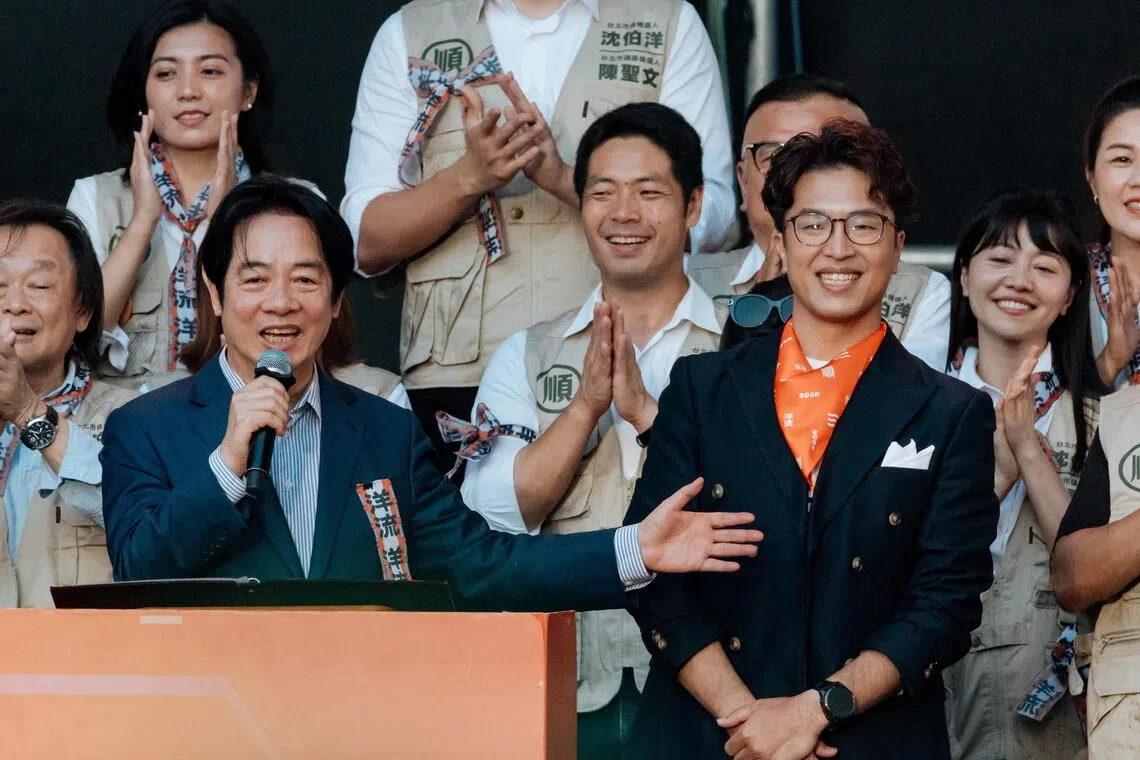
Taiwan President Lai Ching-te (left) delivering a speech in support of Democratic Progressive Party (DPP) Taipei mayoral candidate Puma Shen (right) during the opening of Shen's campaign headquarters in Taipei on Oct 4.
PHOTO: AFP
“Chiang hasn’t made major mistakes and he has a good image. So before today (Oct 4), no one felt his opponent had a chance,” said Mr Tsai Shang-ying, a 63-year-old psychiatrist.
Recent polls show Shen trailing Chiang, but within striking distance of a win. In a mid-September survey by the Taipei Trust in Democracy Association, Chiang had 41.7% support, just 1.2 percentage points ahead of Shen’s 40.5%.
This, however, was met with derision from KMT-leaning media, who questioned the reliability of the poll and have repeatedly accused the “ocean current” of being fake.
It could also be argued that the large turnout at Shen’s Oct 4 event may not translate to votes. Some in the crowd that day, as seen in interviews aired during the rally and in the media, were not from Taipei.
“(Chiang) still has a good chance of winning so long as he and his team don’t make…major mistakes,” said National ChengChi University’s Huang, who leans towards the KMT.
He also noted that if Chiang’s general supporters, who are not as effusive as those who support the DPP, feel that Shen is catching up quickly, a “sense of danger” may trigger a greater voter turnout for Chiang on Nov 28.
Meanwhile, political scientist Chen thinks that the “ocean current” is real. This can be seen from the crowds at Shen’s “flash mob” appearances, he said.
Shen has been campaigning at night markets, parks and MRT stations, sending out alerts on the Line messaging app just hours before making an appearance.
“Even though his events are on short notice, there are large crowds following him, it’s evident there is a group of fans forming,” said Chen, who leans towards the DPP.
Chen thinks Shen appeals to voters partly because he has rarely attacked his opponents. “Even when opponents attack him, he always steers the discussion back to municipal affairs,” he said.
Huang, on the other hand, emphasised Chiang’s policy achievements and 11 years in public service. “Also, he is promoting his vision about Taipei being safe, liveable, and vitality in the context of an AI smart city,” he added.
The Taipei City mayor race is part of local elections, also known as the nine-in-one elections, which will see Taiwan elect 11,051 local government officials across 22 cities and counties.
With polling day nearly two months away, it remains to be seen whether the “ocean current” can be sustained.
Additional reporting by Kok Yufeng