By Bitcoin News | Created at 2026-08-20 02:50:40 | Updated at 2026-08-20 03:28:34
3 hours ago
By Bitcoin News | Created at 2026-08-20 02:50:40 | Updated at 2026-08-20 03:28:34
3 hours ago
A planned revival of the failed BIP-110 stalled fork is putting an old cryptocurrency hazard back in the spotlight: replay attacks, where a transaction intended for one blockchain can potentially be copied onto another.
Key Takeaways
- Dashjr said Aug. 18 that Bitcoin, which he calls “Spamcoin,” should handle replay protection.
- BIP-110 peaked at 2.53% miner support before its minority chain stalled Aug. 8.
- Bitcoin Knots plans a new sighash, but RDTS replay protection would remain opt-in.
The issue matters because Luke Dashjr and other BIP-110 supporters are discussing a hard fork that would replace the minority chain’s SHA-256d mining algorithm with BLAKE2b. Such a move would permanently create a whole new design, but the two networks would still share their transaction history from before the split.
What Exactly Is a Replay Attack?
Imagine someone holds 1 bitcoin before a hard fork. When the blockchain divides, the same historical unspent transaction output, or UTXO, exists on both networks. In practical terms, the owner controls corresponding coins on each chain with the same private key.
Trouble begins if both networks also recognize the same transaction and signature rules. Suppose the owner sends the coin to an exchange on Chain A. If that signed transaction is also valid on Chain B, another party can copy it and broadcast it there. Chain B may accept the transaction because, cryptographically, nothing distinguishes the authorization from one intended for its network.
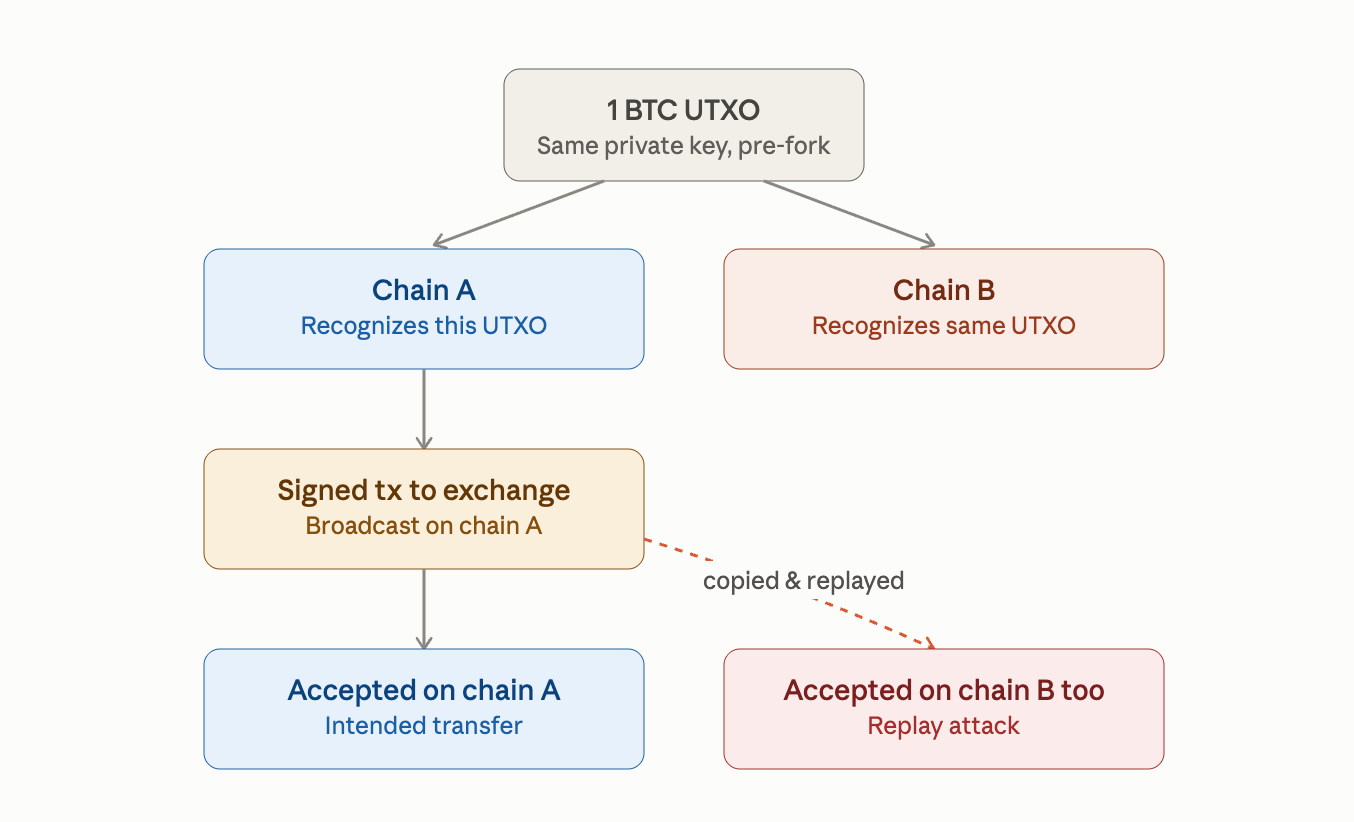 A visual diagram of how a replay attack works.
That is a replay. Nobody steals the private key or breaks Bitcoin’s cryptography. The problem is simpler: the user created one valid authorization, but two blockchains recognize it. And while the BIP-110 chain sits at block height 961636, people spending BTC are moving BIP-110 coins, or whatever they will be called going forward, at the same time, without even knowing.
“The overwhelming majority of these [BIP-110 minority chain] blocks are just replaying days-old transactions from the main chain,” Mempool.space developer Mononaut wrote on X. This replay protection or replay attack subject has caused a viral conversation on X over the last few days.
Replay Protection Builds a Wall Between the Chains
Replay protection prevents that crossover by making transactions on the competing networks distinguishable. One method changes the signature hash, commonly called sighash, so a transaction signed for one chain fails the consensus rules of the other.
Mandatory protection makes this distinction part of the fork itself. Opt-in protection leaves ordinary transactions potentially compatible with both chains and requires users to deliberately use a chain-specific mechanism when they want to separate their coins.
That distinction has become important for BIP-110. The emerging plan does not appear to provide automatic, comprehensive two-way replay protection. Instead, at least according to Discord discussions, Bitcoin Knots is implementing a new sighash option that can create a transaction valid on the RDTS chain but invalid under Bitcoin Core.
Dashjr Says Protection Is the Other Chain’s Problem
Dashjr has taken an unusual position on which network should bear responsibility. Asked Aug. 18 about replay protection for the proposed hard fork, he said, “Replay protection was Spamcoin’s responsibility since it’s the airdrop altcoin.”
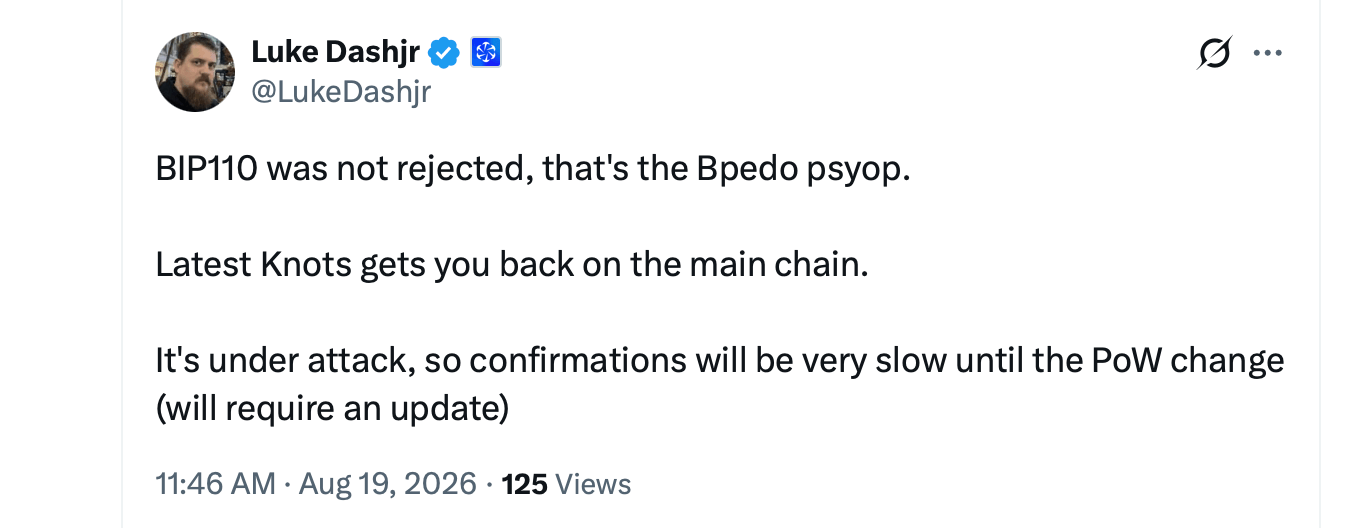 Image source: X
He added that there would be ways to separate transactions but argued that “legitimate Bitcoin transactions need to remain valid on Bitcoin.” His reasoning rests on his assertion that the BIP-110/RDTS minority network is Bitcoin, while the overwhelmingly dominant SHA-256d Bitcoin blockchain is the breakaway network.
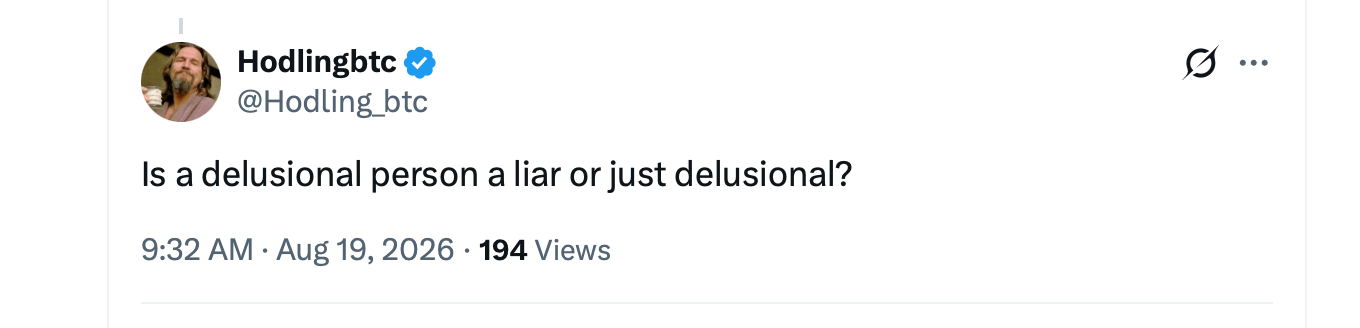 Image source: X
Dashjr has repeatedly used derogatory names for the dominant Bitcoin chain, including “Spamcoin” and “Bpedo,” a reference incorporating “pedo.” He has characterized that network as the altcoin while continuing to describe the BIP-110 branch as the legitimate Bitcoin.
The Network Numbers Tell a Very Different Story
That characterization collides with observable network activity. BIP-110 miner signaling peaked at roughly 2.53%, and when its consensus rules took effect Aug. 8, its minority branch produced only two immediate blocks before stalling. Bitcoin’s dominant chain continued operating while the gap widened by hundreds of blocks. A few other BIP-110 blocks have been mined at an extremely slow rate.
The majority network retained essentially all meaningful Bitcoin hashrate, the longest chain, weight of work, liquidity, and economic recognition. The BIP-110 proposal was subsequently marked closed, while supporters moved toward plans for a BLAKE2b proof-of-work (PoW) change intended to revive the minority network.
Moreover, the Bitcoin community is frustrated with Dashjr’s repeated claims and the intended opt-in styled replay protection being discussed is a bone of contention. “Lol. Luke isn’t gonna launch his sh**coin with replay protection, is he? I guess it won’t be listed on exchanges then,” one X user wrote on Wednesday.
“This has crossed the line from nonsense into bad-actor behavior. Spreading false information like this can cause real financial harm to Bitcoiners.”
Opt-In Protection Leaves Responsibility With Users
Under the approach now being discussed on the Bitcoin Knots Discord channel, ordinary transactions may remain replayable because RDTS intends to maintain compatibility with Bitcoin Core’s existing sighash types. Users wanting RDTS-specific protection would need to use the new sighash, requiring supporting wallet software or hardware-signing firmware.
 A conversation in the Bitcoin Knots Discord – screenshot.
Users can also attempt to split their coins manually. A Bitcoin transaction containing data that RDTS rejects could create an output existing only on the dominant chain. Conversely, the proposed RDTS-specific sighash could produce a transaction that RDTS accepts, but Bitcoin Core rejects.
The result looks far more like opt-in replay protection than the automatic firewall users expect from a contentious hard fork. That leaves wallets, exchanges, and holders responsible for knowing exactly which transactions can bleed across chains. The decision is strange, especially for a new chain and crypto asset with zero exchange support. Infrastructure providers, particularly crypto exchanges, are unlikely to touch a chain that chooses opt-in protection over a universal replay barrier.
If the BLAKE2b fork proceeds around Sept. 1, replay protection will therefore be more than an obscure technical detail. It will become a practical test of whether users can safely separate assets inherited from the same Bitcoin history, even as Dashjr continues making the far larger claim that the network carrying virtually all of Bitcoin’s hashrate, liquidity and economic activity is somehow the altcoin.