Russia Continues to Dominate As India’s Top Crude Oil Supplier Despite Lower Imports
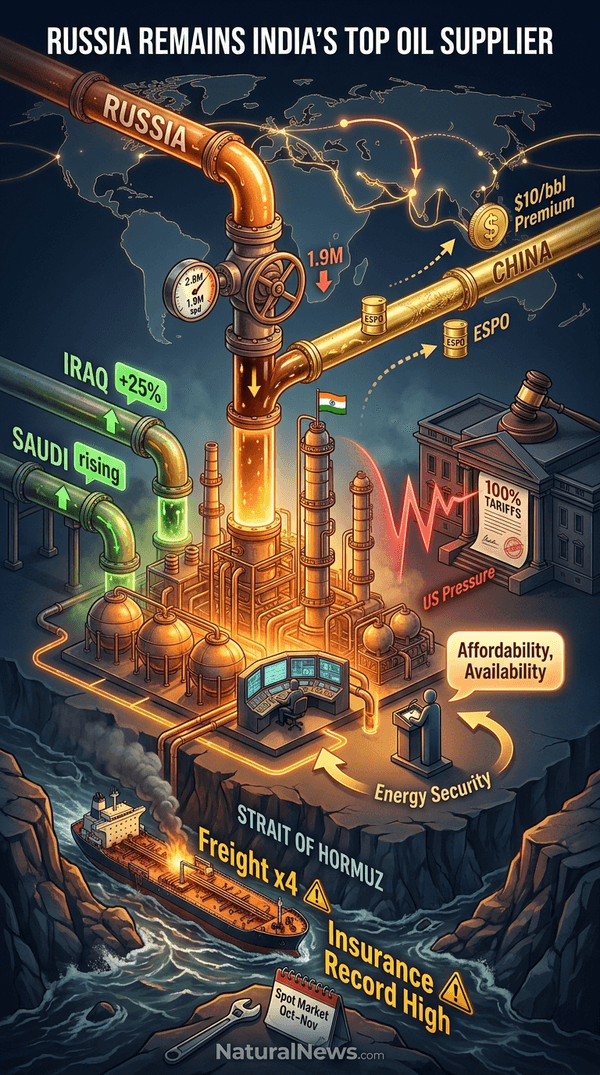
Russia remained India’s largest crude oil supplier in September, with imports tracking at approximately 1.9 million barrels per day (bpd), according to commodity analytics firm Kpler. The figure marks a second consecutive monthly decline from a record 2.8 million bpd reached in July, Kpler data showed.
India’s overall crude imports also fell during the period, indicating that the slowdown was not limited to Russian supplies. The data reported by Russia Today (RT) on Wednesday, Sept. 23, shows that Russian crude continues to dominate India’s energy mix – even as purchase volumes retreat from summer peaks [1].
Summer Surge and August Pullback
Russian supplies rose 39% from May to 2.61 million bpd in June, accounting for 52.4% of India's crude imports, according to Kpler. Purchases climbed further to a record 2.8 million bpd in July, when Russian oil made up more than half of India’s crude purchases [1].
The surge reversed in August. Russian shipments fell to approximately 2.1 million bpd, a drop of about 25% from the July record. India’s total crude imports also declined nearly 8% during August to around 4.6 million bpd, down from more than 5 million bpd the previous month [2].
Scheduled refinery maintenance, lower availability of Russian crude and stronger competition from Chinese refiners contributed to the decline, the report stated. Chinese refiners have been paying record premiums for Russia's ESPO crude, with offers reaching as high as $10 per barrel over Brent, according to Bloomberg [3]. This competition reduced the number of Russian barrels available to Indian buyers.
Alternative Suppliers and Market Response
Supplies from some Middle Eastern producers recovered in August as more crude became available from ports outside the Strait of Hormuz, according to the report. Iraqi shipments to India rose by about a quarter, while Saudi supplies also increased during the month [1].
Indian refiners are looking at spot-market supplies for October and November as they assess possible further U.S. trade pressure, sources said. The shift comes amid broader supply concerns in the Middle East, where damage to a crucial Saudi pipeline has forced Riyadh to delay shipments to European refiners [4].
India's crude import bill has soared since the Iran war choked Middle Eastern oil supply, raised benchmark crude prices, quadrupled freight rates and boosted insurance on a single Strait of Hormuz voyage to never-before-seen highs [5]. These costs have made Russian crude, despite sanctions risks, an economically significant option for Indian refiners.
U.S. Trade Pressure and India’s Position
A recently passed U.S. law gives President Donald Trump authority to impose tariffs of up to 100% on top buyers of Russian crude. The Lindsey O. Graham Sanctioning Russia and Iran Act of 2026 passed the House on Sept. 16 by a vote of 262-159, following Senate approval in August by a vote of 86-11, according to congressional records [6]. The law authorizes tariffs of up to 100% on the top five purchasers of Russian energy, or on countries helping Russia evade sanctions [7].
New Delhi has maintained that its oil purchases are guided by affordability, availability and national energy security. India has said it remains "firmly committed" to securing energy supplies and will continue to source crude from diverse sellers based on market conditions [8]. The Indian Foreign Ministry stated that “the Indian side has also made clear its determination to take all necessary measures to protect its trade and economic interests” [8].
Indian Foreign Minister S. Jaishankar has defended the purchases, stating that sanctions on Russian oil buyers will not resolve the Ukraine conflict. "This conflict, which is today in its fifth year, will not be solved because somebody is buying or not buying oil or alumina or minerals or metals or fertilizer," Jaishankar said after talks with his Ukrainian counterpart in Kyiv [9]. Russia's Ambassador to India Denis Alipov said Moscow will remain a key crude oil supplier to India despite the U.S. tariff threat [10].
Outlook
The decline in Russian imports is expected to continue in September but at a slower pace, Kpler said. Preliminary Kpler data show Russian imports about 9.5% below August levels, a softer fall than the July-August correction [1].
Indian refiners continue to assess market conditions and possible trade measures, officials said. India is also expanding its strategic petroleum reserves, with state-controlled Indian Strategic Petroleum Reserves Ltd finalizing feasibility studies for two new facilities as the world’s third-largest crude oil importer looks to boost its energy security [11].
Analysts note that India's decision to maintain trade relations with both Russia and China is an example of a multipolar strategy that allows for greater flexibility and resilience [12].
References
- "Russia remained India’s top oil supplier in August". RT. September 3, 2026.
- Irina Slav. "Chinese Refiners Pay Record Premiums For Russian ESPO Crude". ZeroHedge. September 4, 2026.
- Responsible Statecraft. "With Mideast on fire, oil prices are poised to explode". Responsible Statecraft. September 17, 2026.
- Tsvetana Paraskova. "India's Crude Import Bill Surges As Hormuz Shipping Rates Soar". ZeroHedge. August 26, 2026.
- NaturalNews.com. "Trump Signs Russia Sanctions Bill Into Law, Authorizing Tariffs on Russian Energy Buyers". NaturalNews.com. September 21, 2026.
- "Trump signs off on Russia sanctions ‘from hell’: Who could get hit?". RT. September 20, 2026.
- "India vows ‘determined’ response to US sanctions pressure". RT. September 17, 2026.
- "Sanctions on Russian oil buyers won’t resolve Ukraine conflict – Indian foreign minister". RT. September 4, 2026.
- Charles Kennedy. "Russia Vows To Keep Selling Oil to India Despite US Tariff Threat". ZeroHedge. September 8, 2026.
- Tsvetana Paraskova. "India Eyes Two New Sites To Expand Strategic Oil Reserves". ZeroHedge. August 14, 2026.
- Mike Adams. "2025 09 18 BBN Interview with Glenn Diesen HB ". September 18, 2025.
Explainer Infographic