By The Moscow Times | Created at 2026-09-16 16:15:17 | Updated at 2026-10-07 11:32:48
2 weeks ago
By The Moscow Times | Created at 2026-09-16 16:15:17 | Updated at 2026-10-07 11:32:48
2 weeks ago
In the hit 2007 Russian political satire “Election Day,” a group of radio executives is sent to a provincial region as it elects its new governor. Their task is to manufacture a candidate, win over voters and make sure the right person gets elected.
One song from the film’s soundtrack, sung by punk rocker Sergei Shnurov, would become a national catchphrase: “Elections! Elections! All the candidates are motherf***ers!”
But what was once political comedy now feels like a glimpse into a different era. Elections at that time may have been cynical and manipulated, but they still involved a semblance of genuine competition.
Nearly two decades later, as Russia prepares to elect a new State Duma for the first time since invading Ukraine, the question is how much of that competition remains.
Wartime elections
When Russians head to the polls on Sept. 18-20, they will elect 450 lawmakers in the lower-house State Duma as well as regional legislators and governors across the country’s 11 time zones.
Among the major political parties contesting seats in the Duma — Russia’s most important election this year — are the ruling, pro-Kremlin United Russia party, the Communist Party, the Liberal Democratic Party (LDPR), A Just Russia, New People and Yabloko.
Experts say these parties’ platforms are broadly similar and largely back the Kremlin’s policies. The only exception is Yabloko, which is campaigning on an anti-war platform but was barred from the State Duma’s party-list vote, the nationwide contest in which voters choose a party rather than an individual candidate.
United Russia, which currently holds 321 of 450 seats in the State Duma, is widely expected to win a majority of the vote. Even so, experts say that the elections remain an important gauge of public sentiment.
The election will also be held in the four partially occupied regions of Ukraine that Moscow claims to have annexed and where fighting continues.
Voting will be spread over three days, while 33 regions will offer electronic voting — two measures that critics say could make it easier to manipulate the results.
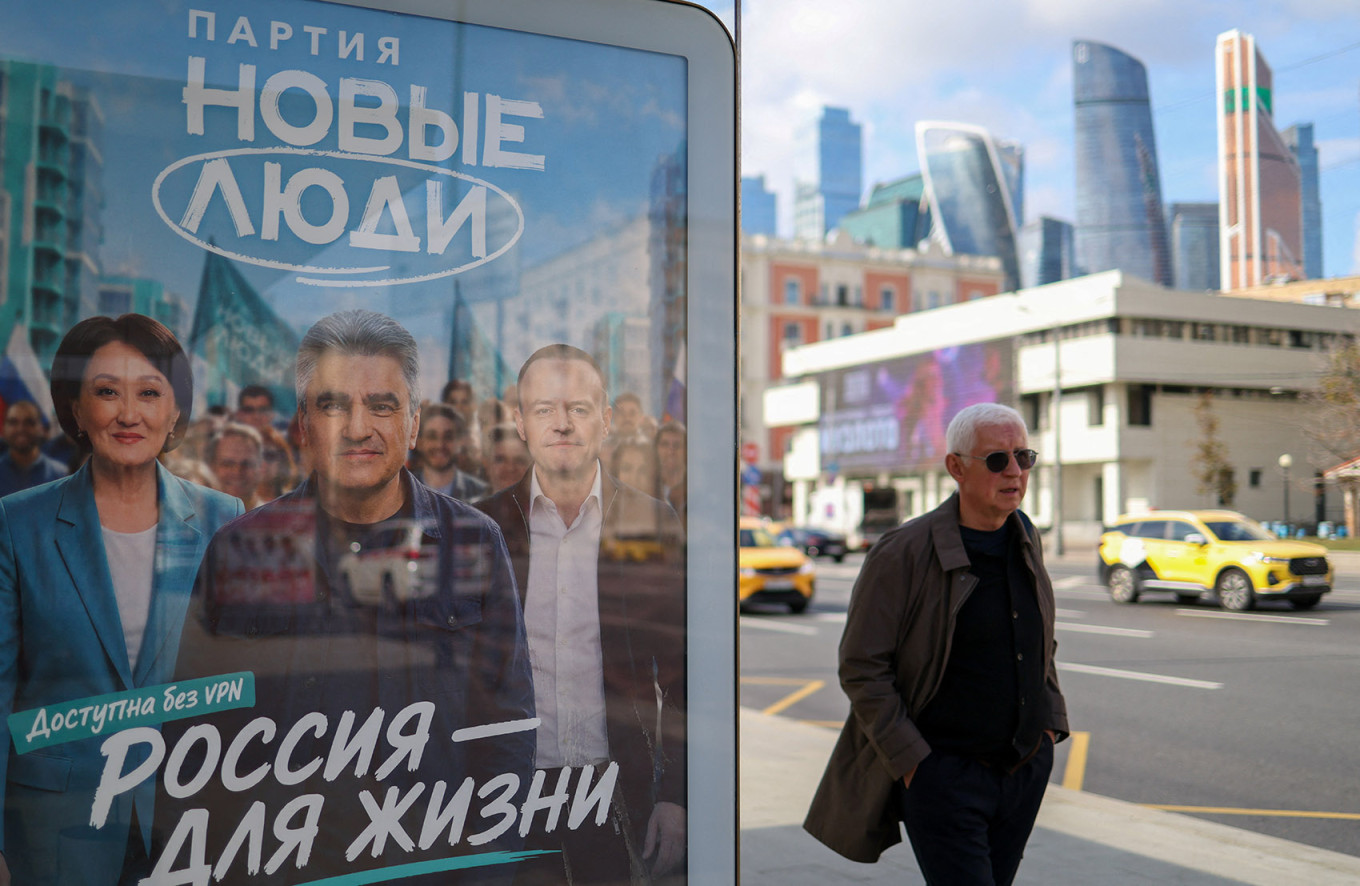 A man walks past a billboard promoting the New People party in Moscow.
REUTERS / Ramil Sitdikov
A man walks past a billboard promoting the New People party in Moscow.
REUTERS / Ramil Sitdikov
'Electoral authoritarian system'
Experts differ on how and when exactly Russia’s elections lost their competitiveness, but they agree that the invasion of Ukraine in 2022 marked a major turning point.
Political scientists now describe Russia as an electoral authoritarian system: an autocracy that continues to hold elections while tightly controlling the conditions under which they take place.
“You can't openly call for an end to the war and you can't openly challenge [President Vladimir] Putin's legitimacy,” said Ora John Reuter, a professor of political science at the University of Wisconsin-Milwaukee and expert on Russia’s electoral politics.
“Beyond that, the candidates and parties that are running have a little bit of freedom to debate other policy issues within those constraints,” he told The Moscow Times.
Exiled political commentator Ekaterina Schulmann said that by 2011, the authorities were already shaping the composition of successive Dumas by “the desired degree” and that they “did not differ significantly from one another.”
For the Kremlin, United Russia “must always have a constitutional majority,” while the other parties must know their place and “not interfere with the smooth and energetic legislative process — essentially the rubber-stamping of bills sent over from various branches of the executive government,” Schulmann explained.
It would be wrong to believe that “there were some remnants of freedom before, which have only now been completely stamped out,” she added.
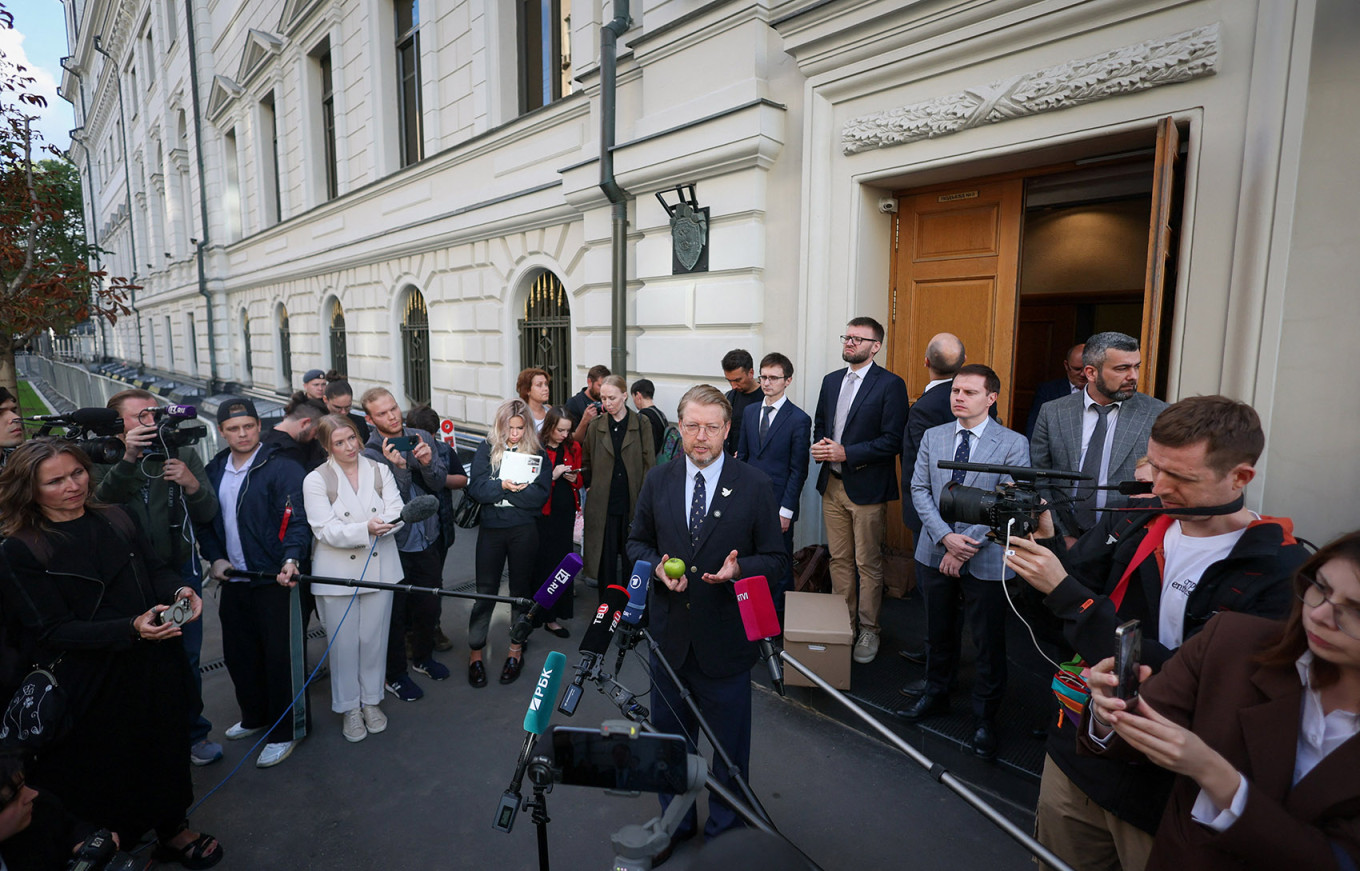 Yabloko party chairman Nikolai Rybakov speaks after an appeal hearing in the Supreme Court, which barred it from the single-member vote for the State Duma.
REUTERS / Ramil Sitdikov
Yabloko party chairman Nikolai Rybakov speaks after an appeal hearing in the Supreme Court, which barred it from the single-member vote for the State Duma.
REUTERS / Ramil Sitdikov
But the range of political alternatives available to voters has narrowed sharply, even by formal measures, experts say.
“Over the past 10 years, the number of legally registered political parties has dropped from 75 to 17,” said Vadim Ternovoy, an expert with the Election Atlas project.
For the first time since 2012, “only parties that are exempt from collecting voter signatures were able to nominate candidate lists for the State Duma elections,” he said. Under Russian law, parties must collect 200,000 voter signatures to appear on the ballot unless they are already represented in the State Duma or have won seats in at least one regional legislature.
The number of candidates in elections at all levels has fallen by around 20% since 2022, Ternovoy said. This figure refers to those who put themselves forward, rather than those who were ultimately registered — which suggests that even the willingness to participate in elections is declining.
Experts linked the decline in interest to the growing imbalance between the risks and benefits of being in politics. Repression has affected not only civil society activists and anti-war Yabloko candidates, but also members of the Communist Party and LDPR in some regions, Ternovoy said.
Even prominent United Russia members have complained of pressure from within their own party during primaries and some have faced criminal charges, he added.
“As a result, many people who might take part in elections with a realistic chance of doing well simply choose not to run. This leaves voters with fewer opportunities to hear different views and make their own voices heard,” he said.
Transition
The erosion of Russia’s political and electoral system began in the mid-2000s as the Kremlin tightened its grip on the media and moved against oligarchs who had amassed political influence. But at times, this decline slowed, and some reforms briefly opened space for political competition.
Direct gubernatorial elections were abolished between 2004 and 2012, though this restriction remains in some regions. Direct mayoral elections have also been scrapped in regional capitals and major cities, while regulations governing political parties have been tightened.
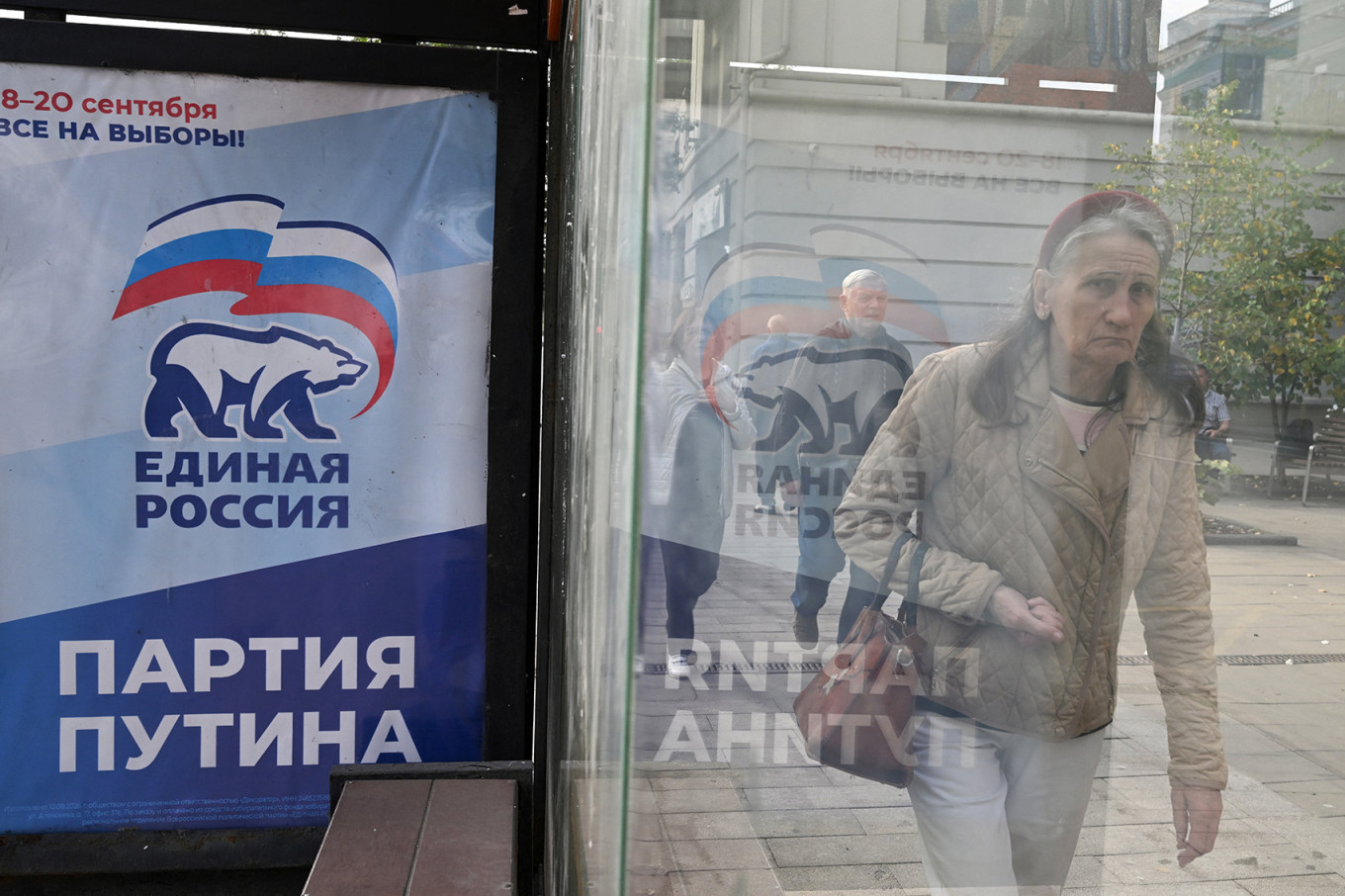 A woman walks past a campaign poster for the United Russia party in Krasnoyarsk.
REUTERS / Vladislav Nekrasov
A woman walks past a campaign poster for the United Russia party in Krasnoyarsk.
REUTERS / Vladislav Nekrasov
More recent measures include rules barring “foreign agents” from running for office and greater restrictions on independent election observers.
The independent election watchdog Golos, which had documented election violations since 2000, was forced to close last year after its co-chair was jailed in what supporters called an attempt to silence the group.
These restrictions were “in fact a response to growing public demand for greater political participation and accountability from the authorities,” Ternovoy said, pointing to late Kremlin critic Alexei Navalny’s attempt to mount a presidential campaign in 2018, as well as mass protests over the exclusion of opposition candidates from the 2019 Moscow City Duma elections.
Is there any competition left?
The fate of Yabloko, the only registered party campaigning on a pro-peace platform, is perhaps most illustrative of the 2026 campaign’s limitations.
In its decision to bar Yabloko from the party-list vote to the State Duma, a court cited alleged violations involving foreign funding, campaign materials distributed through restricted foreign platforms and copyright rules. The party denies wrongdoing.
Yabloko still has registered candidates running in single-member districts, a defined geographic area that elects one lawmaker to the State Duma, as well as in regional legislative elections.
In total, at least 36 opposition candidates were barred from the State Duma and regional legislative elections, according to the exiled outlet Vyorstka. More than half of those cases involved Yabloko candidates, Vyorstka said.
Seventeen of these candidates were disqualified over online posts mentioning Navalny, who is on Russia’s federal list of “extremists and terrorists.” Seven others were barred for sharing links to Facebook and Instagram, which are banned in Russia, or for displaying the platforms’ logos.
Nikolai Bondarenko, a prominent Saratov politician running for the State Duma with the Communist Party, was disqualified after being fined 1,000 rubles ($12) over a photo of Navalny posted in 2024 on a Telegram channel bearing his name. Bondarenko denied having a connection to the channel.
Boris Nadezhdin, whose anti-war presidential campaign in 2024 drew long lines of supporters before the authorities disqualified him, is another would-be candidate this year.
He was barred from running for the State Duma as an independent after being fined for displaying alleged “extremist” symbols in a photo of Navalny, briefly detained and designated a “foreign agent.” He left Russia in August.
Amid these restrictions, the public’s interest — and even interest from candidates themselves — appears limited.
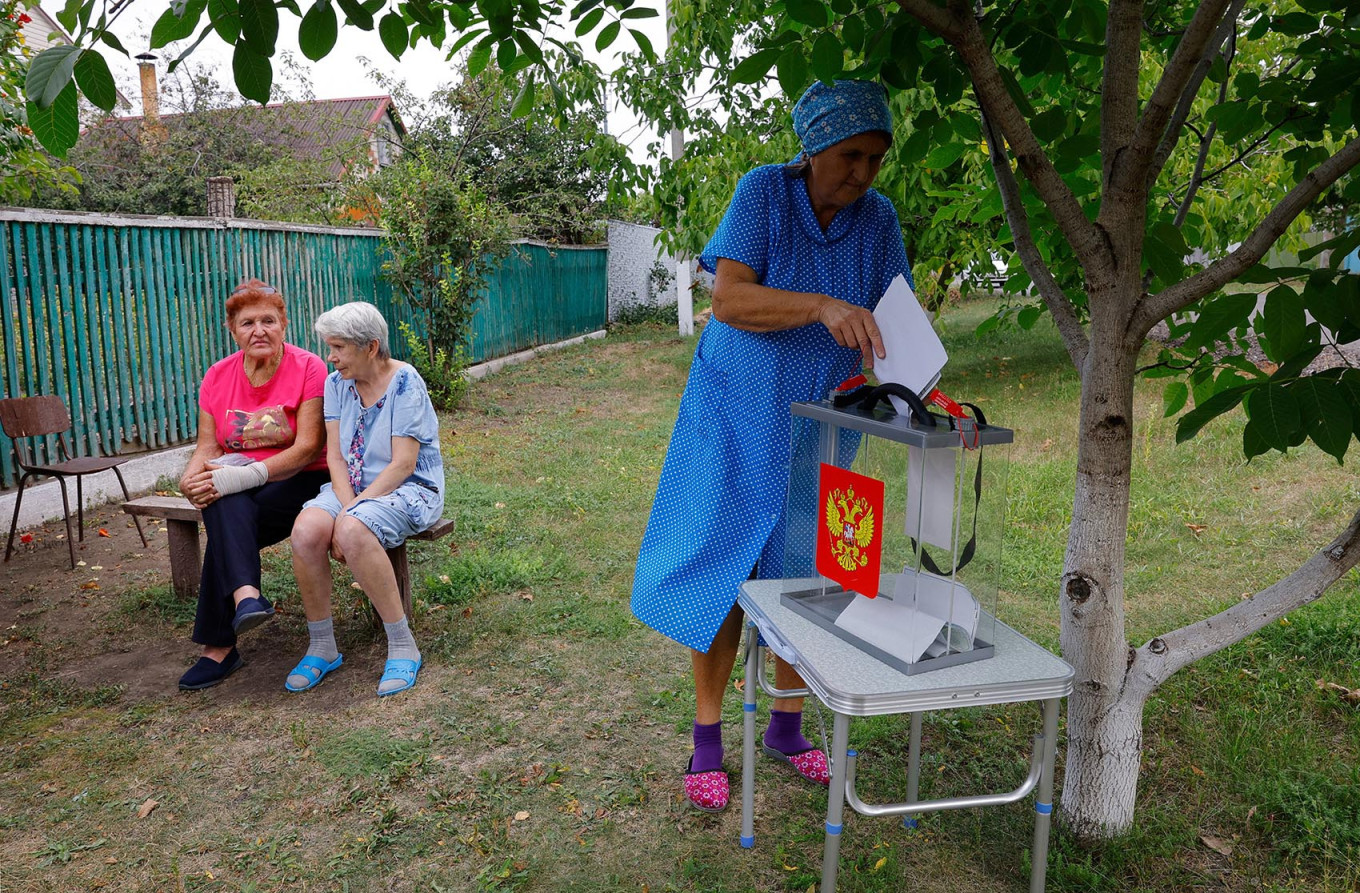 Early voting in Russia's parliamentary election in the occupied Donetsk region of Ukraine.
REUTERS / Alexander Ermochenko
Early voting in Russia's parliamentary election in the occupied Donetsk region of Ukraine.
REUTERS / Alexander Ermochenko
While televised debates are formally part of the election campaign, Putin has never participated in one and many United Russia candidates have followed suit.
In Ryazan, the state broadcaster Rossia 1 spent two consecutive days unsuccessfully trying to assemble State Duma candidates in its studio. Both times, the presenter ended the program shortly after the introduction because no one had shown up.
Sixty-six percent of Russians do not know when the State Duma elections would be held, while 28% said they do not plan to vote, according to a survey published in June by the independent pollster Levada Center.
Among those who do not plan to vote, 41% said their vote would make no difference, while 24% do not believe the elections will be fair.
Yet Ternovoy said the initial registration of anti-war party Yabloko — even without any particularly recognizable party leaders — nonetheless triggered “a largely spontaneous mobilization of part of the anti-war electorate.”
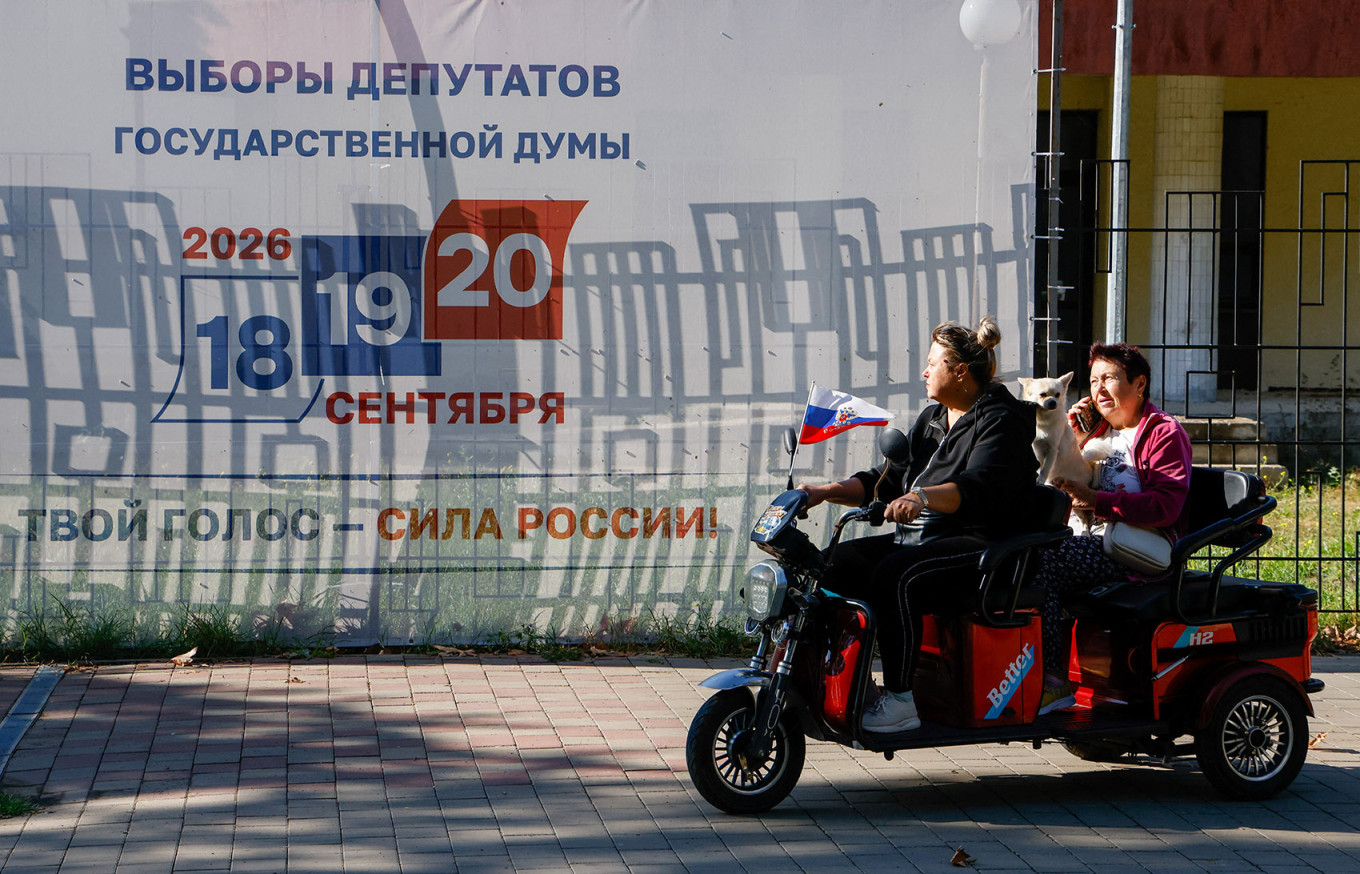 Women with a dog ride an electric motorcycle past a banner promoting Russia's parliamentary elections in Saki, annexed Crimea.
REUTERS / Alexey Pavlishak
Women with a dog ride an electric motorcycle past a banner promoting Russia's parliamentary elections in Saki, annexed Crimea.
REUTERS / Alexey Pavlishak
And when Yabloko was barred from the party-list vote in the Duma, Election Atlas documented an 80-fold surge in interest in the party across social media.
Ternovoy compared this to Nadezhdin’s brief 2024 presidential campaign, which coincided with a decline in support for the war in opinion polls.
“Had Yabloko remained on the ballot [for the State Duma party list], it would, under the law, have been entitled to free airtime on the country’s largest television and radio stations starting in late August ... which could have had a significant impact on public opinion,” he added.
He pointed to Election Atlas’ monitoring of social media, which last month showed that people were more concerned with the growing restrictions on political competition than with what officials including Putin were up to.
“To me, this looks like an important shift in public opinion and, quite possibly, the main outcome” of these elections, he said.
A Message from The Moscow Times:
Dear readers,
We are facing unprecedented challenges. Russia's Prosecutor General's Office has designated The Moscow Times as an "undesirable" organization, criminalizing our work and putting our staff at risk of prosecution. This follows our earlier unjust labeling as a "foreign agent."
These actions are direct attempts to silence independent journalism in Russia. The authorities claim our work "discredits the decisions of the Russian leadership." We see things differently: we strive to provide accurate, unbiased reporting on Russia.
We, the journalists of The Moscow Times, refuse to be silenced. But to continue our work, we need your help.
Your support, no matter how small, makes a world of difference. If you can, please support us monthly starting from just $2. It's quick to set up, and every contribution makes a significant impact.
By supporting The Moscow Times, you're defending open, independent journalism in the face of repression. Thank you for standing with us.
Continue

Not ready to support today?
Remind me later.