By The Straits Times | Created at 2026-08-11 13:02:01 | Updated at 2026-08-11 13:17:44
27 minutes ago
By The Straits Times | Created at 2026-08-11 13:02:01 | Updated at 2026-08-11 13:17:44
27 minutes ago
SINGAPORE - As China’s north-eastern rust belt seeks to transform its economic fortunes after years in the doldrums, Singapore is positioning itself to ride the next wave of opportunity that could come with that.
Six new deals spanning healthcare, research, and technology were signed by Singapore entities in Liaoning province during a trade meeting on Aug 11, which was attended by close to 60 officials and business representatives from both sides.
At the meeting, political leaders from Singapore and Liaoning touted the business prospects arising from a push to revitalise a slowing, greying region that was once at the heart of China’s planned economy.
Liaoning, which has long relied on traditional heavy industries such as steel and petrochemicals, is known as the birthplace of China’s first ocean-going freighter and aircraft.
But in recent years, the coastal province has been plagued by severe brain drain and economic stagnation, driven largely by an aggressive national pivot towards high technology and modernisation.
Home to more than 40 million people, with its largest cities being the capital, Shenyang, and the port hub, Dalian, it has since 2023 sought to reshape its industrial system by focusing on green technology and digital transformation.
Minister for Social and Family Development Masagos Zulkifli, who was in Shenyang to co-chair the 11th meeting of the Singapore-Liaoning Economic and Trade Council, said Singapore has supported Liaoning’s economic development over the past two decades.
“We remain committed to deepening our cooperation with Liaoning as it embarks on the next phase of growth. Through the (council), we look forward to facilitating new partnerships and unlocking opportunities for our businesses, research institutions and communities,” he added.
The trade council, which was established in 2003, had last met in 2019.
Liaoning governor Wang Xinwei, who co-chaired the Aug 11 meeting with Masagos, said the cooperation mechanism has led to fruitful results.
Bilateral trade between Liaoning and Singapore hit 11.84 billion yuan (S$2.25 billion) in 2025, up 28.6 per cent from 2024.
Trade volume between the two markets continued to increase in the first half of 2026, growing by 45.5 per cent year-on-year, said Wang.
The governor, who took office in 2025, also noted that Singapore is Liaoning’s sixth largest source of foreign investment, with 1,126 Singapore enterprises invested in the province as at June 2026.
He said: “We welcome friends from all sectors in Singapore to join us in carving out new growth avenues, fostering new momentum, and writing a new chapter of win-win industrial cooperation.”
Among the deals signed on Aug 11 is a 35 million yuan investment by Aoxin Q&M Dental Group to establish a new 2,430 sqm dental hospital in Shenyang’s central Shenhe district.
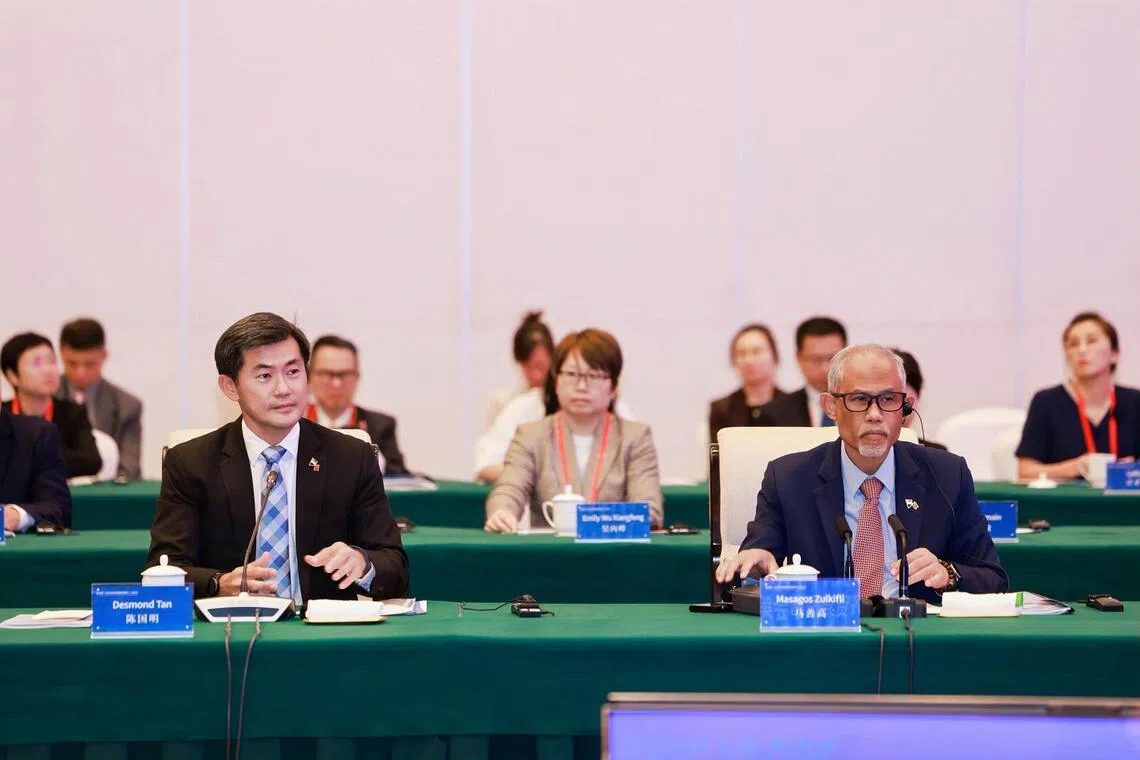
Senior Minister of State in the Prime Minister’s Office Desmond Tan (left) and Minister for Social and Family Development Masagos Zulkifli at the 11th Singapore-Liaoning Economic and Trade Council meeting in Shenyang on Aug 11.
PHOTO: ENTERPRISE SINGAPORE
The Singapore-listed company, which has been operating in Liaoning since 2013, believes there is still room to further cultivate the market there.
“Because of rising incomes, an ageing population and increasing public awareness of oral health, demand for specialist dental services has continued to grow. Liaoning’s policies also support the parallel development of private medical institutions alongside the public system,” said the group’s non-executive chairman, Chua Ser Miang, in a statement to the media.
Other agreements inked at the Aug 11 meeting include deals to build infrastructure for data centres and establish a new research and development centre for carbon fibre in Shenyang.
More partnerships are in the works, with ComfortDelGro prepared to work with Liaoning’s authorities on a phased rollout of robotaxis, Masagos said.
The homegrown transport giant, which operates Shenyang’s largest taxi fleet of more than 1,500 vehicles, will draw on its experience with autonomous vehicles in other parts of China, he added.
Meanwhile, port operator PSA is working with the Liaoning Port Group to optimise operations at its container terminal in Dalian, deploying technologies such as unmanned electric trucks and AI-enabled systems.
The relationship between Singapore and Liaoning is also increasingly becoming a two-way street, with Desmond Tan, Senior Minister of State in the Prime Minister’s Office, positioning Singapore as a “trusted gateway” for Liaoning businesses to accelerate their international expansion.
One example cited was Liaoning robotics manufacturer Siasun, which set up its regional operating and sales hub in Singapore to serve global clients such as American conglomerate 3M, e-commerce platform Lazada and medical technology firm Becton Dickinson.
Tan said: “A new chapter is beginning in the cooperation between Singapore and Liaoning province. Singapore can become a reliable partner for Liaoning enterprises to expand into South-east Asia and go global.”