By Literary Hub | Created at 2026-06-25 09:12:10 | Updated at 2026-06-25 21:43:14
12 hours ago
By Literary Hub | Created at 2026-06-25 09:12:10 | Updated at 2026-06-25 21:43:14
12 hours ago
To examine the increasing similarities between television storytelling and literary fiction—particularly their shared emphasis on complex characters and challenging themes—I recently spoke with Rasheed Newson, television writer (Narcos, The Chi), showrunner (Bel-Air), and novelist (There’s Only One Sin in Hollywood and My Government Means to Kill Me). Here is an excerpt from our talk.
Article continues after advertisement
*
Spiro Skentzos: Rasheed, do you see writing for the screen and writing a novel as closely related or fundamentally separate?
Rasheed Newson: They’re fundamentally separate for what I have to do. The feeling of where the story is going and the reaction you want to elicit from the audience doesn’t change: excitement is excitement, suspense is suspense, humor is humor. But how you as the writer are going to deliver on your intent changes pretty fundamentally. I think people have trouble when they jump from one medium to the other without taking into consideration the real differences between them. Novels feed on interiority and screen writing relies on external visual cues.
SS: What does that level of interiority in a first-person novel allow you to do with a character that television just cannot?
RN: When we think about the characters we love from television, we’re actually thinking about the experience of getting to know them across dozens of episodes and several seasons. If you go back and you watch the first handful of episodes in a series, you probably don’t have that much information about the leads. With a book, reader want to know this person and expect something interior, and so you have the room to explore it more in a novel than in television.
Constraint is where the art lies, right?
The other great thing about first person is I’m not responsible for getting in everybody else’s head. In television, you have your protagonist. There’s always a question of, should we have a privileged scene with their enemies? How much of everybody else’s point of view is also valid to the story? When you’re in first person, you don’t have a responsibility to service everybody else on the board, which is also something that eats up time in television.
Another element I think is very fun about writing books is your ability, for the most part, to focus everybody’s attention on what you want them to know about a scene. If you want to describe the room and the color of the walls, you’re free to do that, but you don’t have to. Whereas in television, everything’s at play all at once, and it sometimes gets to be a distraction.
SS: What types of tools do you use to show character interiority?
RN: In television, you’re typically looking for something visual that lets the audience know the character is uneasy, or that they’re lying. Again, that camera’s doing a lot of work for you, because it’s telling the audience, this is what this person is focusing on, this is what they want, this is what they desire. In television, we have to establish very quickly that this person can be violent at a moment’s notice, or is vain beyond comprehension. In a book, you can spend three or four pages getting ready in the morning, and talking about the worries of your day.
SS: That brings us to the ‘pet the dog moment’—that moment the character pets that dog as they’re walking out the door in TV series, and we know that’s a nice person.
RN: It works. People gave Tony Soprano so much credit in the first season because he cared about those ducks who landed in his pool. He’s a murderer. But he was really heartbroken when those ducks stopped coming to the pool.
SS: How do you view and deal with the constraints in television?
RN: Constraint is where the art lies, right? People watching television don’t necessarily know this, but there are so many episodes that are purely dictated by how many days on set we can do versus how many days out on location can we do. Even contract limits with actors prevent us from using a recurring character in this episode because we don’t have them for the full season. No one’s going to necessarily cry for television writers, but I do sometimes, [laughs] when I see audiences upset about an episode, and they say, “That wasn’t very good.” I always want to reply, “Imagine how we feel. You spent about an hour watching it. I had to get up at 5:30 in the morning and drive out to Santa Clarita for a week to shoot this thing.” If we had unlimited budgets and unlimited time, we would tell these stories differently, but it really does turn out that this is sort of like a game of Jenga.
SS: And do you think that the constraint changes the kind of character that can exist, or just how the character is revealed?
RN: Oh, yeah. Television rewards flashy, big personalities. In a book, you could be a very quiet person. But if you’re observing interesting things, that’s fine. In the television version of the Great Gatsby, we follow Gatsby throwing these parties and, Nick, the narrator, just lives across the street. He’s not terribly flamboyant. But he works in that book. In television, Nick would be 4th on the call sheet.
SS: In TV, the dialogue has to do multiple jobs at once. Character, plot, pacing. How does that pressure shape the way you write dialogue in TV versus in a novel?
RN: One of the things I enjoy about writing dialogue in a novel is that dialogue in a novel can be used to establish a bond between two characters. They can feel each other out, and talk about how they each see the world. It’s not necessarily moving the plot along. Maybe what we’re revealing to each other isn’t going to come in play for another 100 pages? It doesn’t have to sing at the same volume of TV to earn your attention. And as long as it holds its authenticity, it doesn’t need to be rushed. Television, very rarely can we have that sort of pace.
SS: In fiction, you have interior access. How does that differ from film/TV?
RN: I feel like you really have to check your math more in a novel because the reader can just flip back to page 47 and say, “Wait a minute, the character just contradicted himself.” Television we’re sometimes discovering stories and motivations as we go. So, strictly speaking somebody can do something that’s a little more inexplicable, or we haven’t necessarily laid the foundation for in television, but everybody goes along with it.
You forgive a lot on television, whereas I think in a book you, your reader will want a stricter scrutiny. It also goes into the way these things are consumed. People will sit down and sometimes read a book over a day or a weekend start to finish. And everything is fresher in their mind. Being told a story over years in television, there’s a lot we can forget.
The stories I’m writing in these books are stories that I think are primarily served by being exactly that, books.
There was a writer on an Aaron Spelling show that I worked with years later. And he told a story where four or five episodes into the season, they recast this actor of a pretty significant character. And they’re like, “What are we going to do?” And he came up with this brilliant idea. The show always began with a “previously on.” So, they shot a “previously on” with the new actor interacting with his wife and his family doing things that have been done in previous scenes. So you saw him in the previously scenes, and then he just was there playing that character. And the show barely heard a peep.
SS: In a third-person novel interiority is available, but it’s still framed externally. Do you think it’s closer to TV in its execution than it is to first-person novel?
RN: I’m working on a third-person novel now. In part because I want to keep the audience out of my main protagonist’s head, and I need to be able to hop into the head of a serial killer. I need to be able to change POVs. It feels more like television, but even then I’ve got a lot more control over of focus, and who we’re giving attention to as we tell the story. I’ve been on these ensemble shows, (Army Wives, Bel-Air) where we have breakfast scenes, and it was always tough to write big group scenes, because all the actors went through hair and makeup and you can’t just give an actor one line. You’d hear: “You brought me in, and all I say is, ‘Pass the orange juice?’” I have to figure out how to service everybody’s dynamics at breakfast. But in a third-person novel, you don’t have that. Like, he goes to the bar with his friends, they’re there, but I don’t have to go around the horn and make sure everybody has something to say.
SS: How has writing for television changed the way you approach your character in novels, particularly in terms of scene construction or restraint?
RN: I tend to write chapters episodically, even as I tell the larger story, have a beginning, middle, and end. I hope that television has given me a story sense so that when people are reading it, not only do they feel the rise and fall of action across the book, but they feel it chapter by chapter. Also, television gives me the idea of set pieces. I don’t necessarily want to play all these chapters in the same living room. There are certainly books where you never leave the house. But generally, I get excited if I realize, “Oh, we’re going to do a gala at the Beverly Hilton.”
SS: Do you think there are techniques that work well in fiction, especially first person that resist translation to the screen?
RN: Television wants us, because of the time constraint, to get as close to the action as possible. We’re not going to necessarily start the story with someone getting fired, and then going to the bar, and then talking about needing money, and then deciding they’re going to team up with this person and rob a bank. We’re probably going to start in the car before they go in and rob the bank. And maybe, in flashback, we’ll show those other story beats, or it may never be compelling enough to get on screen. Unlike television, in books, you’re allowed the grace of a longer warm-up.
SS: Do you think writing across media has made you more cautious or more ambitious with character?
RN: The stories I’m writing in these books are stories that I think are primarily served by being exactly that, books. In television and film, I have to think about the fact that I will be collaborating and that I will have to give up some of this control that I enjoy so much. Television’s a collaborative art. You have to play with everyone else in the classroom.
Now as much as I love control in my novels, in television, I love that I don’t have to think of everything. If there’s a line that isn’t the best, I know this actor will sell it. If a scene is exposition heavy, the wardrobe department can dress the actors extra fancy and the audience is going to be looking at the clothes. You can be saved by your peers in television.
__________________________________
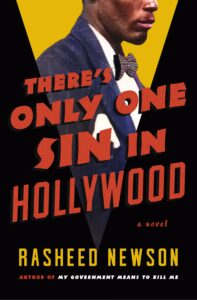
There’s Only One Sin in Hollywood by Rasheed Newson is available from Flatiron Books.