By Bitcoin News | Created at 2026-08-16 14:58:10 | Updated at 2026-08-16 15:08:28
52 minutes ago
By Bitcoin News | Created at 2026-08-16 14:58:10 | Updated at 2026-08-16 15:08:28
52 minutes ago
Michael Saylor said Strategy’s STRC preferred stock gained 9% over one year while bitcoin lost 47%. The chart leaves out the company’s common stock, which closed roughly 76% below its level a year earlier.
Key Takeaways
- STRC outperformed bitcoin by 56 percentage points over one year.
- Strategy’s other preferred securities recorded losses of 8% to 27%.
- Strategy’s common stock closed about 76% below its year-earlier level.
STRC Outperforms as Bitcoin Declines
STRC outpaced bitcoin by 56 percentage points over the past year, according to a one-year return chart Strategy Inc. (Nasdaq: MSTR) Executive Chairman Michael Saylor shared Aug. 16 on X. The chart measured returns through the Aug. 14 market close and highlighted the performance gap between bitcoin and Strategy’s income-producing securities during the downturn.
Saylor wrote:
“Over the past year, $BTC fell 47%. Our Digital Credit instruments ranged from -27% to +9%, with $STRC up 9%.”
The accompanying chart showed STRD declining 8%, STRF losing 9% and STRK falling 27%, with bitcoin trading near $63,000 on Aug. 16. Strategy stated that the one-year calculations covered Aug. 14, 2025, through Aug. 14 and included cash dividends and distributions, making the figures broader than share-price changes alone.
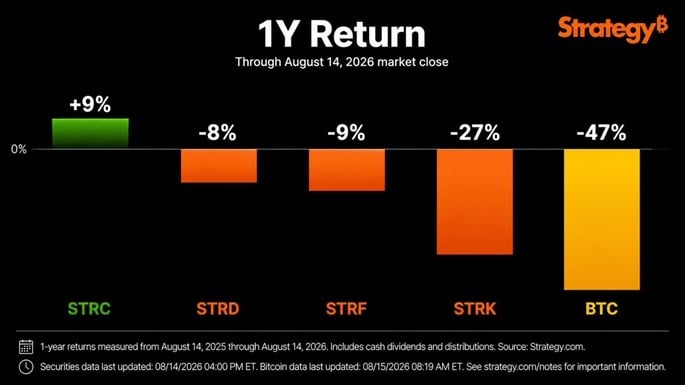 One-year returns for Strategy’s preferred securities and bitcoin. Source: Michael Saylor/Strategy Inc. via X
Stretch, trading under the STRC ticker, is a perpetual preferred stock with a variable annualized dividend rate designed to encourage trading near its $100 stated value. Strategy’s official STRC information page lists a 12% annualized rate for August, with cash dividends payable semi-monthly, subject to board declaration.
STRD is Strategy’s perpetual preferred stock with a stated fixed 10% annual dividend payable quarterly. STRF is the company’s senior-most perpetual preferred stock, offering a stated fixed 10% annual cash dividend payable quarterly. STRK is its convertible perpetual preferred stock with a stated 8% annual dividend payable quarterly. The dividends are not guaranteed.
Dividends Reshape the Return Comparison
STRC’s 9% one-year gain differs from its current 12% annualized dividend rate, which applied to only part of the measured period. The preferred stock launched in July 2025 at a 9% rate and climbed through seven consecutive monthly increases before reaching 12% for record dates on or after July 1. Its market price may rise or fall, while dividends were included in the reported one-year return.
Strategy described digital credit as a central funding channel in its second-quarter financial results. The company reported that STRC issuances raised $7.53 billion year to date in 2026 as of July 26, a 254% increase, while cumulative dividends paid across all preferred stock reached $1.06 billion.
The company’s Digital Credit Capital Framework established a cash reserve policy, revised STRC’s dividend policy, and authorized up to $1 billion in preferred-security repurchases alongside a separate $1 billion common stock repurchase program. Strategy also authorized bitcoin sales for specified purposes, including funding reserves, dividends, interest payments, and approved buybacks.
Saylor has presented STRC as the income-producing layer of a four-part digital money stack. His model assigns bitcoin the capital role while using preferred securities to create income instruments with different volatility and risk characteristics.
Lower Volatility Does Not Eliminate Risk
Despite its positive one-year return, STRC fell to an all-time low of $71.25 on June 26 and has traded below its $100 stated value since. Strategy maintained its 12% dividend rate for August after the preferred stock closed July at $89.46, reflecting the company’s effort to support its market price.
Digital credit repurchases began in late July, when the firm bought 288,930 STRC shares for about $25 million, an average of $86.53 per share and a 13.47% discount to the $100 stated amount. Strategy has sold approximately $218.4 million of bitcoin year to date to fund a portion of its preferred dividends.
The dividend structure depends partly on Strategy’s ability to meet continuing cash obligations while maintaining its bitcoin-focused balance sheet. The preferred stock is not collateralized by the company’s bitcoin holdings. Saylor previously said bitcoin would need to achieve annual appreciation above the company’s BTC breakeven rate for capital gains to cover STRC dividends over time.
Bitcoin as an asset class historically carries substantially greater volatility than traditional stocks, bonds, and commodities, which is the gap Strategy’s preferred structures are built to narrow.
Where Strategy’s Common Stock Stands
The one-year chart covered Strategy’s four preferred securities alongside bitcoin, while MSTR, the company’s class A common stock, sits below all of them in the capital structure. MSTR closed at $93.04 on Aug. 14, roughly 75.52% below its level a year earlier.
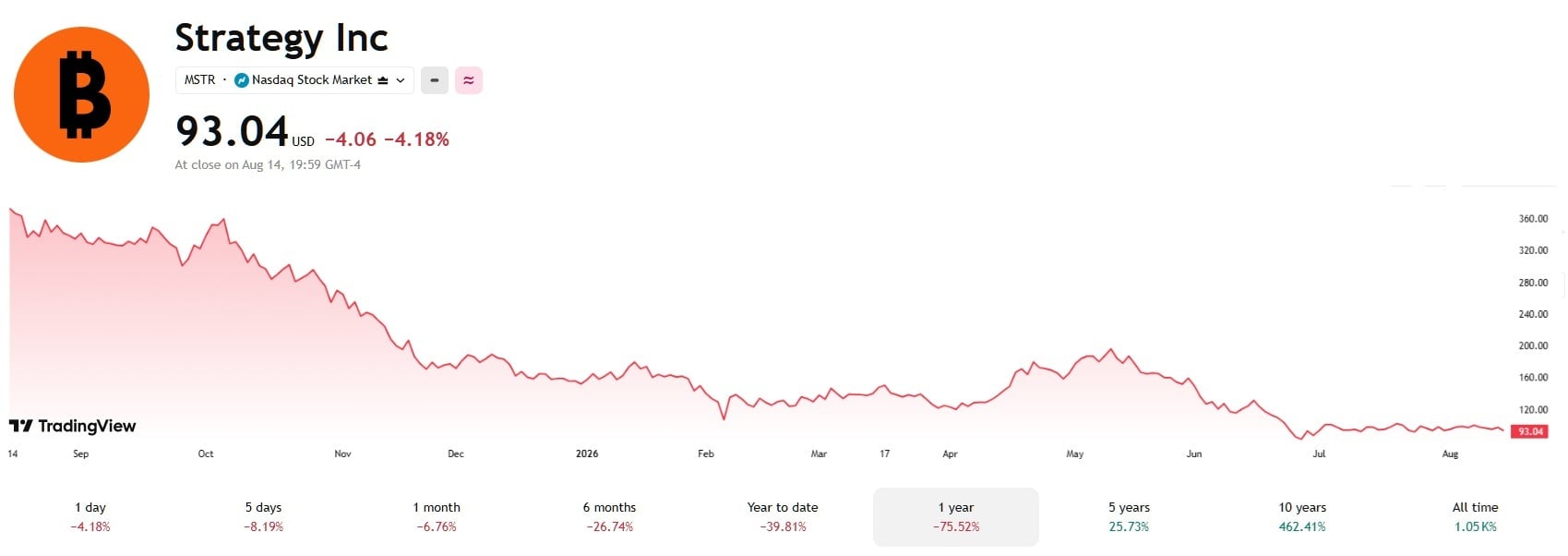 Strategy Inc.’s MSTR price chart. Source: TradingView
Common shareholders hold the residual claim after preferred dividends, which reached $400.7 million in the second quarter alone. Strategy posted a second-quarter net loss of $8.22 billion, or $24.45 per diluted common share, on an $8.32 billion unrealized loss on its digital assets. The $1 billion MSTR repurchase program remains fully available, with the company saying it will consider buybacks when management believes the stock trades below intrinsic value.