By Science Daily (Science) | Created at 2026-08-04 04:14:50 | Updated at 2026-08-04 12:00:43
10 hours ago
By Science Daily (Science) | Created at 2026-08-04 04:14:50 | Updated at 2026-08-04 12:00:43
10 hours ago
Taiwan, once widely known as Formosa, conceals a remarkable natural world within its steep and rugged interior. It is one of the few places on Earth capable of supporting truly giant trees, including specimens that rise more than 80 meters above the forest floor.
Since 2014, our group, the 'Taiwan tree seekers,' has worked to find, measure, and document these extraordinary trees. The team brings together professional tree climbers, ecologists, geologists, and remote sensing specialists.
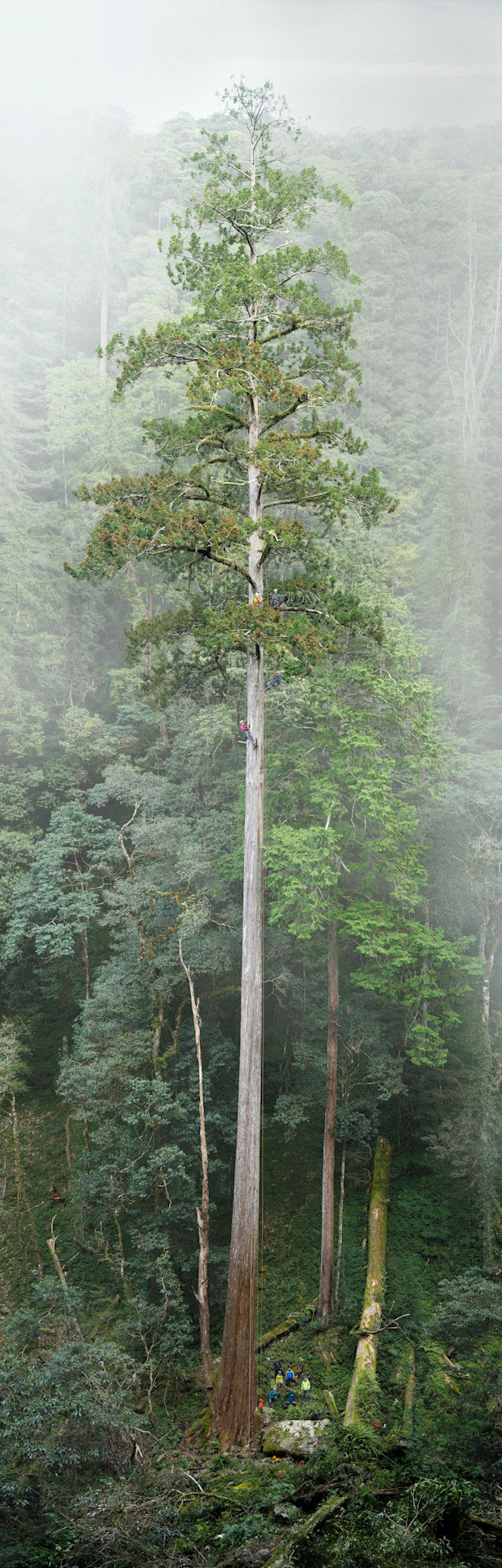
That long search reached a major milestone in 2023, when we identified an 84.1-meter-tall (276-foot-tall) Taiwania fir (Taiwania cryptomerioides). It is now recognized as the tallest tree in Taiwan and all of East Asia. The Indigenous Rukai people have a poetic name for these immense firs: 'The tree that hits the moon'.
Taiwan's Mountainous Landscape
Taiwan's geography helps explain why trees of this size can grow there. The island covers roughly 36,000 square kilometers, making it similar in area to Switzerland. Much of the landscape is mountainous, with 258 peaks rising above 3,000 meters. The highest, Mt. Jade, reaches 3,952 meters.
This wide range in elevation supports an exceptional variety of plant life. An estimated 5,000 plant species grow across Taiwan, occupying environments that extend from humid tropical rainforests near sea level to cold alpine tundra at the highest elevations.
About 60% of Taiwan is still covered by forest, with an estimated 950 million trees growing across the island. Industrial logging from 1912 to 1991 removed much of the original primary forest. However, the steepest and most inaccessible terrain acted as a natural barrier, protecting important areas of old-growth forest that logging crews could not easily reach.
The First Expeditions
Our organized search began in August 2014, when researchers from the Taiwan Forestry Research Institute (TFRI) entered the Cilan conservation area for a major expedition. The goal was to investigate a famous group of giant Taiwania firs known as the 'Chilan Three Sisters'.
Local communities had known about the three trees for many years, but the giants had never been carefully measured or scientifically documented. Our survey showed that the tallest stood 69.3 meters high and had a trunk nearly three meters wide.
The trees drew international attention in 2017, when professional climbers from 'The Tree Projects' in Australia came to Taiwan to photograph the Three Sisters in full. Their work helped introduce the remarkable scale of Taiwan's forests to a wider global audience.
A Difficult Search Near Great Ghost Lake
Encouraged by the discovery, we turned our attention to a more isolated area near Mt. Benya. Reports suggested that the region might contain Taiwan's largest concentration of Taiwania firs. It lies close to Great Ghost Lake, a place considered sacred by Indigenous peoples.
Reaching the area required four days of demanding hiking while carrying heavy equipment. The expedition also revealed a major problem with searching for giant trees from the ground. In an old-growth forest with a dense, multi-layered canopy, visual estimates can be highly misleading.
During that trip, we climbed a tree measuring 71.7 meters. Even so, it became clear that traditional ground surveys alone would not be enough. We needed a more reliable way to examine vast areas of remote forest.
Using LiDAR to Map Giant Trees
Searching among 950 million trees scattered across mountains and deep valleys was like looking for a needle in a haystack. To make the process more efficient, we partnered with remote sensing specialists at National Cheng Kung University and began using LiDAR (Light Detection and Ranging).
LiDAR is an advanced 3D scanning method that sends laser pulses from an aircraft toward the landscape below. By recording how long each pulse takes to return, the system can build a detailed 3D model of the terrain and estimate the height of individual trees.
Citizen Scientists Join the Search
Taiwan's steep and irregular terrain created another challenge. Automated software often reported trees as being much taller than they really were, especially when they stood beside cliffs or sharp changes in elevation.
People were better than the algorithm at recognizing these geological 'tricks'. In 2020, the project expanded into a large community effort. Hundreds of Taiwanese citizens began examining LiDAR profile images and helping the researchers eliminate tens of thousands of false candidates.
The scale of the problem was substantial. The automated system had incorrectly measured 93% of the trees it identified. Without citizen scientists reviewing the data, researchers could have spent years traveling to trees that were far shorter than the maps suggested.
By the end of 2022, the collaboration produced the 'Taiwan Giant Tree Map,' which documented 941 individual trees taller than 65 meters.
Finding the 'Heaven Sword'
In January 2023, during the Lunar New Year holiday, we used the new map to investigate the strongest candidate for the title of 'tallest tree'. Reaching it required tracing a river for 20 kilometers, followed by two days of steep uphill hiking.
After climbers reached the crown, they lowered a measuring tape from the highest point to the ground. The final measurement was 84.1 meters.
The tree was named the 'Heaven Sword of the Da'an River,' and it was officially recognized as the tallest known tree in both Taiwan and East Asia.
By early 2026, our continued surveys had identified and climbed ten Taiwania trees taller than 70 meters. Two of them exceeded 80 meters.
Hidden 'Temples of Giants'
The Giant Tree Map also guided us toward exceptional concentrations of massive trees that we call 'temples of giants'. Near Mt. Benya, one hectare of forest contained 11 trees, each more than 65 meters tall.
Ten years after our first journey to the Great Ghost Lake region, we returned and encountered an even more astonishing sight. Roughly 30 giant Taiwania firs were growing together in a dense and ancient 'pure forest'. The scale of the cluster left the team speechless.
Giant Forests as Carbon Vaults
These forests are important not only because of their beauty and size. They may also play a major role in storing carbon and supporting the health of the planet.
In 2024, we joined 15 citizen scientists to conduct a detailed study of the 'Tao Tree' valley, home to Taiwan's third-tallest tree. The goal was to determine how much carbon dioxide the forest removes from the atmosphere and stores in its wood.
The findings were remarkable. The forest's total carbon density (even without counting the massive root systems) reached 1,384.5 Mg/ha.
That figure places Taiwan's giant forests among the most carbon-dense ecosystems in the world, comparable to some of Earth's most celebrated old-growth forests. The 'trees that hit the moon' are more than towering natural monuments. They are also essential guardians of the environment.