By Bitcoin News | Created at 2026-08-02 09:39:41 | Updated at 2026-08-02 21:38:07
12 hours ago
By Bitcoin News | Created at 2026-08-02 09:39:41 | Updated at 2026-08-02 21:38:07
12 hours ago
On Jan. 10, 2026, a bitcoin and litecoin holder handed over their 12-word recovery phrase to someone posing as Trezor support and watched $282 million vanish in minutes, not because any encryption was broken, but because those 12 words are the entire wallet, and whoever holds them holds the funds.
Key Takeaways
- A Trezor-impersonation scam drained $282 million after a victim shared their seed phrase earlier this year.
- A full 12-word BIP39 phrase carries about 128 bits of entropy, effectively impossible to brute force.
- Chainalysis estimates up to 23% of all mined bitcoin, several million BTC, is permanently lost via lost keys.
The Words Aren’t a Password. They’re the Money.
A seed phrase, usually 12 or 24 words drawn from a standardized list of 2,048, isn’t a login credential that gates access to funds sitting somewhere else. It mathematically is the wallet. Every one of those words encodes a chunk of raw entropy that a deterministic algorithm (specified in a standard called BIP39) turns into a master private key, and every bitcoin address a wallet has ever generated or ever will generate is derived from that single key.
There’s no company database holding a copy, no customer service line that can look up a forgotten one, and no “forgot password” flow. Whoever can produce the words controls every coin those words can derive (instantly, and irreversibly).
That’s precisely why the January theft worked without any technical exploit at all. Blockchain-forensics firm ZeroShadow, which helped trace the stolen funds afterward, described it as resulting “from social engineering rather than any compromise of wallet software or private-key infrastructure.”
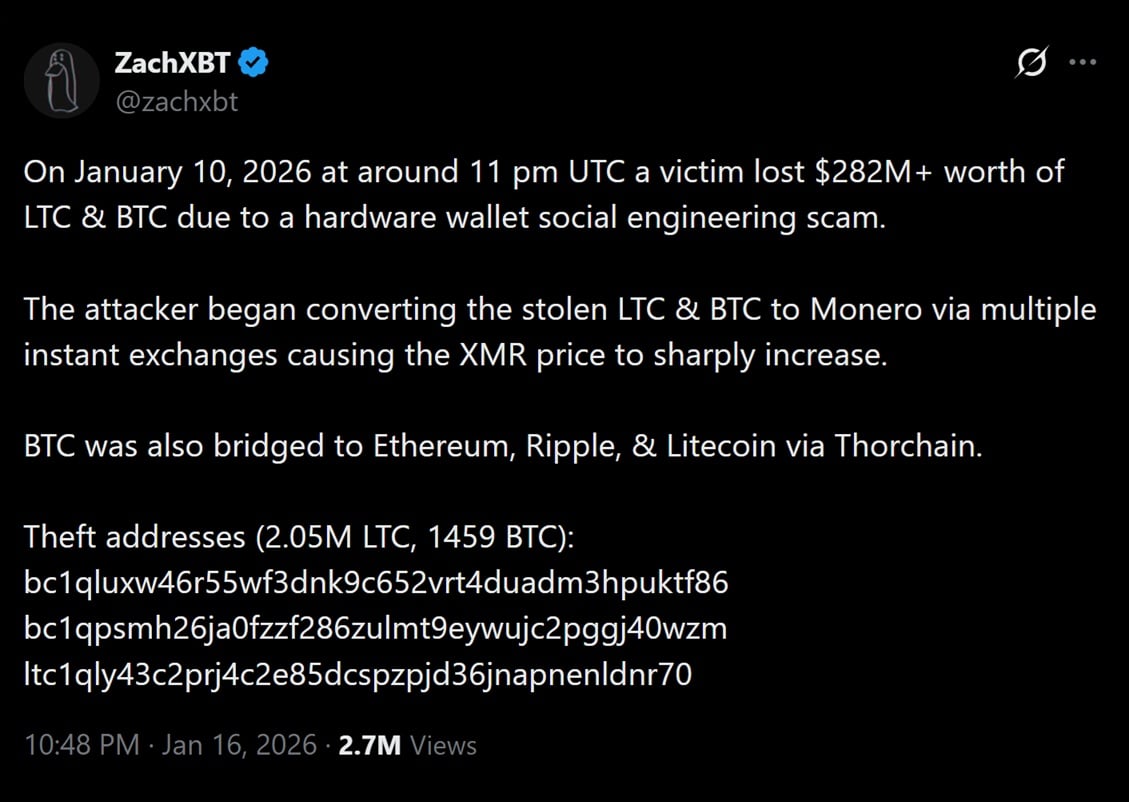 Image source: X
The attacker didn’t need to break anything. They just needed the victim to type 12 words into the wrong place, then moved fast: the roughly $139 million in bitcoin and $153 million in litecoin was split across THORChain bridges, run through instant-exchange services into monero, and layered through peel-chain transfers within minutes.
ZeroShadow’s monitoring team managed to flag and freeze about $700,000 of it inside 20 minutes, a rare partial save, and a reminder of just how small a fraction of a seed-phrase theft is usually recoverable at all.
Why 12 Words Is Actually an Enormous Number
Each BIP39 word carries 11 bits of entropy, because the wordlist has exactly 2,048 (2^11) entries. A 12-word phrase carries roughly 128 bits of total entropy once you account for a built-in checksum, and a 24-word phrase carries 256 bits.
Those aren’t just “bigger” numbers than a typical password, they’re astronomically bigger. Brute-forcing every possible combination of a full 12-word phrase, even at an extremely generous 1 billion guesses per second, would take on the order of 10^22 years. The universe is about 13.8 billion years old.
There is no realistic amount of future computing power that closes that gap; guessing a complete, unknown seed phrase isn’t a risk anyone needs to plan around.
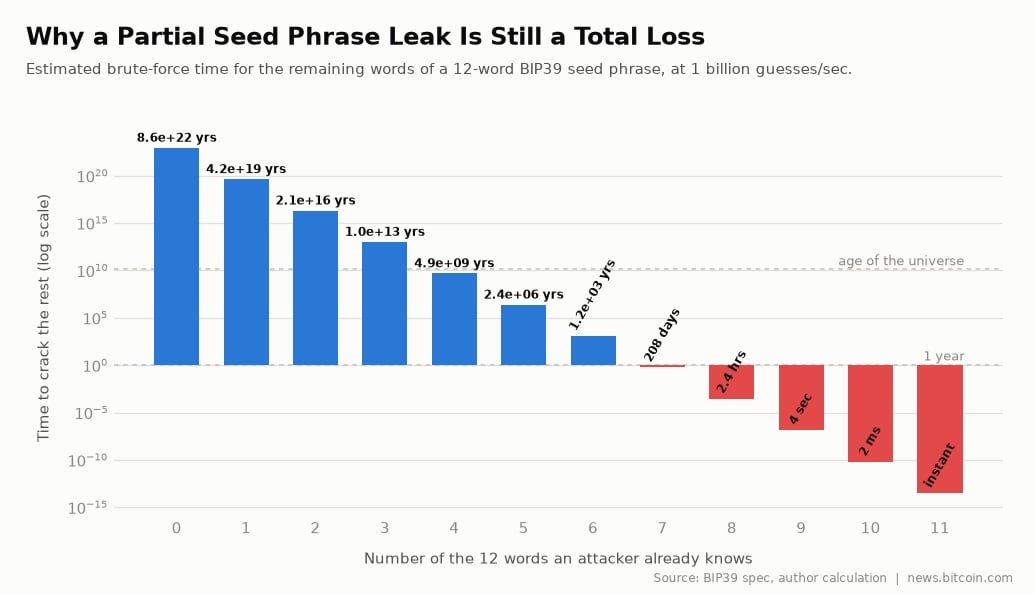
The danger is never the math but exposure. If even a handful of the words leak, or an attacker learns some of them from a photo, a cloud backup, or a support-impersonation scam, the remaining search space collapses catastrophically rather than gracefully. The chart above shows why: with 6 of 12 words already known, cracking the rest would still take an estimated 1,169 years at that same guess rate (still safe).
But at 7 words known, that number drops under a year. At 8 words known, it’s a few hours. By 10 or 11 words known, it’s milliseconds. Security doesn’t degrade in a straight line as words leak; it falls off a cliff, which is exactly why “just the first six words” or “half my phrase” is not a meaningfully safer thing to expose than the whole thing.
The One Feature Built to Catch Mistakes, Not Attackers
BIP39’s checksum exists for a much more mundane reason than security against guessing: it catches typos. The last word of a seed phrase isn’t purely random; a few of its bits are a checksum calculated from the other words, so a wallet can verify the phrase was transcribed correctly.
Write down one word wrong, and there’s a very high chance the wallet will flag the phrase as invalid the moment you try to restore it, rather than silently generating a wallet with a different, empty balance. It’s a small piece of the design, but it’s the reason a garbled backup usually announces itself immediately instead of turning into a slow-motion disaster discovered months later.
Millions of Coins Prove the Bigger Risk Isn’t Theft
For all the attention a $282 million phishing heist draws, the far larger, quieter cause of loss is simpler: people losing access to their own words. Estimates vary, but blockchain analytics firm Chainalysis has put the figure as high as 23% of all mined bitcoin (several million BTC out of the roughly 19.8 million mined to date) permanently inaccessible, largely through forgotten phrases, destroyed backups, and deaths without any inheritance plan for the words. No hacker, no exploit, no phishing page, just a wallet nobody can open anymore, holding coins that will never move again.
That’s the real weight of a seed phrase, i.e. not a password to be remembered, but the sole, non-negotiable proof of ownership for an asset with no recovery mechanism at all. Written down wrong, it fails safely. Exposed even partially, security collapses fast. Lost outright, with nothing else to fall back on, the bitcoin behind it simply stops existing for anyone.