By Gatestone Institute | Created at 2026-09-29 09:25:14 | Updated at 2026-09-29 10:10:06
44 minutes ago
By Gatestone Institute | Created at 2026-09-29 09:25:14 | Updated at 2026-09-29 10:10:06
44 minutes ago
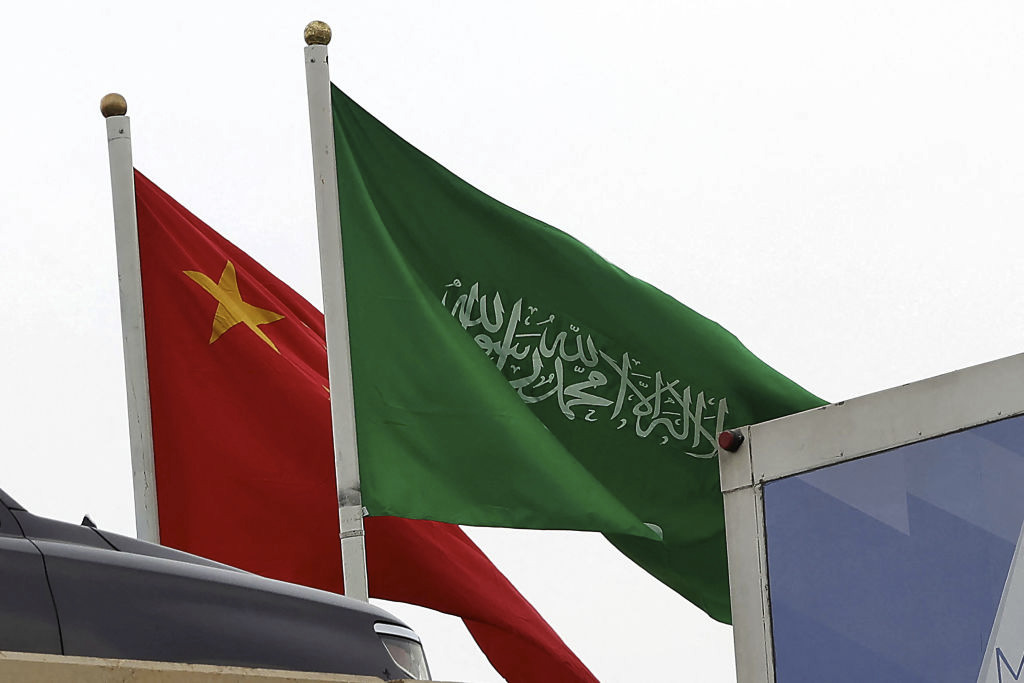 US President Donald Trump's decision to sell state-of-the-art F-35 stealth fighter jets to Saudi Arabia seriously risks undermining his efforts to secure America's technological advantage over China, both in national security and the battle for global AI supremacy. Pictured: The Chinese and the Saudi flags fly in Riyadh, on December 7, 2022, ahead of Chinese President Xi Jinping's visit to the Saudi capital. (Photo by Fayez Nureldine/AFP via Getty Images)
US President Donald Trump's decision to sell state-of-the-art F-35 stealth fighter jets to Saudi Arabia seriously risks undermining his efforts to secure America's technological advantage over China, both in national security and the battle for global AI supremacy.
Trump initially agreed to sell the Saudis 48 F-35s in a deal worth an estimated $24.3 billion when he hosted Crown Prince Mohammed bin Salman at the White House in November 2025.
The administration has now approved the sale, giving the go-ahead for a deal that will provide Riyadh, which enjoys close diplomatic and trade ties with China, access to some of the American military's most advanced technology.
The deal has already generated a great deal of controversy, not least because of warnings from American intelligence that it could result in Beijing using its ties with Riyadh to acquire the F-35's top-secret stealth technology.
US intelligence officials have already flagged their concerns about possible Chinese espionage through the security partnership between Beijing and Saudi Arabia.
The Pentagon's Defense Intelligence Agency recently issued a report claiming that Chinese military access to Saudi bases, and the Saudi use of Chinese technology, could compromise the F-35 technology.
The proposed deal has also prompted fierce criticism from Israel, the only Middle East country that currently operates F-35s. Israel fears the deal would effectively give the Saudis parity with their own air force, which operates a fleet of F-35 fighters that have recently seen action in Iran, Lebanon, Syria and Yemen.
Providing Saudi Arabia with the warplanes risks undermining the Trump administration's commitment to help Israel maintain a "qualitative military edge" over other countries in the region, a commitment the US State Department stressed would not be affected by the sale.
"The proposed sale of this equipment and support will not alter the military balance in the region," the State Department alleged in a notice announcing the decision.
The controversy over the sale to Saudi Arabia is likely to continue, as it will require the approval of the US Congress, which has already raised concerns about the likely security implications of the deal.
As US Rep. Raja Krishnamoorthi (D-Ill.), who sits on the House Intelligence Committee, recently commented, the deal "could put the crown jewels of American military technology within reach of the Chinese Communist Party."
Congressional concerns over the deal, moreover, have deepened following reports that sensitive F-35 technology may have already fallen into Chinese hands after a shipment of weapon components was unexpectedly diverted to Hong Kong in the summer.
The shipment, which was being sent from the US to Australia, included one of the F-35's canopies, which covers the cockpit and contains stealth technology that only the US and its allies have access to. This has prompted concerns that the parts could be analysed by Chinese scientists and used to improve Beijing's own military technology.
The Pentagon has issued a statement saying it was "aware of the shipment issue", while politicians on Capitol Hill are undertaking their own inquiry.
The Trump administration's attempt to sell-F-35s to Saudi Arabia is not the first time it has faced stiff Congressional scrutiny about signing lucrative deals to provide the world's most sophisticated fighter to countries with questionable alliances.
The United Arab Emirates officially paused a proposed $23 billion F-35 purchase agreement in 2021, after the Biden administration expressed concerns over Abu Dhabi's relationship with Beijing and its use of Huawei 5G technology.
More recently, Congress has raised concerns about the Trump administration's recent willingness to allow Turkey to rejoin the F-35 programme, years after it was suspended due to the country's purchase of the Russian S-400 air defence system.
The pressure on the Trump administration to cancel the F-35 sale to the Saudis is likely to intensify. It comes against the backdrop of the deepening rivalry between the US and China over who wins the AI race, with Beijing being accused of waging a dirty tricks campaign to gain an advantage over US technology firms.
US Treasury Secretary Scott Bessent recently warned that China had been "kicking" the US on rare earth minerals and AI intellectual property theft as part of its long-running campaign to achieve technological supremacy over the US. "And you know, if we have to," he said, "we'll kick back."
A recent warning issued by US intelligence and cybersecurity agencies highlighted an aggressive campaign by Chinese AI developers to extract "proprietary functionalities and capabilities" from American frontier AI models to advance the development of their own models. "China-based AI companies are engaging in aggressive, malicious, and targeted distillation activities at an industrial scale," the report stated.
While China is indulging in these practices to win the AI race with the US, there is no doubt that it will attempt to obtain F-35 technology. The Trump administration therefore needs to proceed with the utmost caution before signing off on any deal that could enable highly sensitive technology, whether it relates to AI or stealth fighter jets, to fall into Chinese hands.
Con Coughlin is the Telegraph's Defence and Foreign Affairs Editor and a Distinguished Senior Fellow at Gatestone Institute.