By The Straits Times | Created at 2026-08-31 08:11:27 | Updated at 2026-09-29 10:36:38
4 weeks ago
By The Straits Times | Created at 2026-08-31 08:11:27 | Updated at 2026-09-29 10:36:38
4 weeks ago
TASHKENT – Growing major-power rivalries and the weaponisation of trade dependencies are leaving smaller countries with less room to chart their own paths, said Senior Minister Lee Hsien Loong.
But countries such as Singapore and Uzbekistan cannot respond by turning inwards, he said in a speech to Uzbekistan’s Parliament, the Oliy Majlis, in its capital Tashkent on Aug 31. Instead, they must remain open and strengthen ties with like-minded partners.
“Trade dependencies are becoming weaponised. In response, countries are emphasising resilience and security over economic interdependence and mutual prosperity,” he said.
“In such an environment, small- and medium-sized countries face greater uncertainty, enjoy fewer opportunities, and have less international space to pursue our own independent paths. This worries us in Singapore, and it must concern you in Uzbekistan too.”
Lee said the rules-based international order that prevailed after the Second World War and the Cold War had given smaller countries a measure of protection and predictability.
Singapore and Uzbekistan had both benefited greatly from the rules-based international order, including the multilateral trading system centred on the World Trade Organization (WTO), he noted.
But multilateralism is now being eroded, with rivalries and tensions between major powers growing. While bigger countries may be able to pursue self-sufficiency and erect trade barriers to protect their domestic markets, smaller ones will always have to do business with the world.
“Closing ourselves off and turning inwards is simply impossible. We must remain open and outward-looking, and seek out like-minded partners who will work with us to support and uphold multilateral rules,” Lee said.
Lee said he welcomed Uzbekistan’s impending accession to the WTO, saying the move demonstrated that countries were still pursuing openness, rules-based trade and economic interdependence even as the global trading system comes under pressure.
Uzbekistan, a country of about 38 million people, first applied to join the WTO in 1994, but the process stalled for years. Negotiations resumed in 2020 as the country pursued economic reforms and opened up its economy under President Shavkat Mirziyoyev. It is now aiming to become a WTO member in 2026.
Joining the WTO would give Uzbekistan greater access to global markets, while requiring it to follow common international rules on trade and provide more predictable conditions for foreign businesses and investors.
Lee said Uzbekistan’s accession would strengthen the “coalition of like-minded countries” working to shore up the multilateral trading system.
Challenges beyond trade
Lee noted that both Central Asia and South-east Asia have long been regions where major powers jostled for advantage and influence.
“Today, the Great Game continues and has intensified,” he said, referring to the historical rivalry among major powers for influence in Central Asia.
Despite being some 6,000km apart, Lee said the two countries shared several similarities.
Both became independent after peacefully splitting from larger federations - Uzbekistan from the former Soviet Union and Singapore from Malaysia - and are relatively small compared with some of their neighbours.
Both are also heavily affected by changes in the wider world, from geopolitics to climate change, Lee noted.
“Geography may be an obstacle, but geography does not determine our fate. Countries have agency, because their peoples and their leaders can take their fates into their own hands,” he said.
Lee told the parliament that the two countries have stepped up cooperation since Mirziyoyev’s state visit to Singapore in 2023.
He said that then, he and Mirziyoyev had discussed attracting foreign investment, improving the quality of government and investing in education. They also discussed urban development, digitalisation and innovation, as well as fostering interfaith harmony.
These were areas that had also been important to Singapore’s development, Lee said. Despite their different histories and circumstances, both countries faced many similar challenges and had much to gain from exchanging experiences.
Economic ties remain nascent, but Lee said trade and Singapore’s direct investments in Uzbekistan are growing, alongside greater interest among Singapore businesses in opportunities in the country.
During Lee’s visit, Singapore and Uzbekistan agreed to launch negotiations on a free trade agreement, which he said would make it easier for businesses in both countries to access each other’s markets and further boost economic ties.
The partnership could also expand into areas such as water management, where Singapore has developed expertise, and newer domains such as financial technology, Lee said.
Another area is developing people and institutions, and Lee shared how several hundred Uzbek officials have travelled to Singapore for training in public administration, civil aviation and urban development. Lee said that the two countries are now exploring a dedicated programme for senior Uzbek government officials on leadership and governance.
Turning to regional ties, Lee said Singapore and Uzbekistan could also help forge stronger links between Central and South-east Asia.
He welcomed Uzbekistan’s planned accession to ASEAN’s Treaty of Amity and Cooperation, a pact that sets out principles for peaceful relations and cooperation between countries in the region and its partners. No date has been announced for its accession.
Singapore also hopes to identify more opportunities for ASEAN to engage partners beyond its traditional networks when it chairs the grouping in 2027, he said.
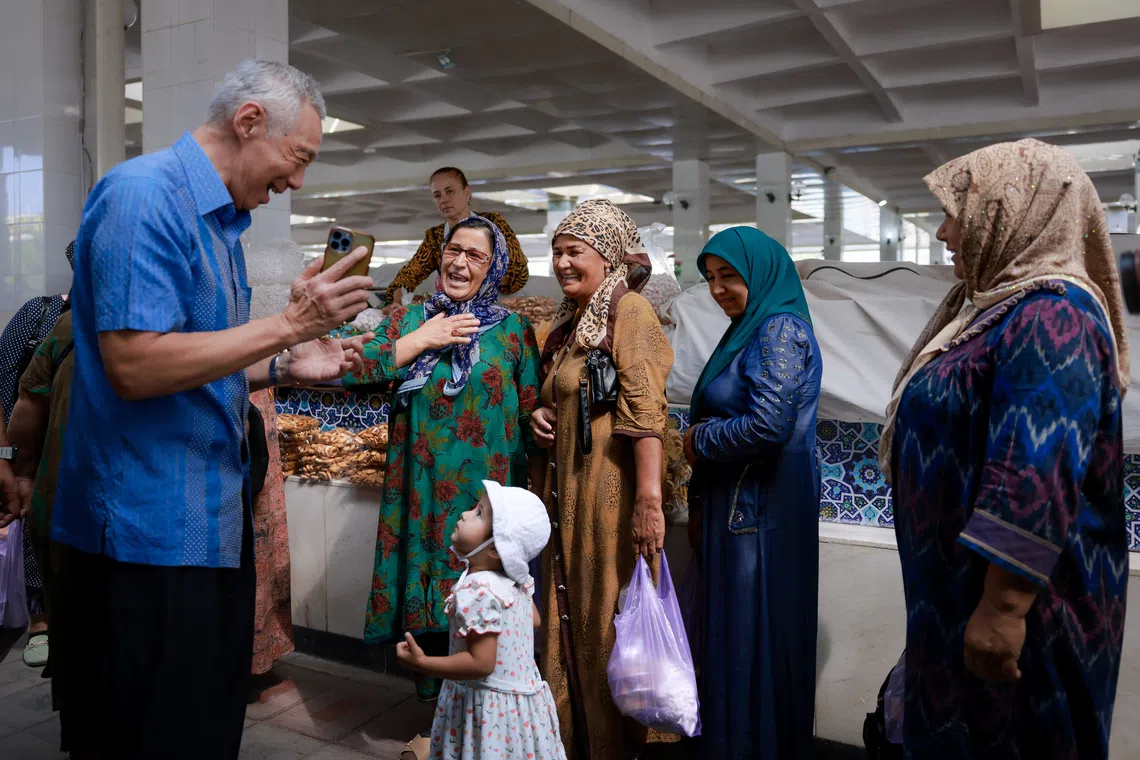
Senior Minister Lee Hsien Loong photographs local shoppers as he walks through Siyob Bazaar in Samarkand, Uzbekistan, on Aug 30.
ST PHOTO: GAVIN FOO
Lee’s visit was also the fulfilment of a long-held wish. He said he had read about Tashkent, Samarkand and Bukhara as a boy, and later told himself during a transit at Tashkent Airport that he would return one day.
When Mirziyoyev invited him to visit in 2023, Lee said he immediately accepted, and that he was glad after all these years he had made it.
Lee also congratulated Uzbekistan on its 35th Independence Day on Sept 1.
Next year will mark 30 years of diplomatic relations between Singapore and Uzbekistan, and Lee said the two countries should build on the progress they have made together.
“Amidst all the uncertainty and turbulence in the world, smaller countries like us must continue to strengthen our partnership and cooperation – globally, between our regions, and bilaterally,” he said.