By Bitcoin News | Created at 2026-07-25 17:55:51 | Updated at 2026-07-25 20:56:34
3 hours ago
By Bitcoin News | Created at 2026-07-25 17:55:51 | Updated at 2026-07-25 20:56:34
3 hours ago
FeaturedPublished:Jul 25, 2026, 1:46 PM
SpaceX completed its 13th test flight on July 24, deploying 20 next-generation Starlink satellites and achieving its smoothest ocean splashdown yet. Despite the success, shares of the firm (Nasdaq: SPCX) barely budged, still trading roughly 15% below their June IPO price.
Published: Jul 25, 2026, 1:46 PM
Key Takeaways
- Starship Flight 13 launched July 24, deploying 20 V3 Starlink satellites and landing intact in the Indian Ocean.
- SPCX shares stayed near $114-116, about 15% below SpaceX’s $135 June IPO price, despite the successful test.
- SpaceX’s performance and overall market reception since its much hyped debut has remained lukewarm.
A Mostly Clean Test, With One Failure
SpaceX launched Starship atop its Super Heavy V3 booster from Starbase in Boca Chica, Texas, just after 6:50 p.m. Eastern on July 24 after several technical glitches and delays. The rocket’s upper stage deployed its full payload of 20 next-generation Starlink V3 satellites, some fitted with cameras to monitor the heat shield during reentry. The satellites were expected to burn up roughly 20 minutes after deployment, as planned for this test configuration.
The upper stage then achieved a soft splashdown in the Indian Ocean, its smoothest ocean landing to date, giving engineers their first clear view of an intact heat shield after reentry. SpaceX called the flight a success overall, saying all major test objectives were met.
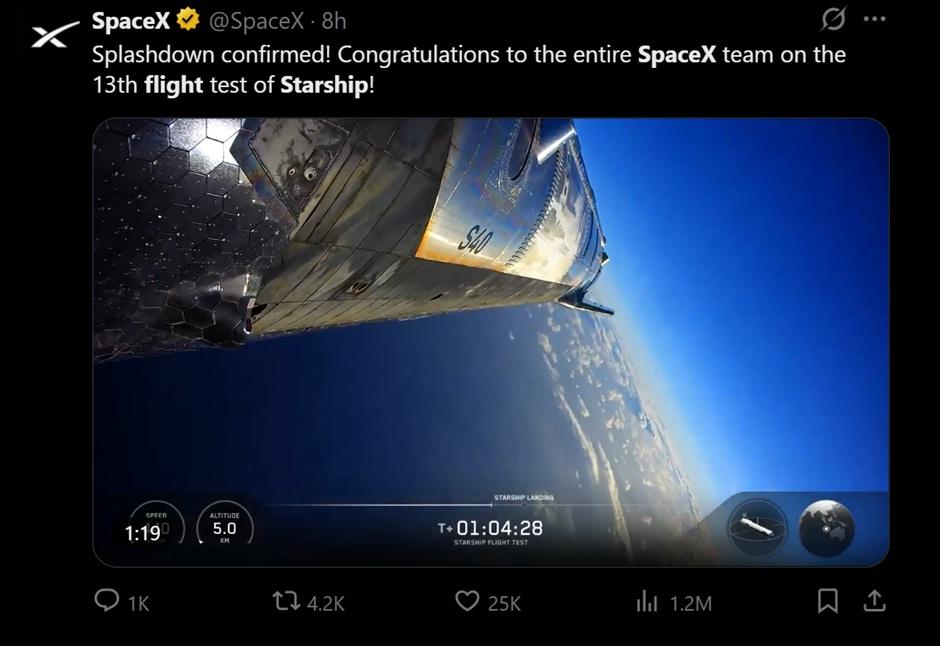 Image source: X
The V3 Starlink satellites carried on this flight represent a significant upgrade over the constellation’s current generation. SpaceX says the new satellites can support up to 1 terabit per second (Tbps) of downlink capacity, roughly 10 times the throughput of V2 satellites, and 160 gigabits per second (Gbps) of uplink, a 22-fold increase. This was the first Starship flight to carry the V3 design into orbit-bound deployment, positioning the test as a milestone for Starlink’s next-generation network rather than just a rocket demonstration.
Stock Reaction Underwhelms Despite Success
Shares of SpaceX slid into the test with clear investor caution, with SPCX falling 2.7% on the trading day before launch, marking a new closing low of $115.07 and a 7.2% decline for the week. Pre-market trading on July 24 saw shares dip a further 1.15% to $113 ahead of the launch window.
Following the test, SpaceX stock barely moved, even though the flight met its major objectives. Shares were trading around $115, about 1.2% above the stock’s all-time low of $110.85 and roughly 15% below the $135 price investors paid at SpaceX’s June initial public offering (IPO).
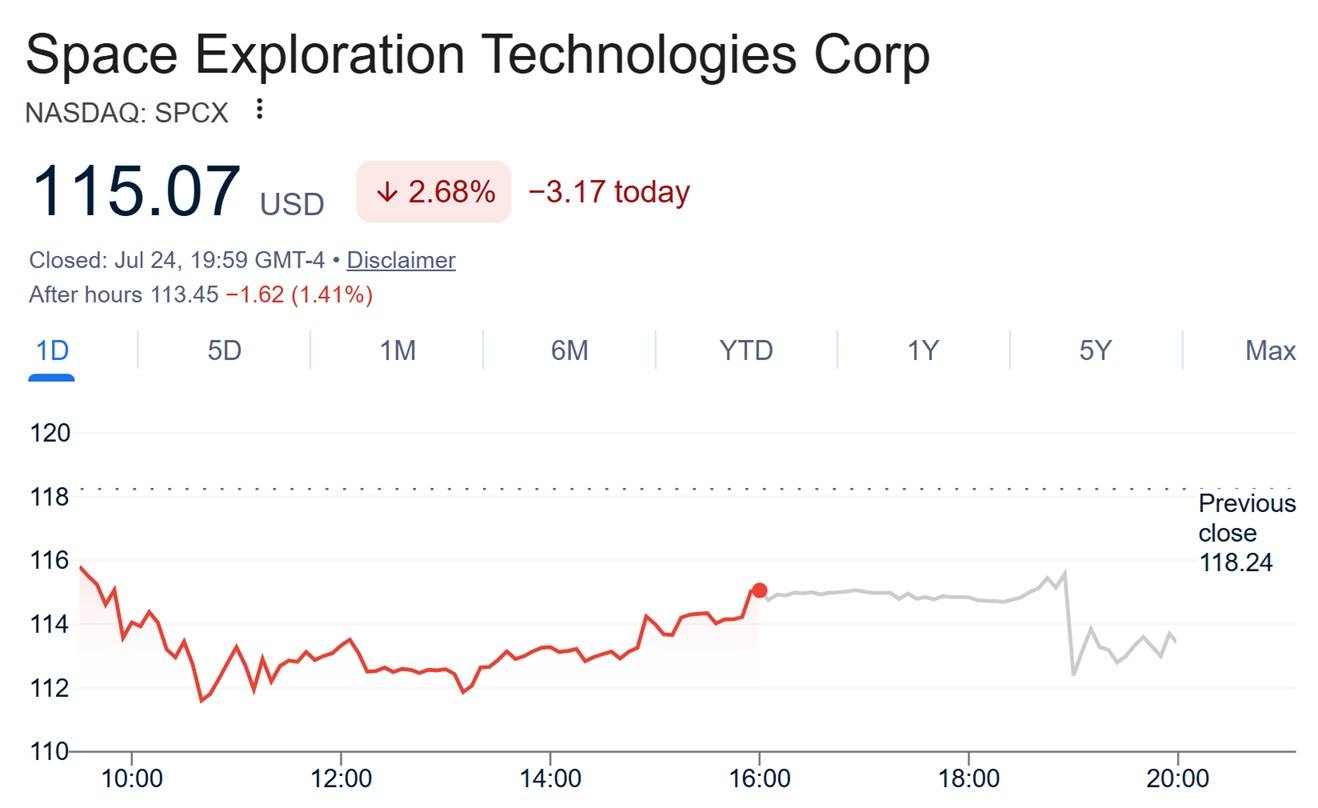
The muted reaction suggests investors have continued to weigh broader questions about SpaceX’s cash-burning Starship program as heavily as the satellite deployment success. It was also the first Starship test to fly since SpaceX went public, giving public shareholders a live look at the program’s execution risk for the first time.
First Test as a Public Company
Friday’s flight carried extra weight as the first Starship test to fly since SpaceX completed its June IPO, giving public shareholders a live, real-time look at the program’s execution risk for the first time. Starship has long been central to SpaceX’s long-term ambitions, from Starlink’s global broadband buildout to NASA’s Artemis lunar lander program, making the rocket’s reliability a direct input into how investors value the broader company.
SpaceX has not announced a date for Starship’s next test flight and engineers will likely focus on diagnosing the Super Heavy booster’s landing burn failure before attempting another Gulf of Mexico recovery, while the V3 Starlink satellites deployed on this mission offer an early proving ground for the network capacity upgrade the company is betting on.