By Literary Hub | Created at 2026-08-27 09:15:33 | Updated at 2026-09-18 14:28:40
3 weeks ago
By Literary Hub | Created at 2026-08-27 09:15:33 | Updated at 2026-09-18 14:28:40
3 weeks ago
In my living room a framed photograph hangs on the wall. A man clad in balloon pants and torn white shirt tosses a wooden pitchfork full of straw into the air with athletic grace. He’s threshing. Behind him spreads a green valley uncluttered by cars, roads, or electric wires. Crouching at the edge of the field, two small children can be seen. One is watching the threshers, but the other turns back, facing the camera. His white robe is ripped; his feet are bare. That boy grew up to be my husband. The photo, taken in 1971, could depict a much earlier time—a century, perhaps two centuries before. What is it that makes the world of this photo such a foreign country—is it distance, or time? To whom does this landscape belong? To my husband, to me, to our children? Or can anyone get a visa to the vast country that is the past?
Article continues after advertisement
I met my future husband Ali in the cramped supply room of the public high school in Tinghir, Morocco where we were both members of the teaching staff. We were formally introduced when the man in charge of the ancient mimeograph machine teased, “Watch out for that one, he might try to steal your pen.” He was boy band cute, with a mop of tousled black curls and a klieg light smile. I had just turned twenty-two. Such is young love. The differences—native language, religious and cultural background—seemed trivial. Our youth alone was a wide path of common ground.
As I imagined the story, I realized I could draw upon memory—mine, my husband’s, and of the life we had shared.
Later that year, I visited his family for the first time. We drove high into the mountains on a single-lane, unpaved track that threaded in terrifying switchbacks alongside treacherous cliffs. At six thousand feet, we entered a narrow valley, where a ribbon of green laced between tall barren mountains. Ali’s father tilled tiny ancestral fields using an irrigation system developed during the Roman empire. His mother spent hours gathering kindling which she carried on her back. His parents could not read or write, and spoke only Tamazight (Berber), the indigenous language of Morocco. You could define this life by what they lacked—electricity, running water, bathrooms, navigable roads. Or you could define it by what they had, an intact agrarian-pastoral culture with ancient ways—seasonal herd migration, news carried by singing poets, communal celebrations, intact tribal and extended family ties.
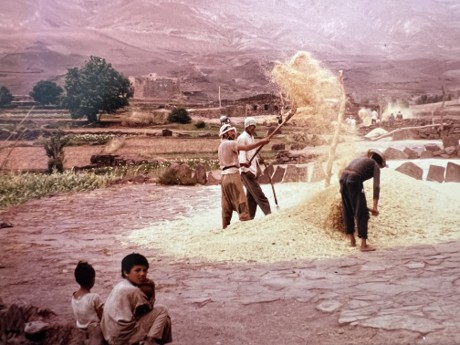 Ali at the threshing field, circa 1974.
By the time we met, Ali had already begun the slow process of departure that started when he left home at age ten to continue his schooling and became permanent when we moved to America for him to enroll in a PhD program. At first, we had no way to contact his family except for in-person visits, which were expensive and therefore rare. But the village slowly began to change, opening to the rest of the world with paved roads and electricity, cell phones and satellite TV and eventually the internet. His family still lives there, but they no longer live in the village of my husband’s youth.
Living in America, unable to visit, unable to call, Ali and I shared the memories of his home. It’s contours lived on between us in a deep and private well of stories that not even our children could understand—the wall his father dreamed of building around their house, the shrines his mother visited to try to heal his brother who was born with bent legs, his uncle who served in the French colonial Army and came home telling wild stories about his wartime experiences that no one believed.
That last story—about the uncle—stuck with me. I imagined Moroccan soldiers who’d served in the French army in World War I. How could you describe what you’d been through and seen in a language that had words for horse and hedgehog and threshing field, but none for cannon, or machine gun, or steel? What would it have been like to depart the High Atlas Mountains and travel by boat and train to the Western Front where European powers had spent centuries using industrial might to develop weapons of war?
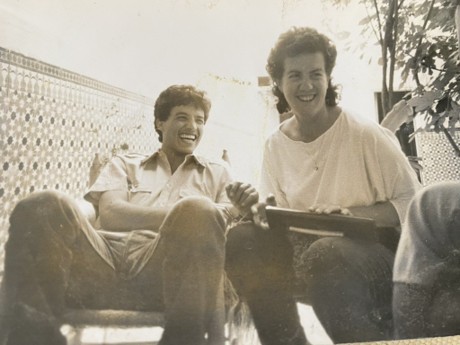 Elizabeth and Ali, 1985.
It’s no surprise that eventually a story found me, about a boy, born in the High Atlas, and a horse born in the Sultan’s palace. The different circumstances of their births are dwarfed by the modernity that bears down on both as they find themselves pulled into the giant vortex of the First World War.
The past is not so much foreign as free, free to anyone who is willing to do the work, to enter the past with a spirit of curiosity and a willingness to conjure a living world out of the detritus that history leaves behind.
It was act of audacity to try to imagine the world through the eyes of a young boy leaving his home in the Atlas Mountains in 1899, to put myself in the shoes of a colonial soldier who ends up at the Western Front, to inhabit a young French woman who encounters this same Moroccan soldier and tries to help him, and to march with a French soldier, born in the colony of Algeria, who has never set foot in France until he arrives to fight a war. But as I imagined the story, I realized I could draw upon memory—mine, my husband’s, and of the life we had shared. It took me forty years to reach that level of confidence, but when I was ready, I dove in without fear.
Because here’s the thing. The past belongs to no one, and as such, it also belongs to everyone. What makes good historical fiction is the author’s authority, and there are many different routes to authority. My path was through lived experience, shared stories, and most importantly, along the lanes of memory. My authority came from encountering life in the High Atlas Mountains before the present replaced the past, slowly but surely, leaving only memory and story in its wake.
The writer L.P. Hartley once famously said “the past is a foreign country; they do things differently there.” But I find that I don’t quite agree. A foreign country is a real place that you can visit, that you can learn about, and that eventually with time and openness, can stop being foreign at all.
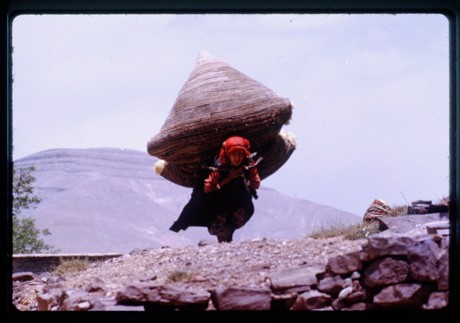 A woman carrying threshed wheat.
The past is different—as impossible to access, as imaginary as Narnia or the Land of Oz. It’s a place we construct out of whatever it is we believe that we know and try to convince our readers to follow.
Which brings me once again to the task of the writer of historical fiction. Everyone who wants to travel into history must cross the most forbidding distance—that of time itself, and of the relentless power of the present to warp our views. “The past,” one of my characters, Hassan, a Moroccan soldier, says, “is a country you cannot visit except in your mind.” I would argue that the past is not so much foreign as free, free to anyone who is willing to do the work, to enter the past with a spirit of curiosity and a willingness to conjure a living world out of the detritus that history leaves behind.
_______________________________
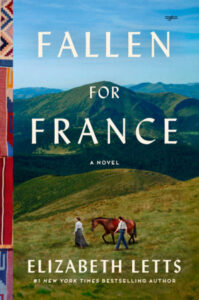
Fallen for France by Elizabeth Letts is available from Ballantine Books, an imprint of Random House, a division of Penguin Random House, LLC.