By crypto.news | Created at 2026-08-18 09:51:04 | Updated at 2026-08-18 10:15:49
59 minutes ago
By crypto.news | Created at 2026-08-18 09:51:04 | Updated at 2026-08-18 10:15:49
59 minutes ago
Short seller James Chanos described Strategy and Bitcoin as an “$80 billion actionable spread” on Aug. 18, reviving debate over the valuation of Michael Saylor’s Bitcoin treasury company.
Summary
- Strategy held 840,447 bitcoin after recent sales, below the 847,363 coin peak disclosed in June.
- At $64,188 per Bitcoin, Strategy’s remaining holdings were worth approximately $53.95 billion on Tuesday morning.
- MSTR’s market capitalization was about $34.4 billion, but direct comparison ignores senior financing claims entirely.
- Chanos previously closed his short MSTR, long Bitcoin trade in November 2025 after spread compression.
- Strategy’s dashboard placed its mNAV near 1.04, indicating only a narrow enterprise value premium Tuesday.
Chanos called the relationship one of the largest “pure arbitrage opportunities” he had seen. His earlier trade involved shorting Strategy’s MSTR shares while taking a long position in Bitcoin.
The latest claim requires context. Strategy no longer holds the 847,363 BTC cited in some reports. Recent company disclosures place its balance at 840,447 BTC following several sales during July and August.
At Bitcoin’s Tuesday price of approximately $64,188, those holdings were worth about $53.95 billion. MSTR had a market capitalization of roughly $34.4 billion, while its shares gained close to 5% to $97.68.
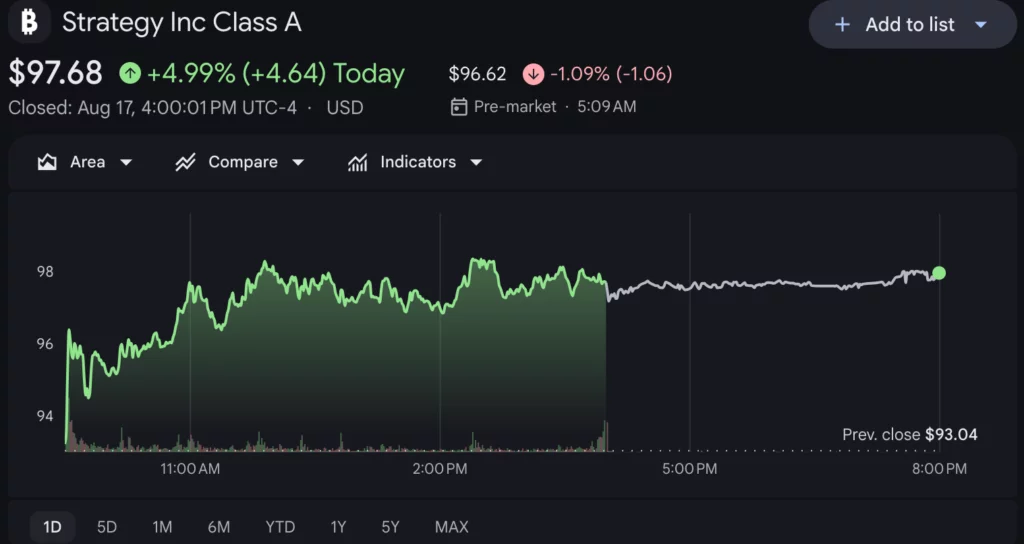 Strategy shares price chart, source: Google Finance
The $19.5 billion difference between those two figures is not a direct arbitrage profit. It excludes debt, preferred stock, cash, software operations, taxes and the costs required to maintain a hedged position.
Chanos’s $80 billion figure is not a simple market gap
Chanos did not publish a complete calculation showing how he reached the “$80 billion actionable spread.” The figure therefore remains his characterization of the opportunity rather than a directly verifiable difference between two market prices.
One of the greatest pure arbitrage situations, ever. An $80B actionable spread. $MSTR #Bitcoin
— James Chanos (@RealJimChanos) August 18, 2026Strategy’s own dashboard placed its modified net asset value multiple, or mNAV, near 1.04 on Tuesday. That measure compares enterprise value with the value of its Bitcoin after accounting for parts of the capital structure.
An mNAV of 1.04 indicates a premium of approximately 4%, based on the company’s methodology. It does not show MSTR trading at the wide premium that supported Chanos’s original trade in 2025.
Comparing common equity market capitalization directly with Bitcoin holdings produces a discount because common shareholders rank behind creditors and preferred shareholders. Strategy has issued several preferred securities carrying dividend obligations and also has outstanding debt.
The company’s software operation, dollar reserve and other assets must also be included. As a result, buying MSTR does not provide the same economic exposure as holding an equivalent dollar amount of Bitcoin.
Strategy’s Bitcoin balance has declined from its peak
A June 29 SEC filing showed that Strategy held 847,363 BTC at the end of June. The company had spent $64.1 billion acquiring the coins at an average price of $75,651.
Strategy subsequently sold Bitcoin under a board authorized monetization program. The program allows sales to fund its dollar reserve, interest expenses, preferred dividends and security repurchases.
As previously reported, the company sold 1,690 BTC and used the proceeds for preferred share repurchases during the week ending Aug. 9.
Those sales reduced the balance to 840,447 BTC. The remaining tokens carried an aggregate acquisition cost of approximately $63.36 billion and an average cost of $75,385 per coin.
At Tuesday’s Bitcoin price, the position was approximately $9.4 billion below its disclosed purchase cost. That is an unrealized accounting difference rather than a realized loss unless the coins are sold.
The same filing series showed that the company raised cash by issuing additional MSTR shares. Common stock issuance increases liquidity but also expands the number of shares participating in the Bitcoin exposure.
MSTR and Bitcoin carry different financial risks
Direct Bitcoin ownership exposes an investor mainly to changes in Bitcoin’s market price and the security of their custody arrangement. MSTR adds corporate financing and management risks.
Strategy has issued STRC, STRF, STRD and STRK preferred shares. These securities sit ahead of common shareholders and carry dividend rates ranging from 8% to 12%, subject to their respective terms.
The company has also established a dollar reserve to meet preferred dividends and interest obligations. In related coverage, the reserve reached $4.65 billion after further common stock sales.
Strategy’s board authorized up to $1.25 billion of additional Bitcoin sales to help fund that reserve. It also approved separate $1 billion repurchase programs for preferred securities and MSTR common stock.
These layers prevent the trade from being risk free. A short seller must borrow MSTR shares, pay borrowing costs and manage the possibility that the stock rises faster than Bitcoin.
The long side also requires financing. If Bitcoin falls while MSTR rises because of short covering, new financing or changing investor demand, both parts of the trade can lose money temporarily.
Chanos previously exited after the premium contracted
Chanos began constructing his earlier position in late 2024, when MSTR traded at a large premium to the value of Strategy’s Bitcoin. The premium exceeded three times the Bitcoin value at points during November 2024.
He publicly described the trade in 2025 as long Bitcoin and short MSTR. Chanos argued that investors were paying too much for Bitcoin exposure available directly or through lower cost exchange traded products.
As Reuters reported, Strategy’s market value stood around 1.74 times its Bitcoin holdings when Chanos renewed his criticism in June 2025.
The gap later narrowed. Chanos said his firm closed the hedged position on Nov. 7, 2025, after the trade gained more than 50%. He described the remaining opportunity as too small to justify keeping the position open.
His latest statement does not confirm that he has reopened the trade. It also does not disclose position size, entry prices, borrowing costs or the instruments that would be used.
Future SEC filings will show whether Strategy continues selling Bitcoin, issuing MSTR shares or repurchasing preferred securities. Those decisions, together with Bitcoin’s price and changes in financing costs, will determine whether the company trades at a premium or discount to its adjusted asset value.