By CryptoSlate | Created at 2026-08-18 15:01:05 | Updated at 2026-08-18 15:17:31
47 minutes ago
By CryptoSlate | Created at 2026-08-18 15:01:05 | Updated at 2026-08-18 15:17:31
47 minutes ago
Strategy (formerly MicroStrategy) directed all $333.7 million raised from common-stock sales last week toward preferred-stock obligations and cash reserves, extending a two-month shift that has prioritized STRC support over additional Bitcoin purchases.
According to an Aug. 17 SEC filing, the company sold 3.45 million MSTR shares from Aug. 10 through Aug. 16, using $52.4 million of the proceeds for dividends on STRC, its Variable Rate Series A Perpetual Stretch preferred stock.
The firm further revealed that it used $132.2 million to repurchase STRC shares, and $149.1 million to increase its US dollar reserve to $4.8 billion.
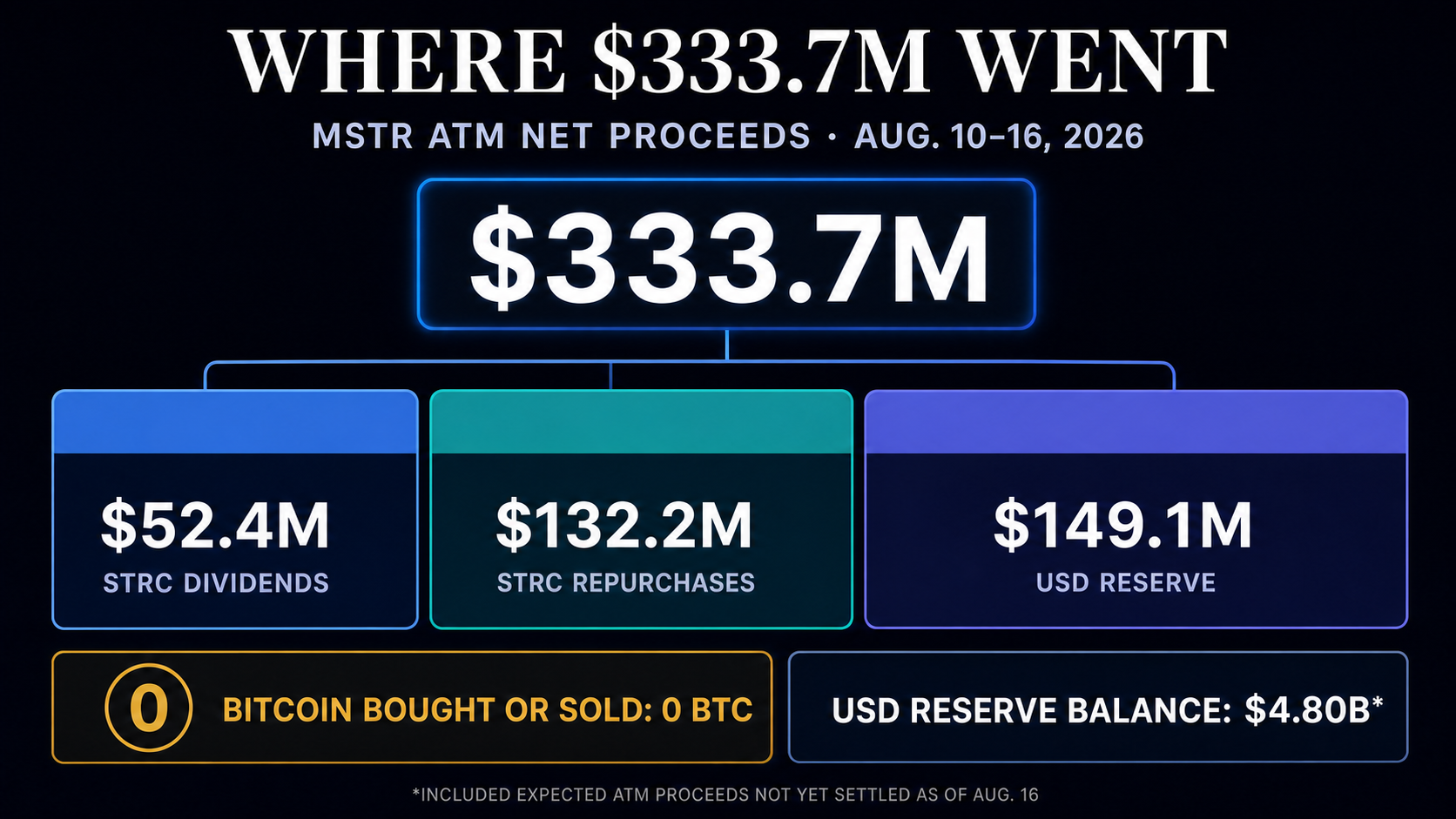
Strategy bought or sold no Bitcoin during the period, leaving its holdings unchanged at 840,447 BTC. The firm acquired these holdings for $63.36 billion at an average price of $75,385 per coin.
This move extends a broader reversal in the financing cycle that helped make Strategy the world’s largest corporate Bitcoin holder.
The company has not increased its BTC holdings since June 21 and has sold nearly 7,000 Bitcoin over the past two months, while accumulating billions of dollars in cash and repurchasing about $347 million of STRC.
That shift has coincided with a much steeper decline in MSTR than in Bitcoin.
Data from Saylortracker shows that Strategy’s shares have fallen roughly 35% over the past two months, compared with a decline of about 10% in Bitcoin.
 MSTR and Bitcoin Price Performance Since June 1 (Source: Saylortracker)
Strategy says STRC support will eventually lift MSTR
MSTR’s widening underperformance has put Strategy’s new capital priorities under scrutiny, with shareholders questioning why common equity is being used to support STRC while Bitcoin accumulation has stalled.
That concern surfaced directly during an Aug. 17 investor Q&A, when one shareholder complained that MSTR appeared to have become management’s lowest priority as Strategy used common-stock issuance to support its preferred securities.
CEO Phong Le rejected that characterization, arguing that restoring value to MSTR still depends on increasing Bitcoin per share and that making STRC work has become one of the main ways Strategy intends to achieve that.
The company also dismissed the prospect of paying a dividend on MSTR. Le said capital was better deployed to strengthen the balance sheet and expand the digital-credit business, which management expects to provide additional financing for future Bitcoin purchases.
According to him:
“The best deployment of capital for us is to get stretched to work to buy Bitcoin and put it on our balance sheet. And that's ultimately the objective of the company. And so over time, if you believe in the underlying asset Bitcoin and Bitcoin starts to rise for all the characteristics uh Mike had mentioned before, then MSTR will start to rise over time and that's ultimately the goal of the company.”
Michael Saylor, the Bitcoin treasury company's executive chairman, said Strategy is effectively in an investment phase, where decisions that may offer little immediate relief to MSTR shareholders are intended to build a credit franchise capable of attracting substantially more capital over time.
That model depends on Bitcoin outperforming Strategy’s cost of funding. Saylor put the company’s hurdle rate at roughly 10% to 10.5% and said billions of dollars in annual credit issuance could generate substantial value for common shareholders if Bitcoin appreciates faster than the cost of servicing that capital.
STRC’s recent weakness, however, has required Strategy to devote more of its balance sheet to keeping that financing engine functioning.
Le said the biggest lesson from the preferred stock’s drawdown was the need to maintain enough dollar liquidity to backstop dividends and reassure institutional investors. Strategy's $4.8 billion US dollar reserve provides about 2.8 years of coverage for preferred dividends and debt interest.
He also said future STRC proceeds could remain in dollars rather than immediately being converted into Bitcoin, allowing the company to maintain a larger liquidity buffer as the credit business grows.
Saylor said the same shift applies to Strategy’s Bitcoin holdings. The company must now be prepared to sell Bitcoin as well as buy it, he said, while also buying STRC when necessary rather than only issuing the preferred stock.
The approach gives Strategy more flexibility to move capital between BTC, cash and its preferred securities, but it also changes the financing cycle MSTR investors had become accustomed to.
STRC support could face a second test from MSTR
Strategy’s effort to stabilize STRC could continue drawing on its balance sheet if the preferred remains below the $99 to $100 range management wants to maintain.
Saylor said Strategy does not want STRC moving materially away from par because predictable pricing and liquidity are central to the product. If the preferred fell to $95 or $90, he said the company would use its resources to bring it back toward its intended range.
Notably, the company still has $653 million remaining under its preferred-stock repurchase program.
However, that demand on capital could become harder to manage if MSTR faces another source of selling pressure.
That demand on capital could become harder to manage if pressure intensifies on MSTR itself.
Strategy faces renewed risk of removal from major MSCI equity indexes under a broader screening proposal that could trigger an estimated $2.8 billion in passive selling.
During the Q&A, Strategy said MSCI-linked indexes account for roughly 3% to 4% of its shares. Le acknowledged that the exclusion would create some selling pressure but called the potential effect “immaterial,” arguing that the affected holdings were too small to materially alter MSTR’s long-term value.
Strategy plans to challenge the proposal and has criticized MSCI’s treatment of Bitcoin when determining which assets qualify as operating assets.
The company also has $1 billion remaining under its MSTR repurchase authorization, giving management another option if the common stock comes under heavier pressure.
Saylor said Strategy would consider buying back MSTR if it traded at a sufficiently deep discount to net asset value. At current levels, however, management has not viewed that as the best use of capital.
An MSCI exclusion could therefore create a new test for Strategy’s expanded capital-management framework.
Cash already being used for STRC dividends, preferred-stock repurchases and reserve growth could also be needed for MSTR buybacks, debt obligations or renewed Bitcoin purchases.
If STRC remains below management’s target while index-related selling adds pressure to MSTR, Strategy could face simultaneous demands from both sides of its capital structure.