By The Straits Times | Created at 2026-08-09 21:36:40 | Updated at 2026-08-09 22:54:50
1 hour ago
By The Straits Times | Created at 2026-08-09 21:36:40 | Updated at 2026-08-09 22:54:50
1 hour ago
SYDNEY – Australia and countries across the Indo-Pacific face a growing threat of attacks on submarine cables that could devastate their economies, and they should take urgent steps such as improving their monitoring and repair capabilities, says a new report from Australia.
The report, by the National Security College at the Australian National University (ANU) and partly funded by Australia’s Department of Defence, warns that submarine cables face “growing threats from state and non-state adversaries”.
Released on Aug 10, it also warns that potential consequences of a disruption to the cables are becoming more severe in Australia due to the country’s growing reliance on digital connectivity.
About 99 per cent of Australia’s international connectivity flows through submarine cables, with most of the remainder carried by satellites.
“Major disruptions to submarine cables can have immediate and severe economic impacts, disrupting financial markets, halting international trade, and severing cloud-based services,” the report says.
“Australia lacks a comprehensive strategy to properly protect and govern its submarine cable networks,” the report says, urging the country to ensure that it can swiftly repair cables and have priority access to repair capabilities.
The report says that there have been multiple apparent attacks on submarine cables in recent years in European waters as well as near Taiwan, suspected to be linked to Russia and China.
The cables connecting Taiwan with its Matsu Islands, near China’s mainland, were severed 27 times from 2018 to 2022, while several incidents were recorded around Taiwan in 2025.
Multiple incidents have occurred off the coast of Norway and in the Baltic Sea in the past five years, including one in November 2024 in which a Chinese-flagged vessel was accused of intentionally dragging its anchor in the Baltic Sea and severing two submarine cable networks.
“The more recent incidents in the Baltic Sea and around Taiwan suggest that state actors are now actively probing and testing cable infrastructure in peacetime as part of broader hybrid warfare strategies, with the intention of being able to rapidly degrade connectivity at the outset of a conflict,” the report says.
Australia has expressed growing concern about the threats to submarine cables.
At the Shangri-La Dialogue in Singapore in May, Australia’s Defence Minister, Richard Marles, warned that the seabed was “becoming a battlefield”.
“We have been slow, collectively slow, to recognise (submarine cables) as the strategic targets they have become,” he said at the annual defence and security forum.
There has been a growing international push to protect submarine cables.
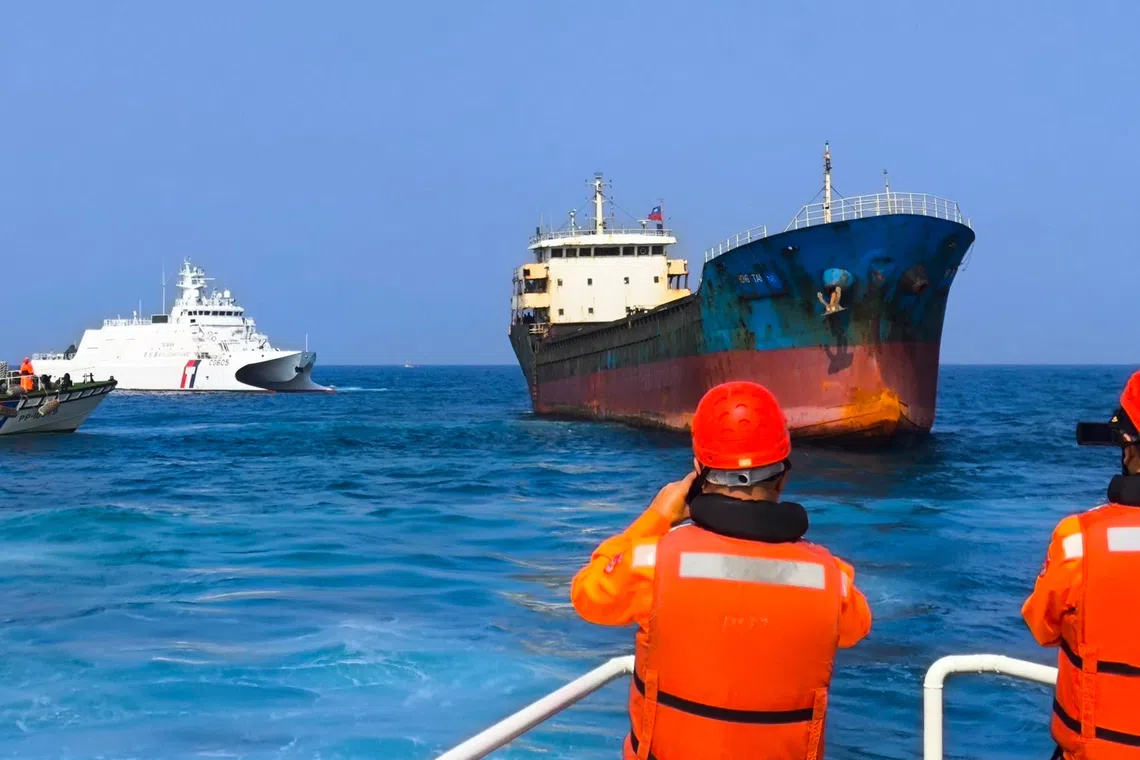
Taiwan detained a Chinese-crewed cargo ship on Feb 25, 2025, after a subsea telecoms cable was severed off the island.
PHOTO: AFP
At the Shangri-La Dialogue, a group of 17 countries, including Australia, Singapore, Malaysia, France and the United Kingdom, launched the Guiding Principles for Underwater Infrastructure Defence Exchanges to strengthen cooperation in protecting underwater infrastructure such as cables.
In addition, Australia, the US and the UK have launched a project as part of their AUKUS security partnership to develop sensors and weapons systems for underwater drones that could protect cables.
But the ANU report says Australia needs to do more to improve international cooperation as cables inevitably cross various countries and international waters.
It says Australia could hold joint exercises with ASEAN and individual partners in South-east Asia to improve monitoring of cables and practise responding to attacks.
Other proposals include establishing an Indo-Pacific association to bring together regional cable operators to cooperate on mitigating risks and convening a conference in the region to develop shared responses to threats and incidents.
“The transnational nature of cables – crossing multiple jurisdictions and spanning vast distances – means that effective protection requires sustained engagement with industry, regional partners and close allies.”
As it is, submarine cables are maintained and repaired by only a few international operators, including Singapore-owned Global Marine Group, Singapore-based ASEAN Cableship and Malaysia-based Optic Marine Services.
One of the report’s authors, Samuel Bashfield, from La Trobe University, told The Straits Times that growing international tensions had increased the risk that submarine cables could be targeted.
He said greater international cooperation was needed to share information about the movement of ships and to find alternative routes for cables to prevent congestion.
Australia could equip its navy ships to conduct cable repairs, he said. It should also have agreements with cable repair firms that ensure priority repairs if requested by the government, he said.
“Navies and militaries are waking up to these threats and looking at what capabilities they need to monitor the seabed or conduct clearance diving or work with partners to ensure cables are protected,” said Bashfield, a research fellow at the university’s Centre for Global Security.
Indeed, the report also urges the Australian military to develop capabilities that protect cables, including improving seabed surveillance, anti-submarine and anti-drone capabilities, and clearance diving and counter-mine warfare.
As these cables “are in deep waters in the high seas”, only a sophisticated state actor could disrupt them, he added.
Meanwhile, international cooperation is not just for tackling threats that are malevolent, said Bashfield.
According to the ANU report, 86 per cent of cable disruptions are due to anchors or fishing trawlers, 7 per cent are due to undersea earthquakes and other natural disasters, 4 per cent are due to abrasion and 3 per cent are due to failures. This list does not include sabotage or attacks because few suspected cases have been proven.