By The Straits Times | Created at 2026-08-06 14:55:14 | Updated at 2026-08-06 15:50:43
1 hour ago
By The Straits Times | Created at 2026-08-06 14:55:14 | Updated at 2026-08-06 15:50:43
1 hour ago
BANGKOK - Thailand has reaffirmed its commitment to “supporting and continuing to work closely” with Myanmar for the latter’s full participation in ASEAN, the two countries said in a joint statement on Aug 6.
“Myanmar expressed its appreciation for Thailand’s constructive role in facilitating the normalisation of its relations with ASEAN,” the statement added.
This follows Myanmar president Min Aung Hlaing’s two-day official visit to Thailand to meet Prime Minister Anutin Charnvirakul – his first since stepping down as military chief. The visit has drawn some controversy because Myanmar is still under heavy sanctions and underscores how ASEAN is deeply divided on how to approach Myanmar.
In the statement, the two countries said they agreed to “further deep dialogue at all levels”, in the areas of security, trade and fighting transnational crimes.
However, at a press conference after the two leaders’ talks, Thailand Foreign Minister Sihasak rejected accusations that the kingdom is according legitimacy to Min Aung Hlaing by rolling out the red carpet for him.
“It’s not about legitimacy, it’s about reality,” he said, noting that Thailand is Myanmar’s immediate neighbour.
“We have problems that we that we face along the border, and at the same time, we have to be proactive in terms of helping Myanmar on the path of peace, stability,” he said. “And the best way to achieve that is to have talks with those who are in the position of power.”
ASEAN has barred Myanmar’s top leaders from attending its summit since the junta overthrew Aung San Suu Kyi’s civilian government in February 2021.
In April 2021, ASEAN drew up a peace plan, known as the Five-Point Consensus (5PC), which includes calls to end violence alongside greater humanitarian aid delivery access. The grouping has since insisted that Min Aung Hlaing implement the 5PC before relations with ASEAN may be normalised.
So far, Min Aung Hlaing has insisted that the 5PC was not fully endorsed by all ASEAN members when it was drawn up and hinted therefore that he has no obligation to implement it.
Five years on, however, a division among ASEAN’s members seems to have emerged, as some, including Thailand, appear to be leaning towards softening their stance towards Myanmar.
At the press conference, Sihasak said Thailand is proceeding with an approach he called “calibrated re-engagement” because he believes that serves the kingdom and the region best.
But he also said he is not expecting others to follow suit as countries have the right to make their own foreign policy choices.
When The Straits Times asked Sihasak if Thailand expects to see Min Aung Hlaing return to the ASEAN leaders’ summit in November, he said this is something the grouping has to agree on.
“It’s a two-way street, it’s a consensus. We have to work to achieve that consensus,” he said. “Thailand is not going to force anything on our colleagues but we know what we have to do because we are the country next door.”
The coup has killed at least 100,000 people in Myanmar, according to estimates by the international crisis-monitoring group Armed Conflict Location and Event Data.
“It’s recognised that there is no military victory, and we should not try to perpetuate the military situation,” said Sihasak.
Sihasak also said it may be time to “take a different approach”, and that if what Thailand is doing is helpful, then Bangkok will continue on this negotiation path with Myanmar.
He added that Thailand has again urged Myanmar to reduce the level of hostilities.
Independent Myanmar analyst Wai Yan Phyo Naing doesn’t expect much change from Myanmar following the bilateral talks.
“Thailand is mainly seeking solutions to lessen the side effects and problems it currently faces due to the conflict in Myanmar,” he told ST.
“At the same time, Thailand hasn’t put stronger pressure on Myanmar to implement the Five-Point Consensus and to improve Myanmar’s domestic affairs and political situation,” he added.
Stepping up collaboration
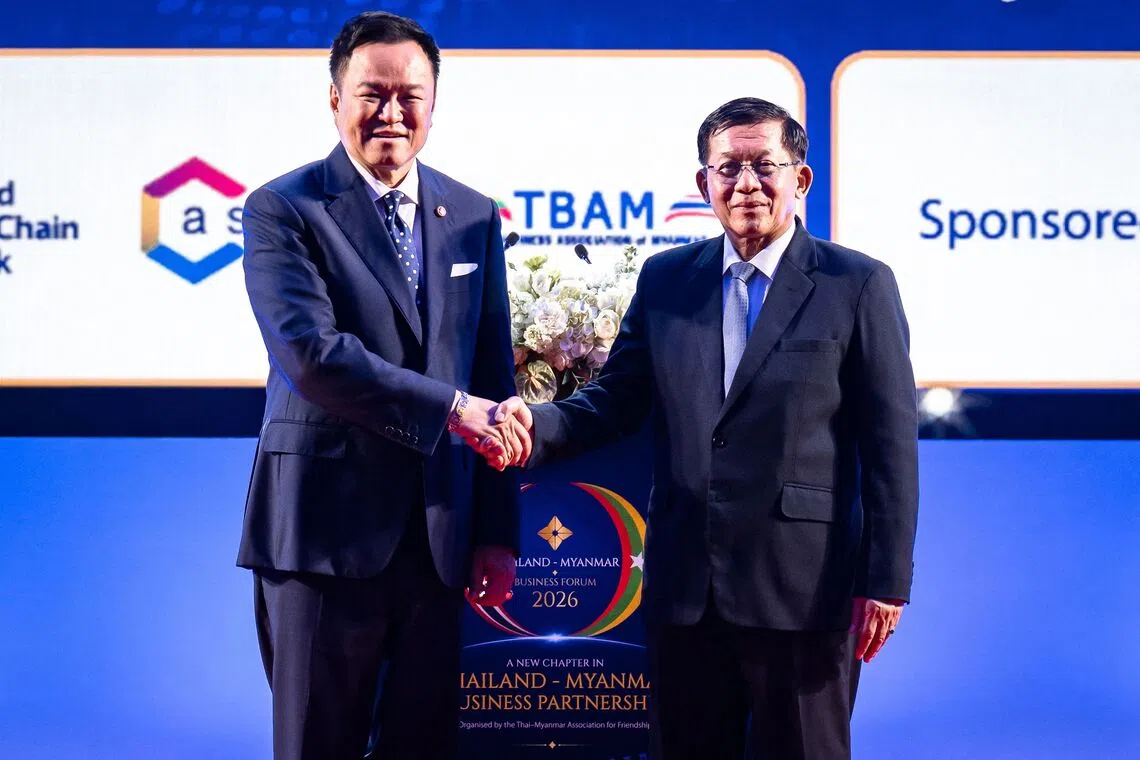
Thailand's Prime Minister Anutin Charnvirakul (left) and Myanmar's President Min Aung Hlaing shake hands during the Thailand-Myanmar Business Forum 2026 at the Queen Sirikit National Convention Center in Bangkok on Aug 6.
PHOTO: AFP
On the first day of Min Aung Hlaing’s visit, Myanmar and Thailand inked three agreements to increase collaboration in areas like labour and tackling environmental pollution along shared rivers.
Speaking at a Thailand-Myanmar business forum with some 700 participants, Anutin said he wants to see renewed economic and trade cooperation between the two countries.
“I have always believed that regardless of the political situation, whether domestic or international, the duty of the Government is to ensure that our people continue to enjoy well being, are able to live safely and securely, have employment, earn income, and have hope for the future,” Anutin said.
“The economy must not be disrupted. Businesses must continue to move forward. That is what we are committed to achieving together,” he added.
Describing Thai-Myanmar relations as “true friends”, the Myanmar president Min Aung Hlaing steered clear of mentioning the ongoing violent conflicts across the country.
Instead, he presented a deck to promote business opportunities in Myanmar.
“Myanmar is a peaceful country blessed with abundant natural resources and sufficient potential to meet domestic demand. We place great importance on promoting investment across a wide range of industries,” Min Aung Hlaing said.
Min Aung Hlaing’s administration does not have full control over the country, with large parts being controlled by ethnic armed groups or civilian resistance forces since the coup.
On June 16, the World Bank cut its economic outlook for Myanmar with annual growth expected to remain “subdued” at 2 per cent, down from 3 per cent prior to the global energy crisis.