By The Rio Times | Created at 2026-06-23 17:21:49 | Updated at 2026-06-25 00:47:21
1 day ago
By The Rio Times | Created at 2026-06-23 17:21:49 | Updated at 2026-06-25 00:47:21
1 day ago
Economy · Brazil
Key Facts
—The number. The Amazon state of Pará is set to draw about $14.7bn in mining investment through 2030, on the mining lobby’s own projections.
—The ranking. That is roughly nineteen percent of all planned Brazilian mining spending, second only to Minas Gerais.
—The pull. Brazil’s total mining pipeline now stands at a record $76.9bn for 2026 to 2030, lifted by iron ore and critical minerals.
—The other bet. The same state is the heart of a push to build a forest-based economy, selling products like açaí and nuts rather than only ore.
—The stage. Pará’s capital, Belém, hosted the COP30 climate summit late last year, putting the state in the global spotlight.
—The tension. Huge export earnings from ore and soy sit beside some of Brazil’s weakest social indicators.
Para mining investment is set to reach nearly one in five of all the dollars Brazil’s miners plan to spend this decade, even as the same Amazon state tries to build a very different kind of economy from its forest.
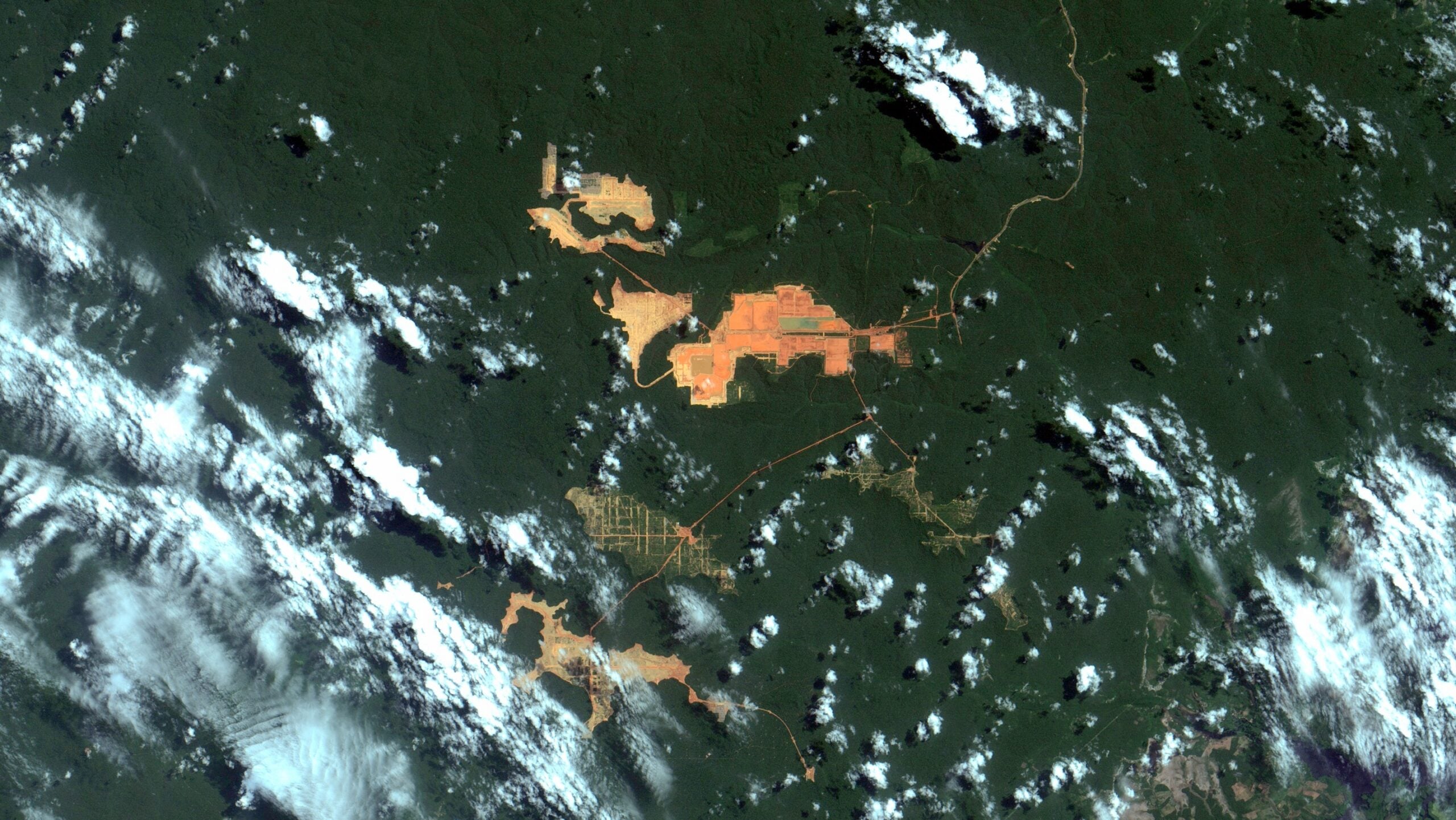 A bauxite mine inside the Saracá-Taquera National Forest in Pará, where mining meets conservation. (Photo: Wikimedia Commons)
One Brazilian state is about to capture a remarkable share of the country’s mining boom. It also happens to sit in the middle of the Amazon rainforest.
That state is Pará, in Brazil’s north, a territory larger than many countries. Its pull on investors captures a wider question about how the Amazon should make its living.
Why Para mining investment is surging
The figures come from Brazil’s mining institute, the industry body that speaks for companies behind most of the country’s output. It expects the sector to invest a record sum nationwide this decade.
The national pipeline reaches almost seventy-seven billion dollars for the years 2026 to 2030, according to the institute. Of that, Pará is set to draw close to fifteen billion.
That single share works out at roughly nineteen percent of all planned Brazilian mining spending. Only Minas Gerais, the country’s historic mining heartland, is set to attract more.
The reason is what lies beneath the ground. Pará holds vast iron-ore deposits, alongside copper and bauxite, the raw materials the world still buys in enormous volumes.
Iron ore remains the engine. It still accounts for more than half of all Brazilian mining revenue, and Pará sits with Minas Gerais at the top of that league.
The forest economy bet
Yet the same state is the showcase for a very different idea. Officials want to grow what they call the bioeconomy, an economy built on selling the forest’s products without cutting it down.
In practice that means goods such as açaí berries, cocoa and nuts, plus services like eco-tourism. Supporters argue these can pay local people while leaving the trees standing.
Açaí shows both the promise and the catch. A single Pará town bills itself as the world’s açaí capital, yet wealth from the berry has not erased the poverty and crime around it.
The ambition is large. Brazil hopes to triple the sector’s weight in Pará’s economy by 2050, betting that a living forest can be worth more than a cleared one.
Researchers see real money in it. Some estimate the bioeconomy could add billions of dollars a year to the wider Amazon’s output by 2050, if the right policies and markets fall into place.
The timing is deliberate. Pará’s capital, Belém, hosted the COP30 climate summit late last year, where the bioeconomy was placed at the centre of the agenda for the first time.
Live Market IntelligenceBrazil — Live Market BoardInside: market breadth, the sector heatmap, currencies & rates, the Latin America scoreboard and the full instrument board.Rio Times · Live Market Intelligence
Brazil — Live Market Board
B3 · São Paulo
Jun 23, 2026 · 14:14
Ibovespa · benchmark
171,482
+0.65%
L 168,495day rangeH 171,570
+25.58% over 12 months
Market breadth · 15 names
60% advancing
9 ▲ advancing6 declining ▼
Currencies, rates & key inputs
Sector heatmap · average move today
Industrials
+1.41%
WEGE3, RENT3
Consumer Staples
+1.39%
ABEV3
Financials
+1.07%
ITUB4, BBDC4, BBAS3, B3SA3
Energy
-0.08%
PETR4, PRIO3
Mining
-1.06%
VALE3, CSNA3, GGBR4
Consumer Disc.
-1.65%
AZZA3
Latin America scoreboard
IndexLastTodayStrength
IbovespaBrazil
171,482
+0.65%
S&P/BMV IPCMexico
67,188
+0.09%
S&P IPSAChile
10,902
+0.12%
S&P MERVALArgentina
3,227,759
-1.52%
MSCI COLCAPColombia
2,341.66
-2.16%
BVL S&P PerúPeru
57,045.35
-0.46%
Full instrument board
| IBOV | 171,482 | +0.65% | +25.58% | 170,370 | 171,570 | 168,495 | — |
| USD/BRL | 5.18 | +0.80% | -6.05% | 5.14 | 5.19 | 5.13 | — |
| SELIC | 14.25% | — | — | — | — | — | |
| PETR4 | 39.48 | +0.79% | +23.22% | 39.17 | 39.50 | 38.84 | 11,892,900 |
| VALE3 | 79.86 | -1.30% | +57.92% | 80.91 | 79.96 | 78.82 | 11,808,300 |
| ITUB4 | 41.24 | +0.73% | +16.13% | 40.94 | 41.38 | 40.39 | 11,833,900 |
| BBDC4 | 17.87 | +1.07% | +8.31% | 17.68 | 17.89 | 17.47 | 8,870,100 |
| BBAS3 | 19.84 | +1.33% | -5.88% | 19.58 | 19.90 | 19.33 | 8,048,400 |
| B3SA3 | 14.87 | +1.16% | +10.97% | 14.70 | 14.99 | 14.44 | 41,179,400 |
| ABEV3 | 16.35 | +1.39% | +20.50% | 16.13 | 16.36 | 16.05 | 14,279,700 |
| WEGE3 | 45.81 | +1.24% | +10.12% | 45.25 | 45.85 | 44.43 | 3,976,300 |
| PRIO3 | 56.15 | -0.94% | +29.83% | 56.68 | 56.50 | 55.72 | 4,119,100 |
| SUZB3 | 41.85 | -0.45% | -19.15% | 42.04 | 41.91 | 41.31 | 2,956,900 |
| RENT3 | 41.46 | +1.57% | -2.29% | 40.82 | 41.66 | 40.19 | 3,093,900 |
| AZZA3 | 19.08 | -1.65% | -50.61% | 19.40 | 19.65 | 18.85 | 2,400,600 |
| CSNA3 | 5.32 | -0.37% | -31.27% | 5.34 | 5.42 | 5.17 | 9,519,400 |
| GGBR4 | 21.57 | -1.51% | +34.00% | 21.90 | 21.75 | 21.31 | 4,928,200 |
| ENEV3 | 25.11 | +1.95% | +81.49% | 24.63 | 25.17 | 24.30 | 2,935,800 |
Largest moves today
ENEV3
25.11
+1.95%
AZZA3
19.08
-1.65%
RENT3
41.46
+1.57%
GGBR4
21.57
-1.51%
ABEV3
16.35
+1.39%
BBAS3
19.84
+1.33%
VALE3
79.86
-1.30%
WEGE3
45.81
+1.24%
The session read
The Ibovespa rose 0.65%, with breadth positive — 9 of 15 names higher. Utilities led, while Consumer Disc. lagged.
From The Rio Times
Related coverage · 23 Jun 2026
Brazil’s Farm Rio May Be Worth More Than the Group That Owns It
Read →
A contrast investors should watch
The two bets do not sit easily together. Mining and soy bring billions in exports, but critics say the wealth rarely reaches the people who live alongside it.
Pará posts a billion-dollar trade surplus yet carries some of Brazil’s weakest social indicators. The forest economy is pitched partly as a way to close that gap.
For a foreign investor, Pará is a test case in miniature. It asks whether a place can dig up minerals at scale and protect a forest the world says it needs, at the same time.
The mining money is committed and measurable. The forest economy is still mostly a promise, and which one defines Pará’s future is far from settled.
Frequently Asked Questions
How big is Para mining investment?
Brazil’s mining institute projects about $14.7bn of mining investment in Pará for 2026 to 2030, roughly nineteen percent of the national total. That makes the Amazon state the second-largest mining-investment destination in Brazil after Minas Gerais.
What is Para’s bioeconomy?
It is an economy based on selling forest products and services, such as açaí, cocoa, nuts and eco-tourism, without clearing the rainforest. Officials want to triple its share of the state economy by 2050 as an alternative to extraction.
Why does Pará matter to investors?
It is a large Amazon state drawing record mining money while also championing a forest-based economy. The clash between the two, in the COP30 host region, makes it a test of whether extraction and conservation can coexist.
The Rio Times · Power Map
See who really holds power in Latin America
Click to open the Power Map →