 By The Epoch Times | Created at 2026-08-13 01:41:57 | Updated at 2026-08-13 02:27:20
57 minutes ago
By The Epoch Times | Created at 2026-08-13 01:41:57 | Updated at 2026-08-13 02:27:20
57 minutes ago
Commentary
Five states were very delinquent in providing their audited financial statements for the fiscal year ending June 30, 2024: Arizona, Illinois, Mississippi, Nevada, and Oklahoma. Nevada wins the trophy for being the last to publish, with its field work completed on June 26, 2026. State Controller Andy Matthews blames a big portion of it on a commonly incurred delay due to the Enterprise Resource Planning software implementation. He expects the 2025 audit to be completed soon.
Now that these states have finally posted their annual comprehensive financial reports (ACFRs), we find some interesting movement. There is a new number one. The state of North Dakota has moved to the top of the list, replacing longtime leader Alaska. In 2016, North Dakota bumped Wyoming into third place and it has been in second place ever since. Near the bottom of the listing, Vermont dropped three places, making it one of the reasons California moved up one place.
Overall, it was a good year for 36 states (72 percent) and a down year for 14 states (28 percent).
The overall combined unrestricted net positions (UNP) improved by $104.9 billion (14 percent) during this year, with California representing nearly half of this amount.
One important goal is that the ACFRs are prepared timely and correctly. But to err is human. And the fiscal year ending in 2024 provided for several errors and corrections.
A positive goal for any municipality is to move up the rankings every year, with making it to the top position the ultimate goal; with congratulations to the Peace Garden State.
Let’s look at the graph below and discuss the four states that moved up five or more places and the two states that moved down four or more places. We’ll review the major components provided in the basic financial statements that will give you the top layer of accounting information. To dig deeper, either review the ACFR or contact your state legislators.
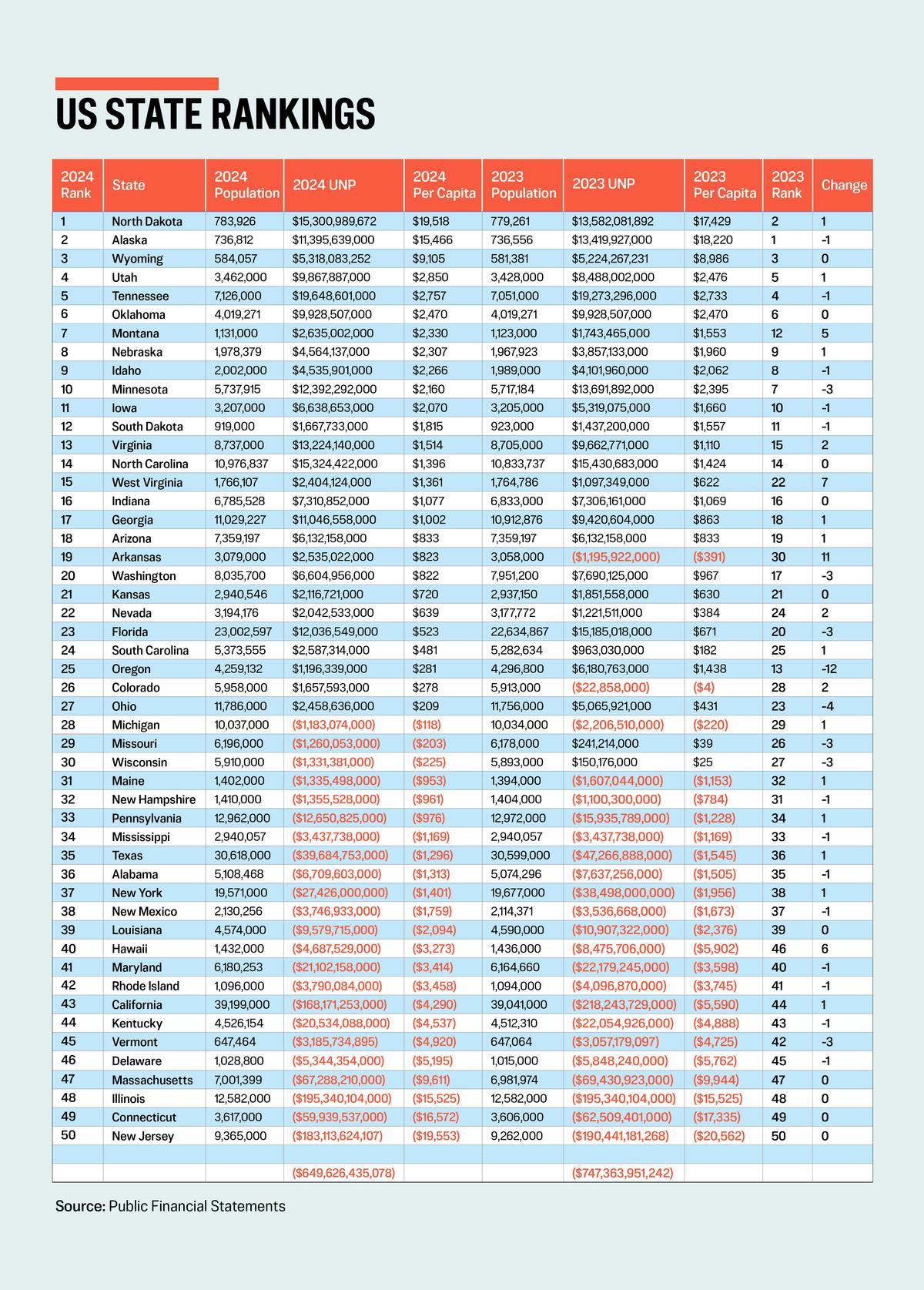
The state of Arkansas had revenues in excess of expenditures of $1.562 billion. It transferred $2.896 billion out of restricted assets and increased its net investment in capital assets by $727 million. Combined, this explains the $3.731 billion improvement in its unrestricted net position, moving it up 11 positions.
The state of West Virginia had revenues in excess of expenditures of $439 million. It reduced its net investment in capital assets by $939 million and transferred $71 million into restricted assets. Combined, this explains the $1.307 billion improvement to its unrestricted net position. But the state’s capital assets actually grew by $570 million and the long-term liabilities decreased by $452 million. For a nearly $1 billion drop, these two should have both gone in the other direction. Notwithstanding this conundrum, it explains the big increase in the unrestricted net position and West Virginia’s move up seven places.
In reviewing the annual comprehensive financial report, note 9 dealing with capital assets does not provide any hint. Capital assets increased during the year. Note 10, addressing long-term liabilities, shows the debts being paid down. There is no new significant debt related to capital assets. And there is no mention of recharacterizing existing debts that were collateralized by capital assets during the year.
Either there was a major undisclosed adjustment to the net investment in capital assets, which is the capital assets on the balance sheet less the related debt on the balance sheet, or a major adjustment needs to be made to explain or correct this odd reduction in the next annual comprehensive financial report.
What makes this discrepancy more intriguing is that West Virginia received the Government Finance Officers Association (GFOA) Certificate of Achievement for Excellence in Financial Reporting.
West Virginia is not alone, as this is not an uncommon matter. I encountered it myself when I served on the Orange County Board of Supervisors. I had to confront the independent outside certified public accounting firm that audited the county. Only to be told that the financial statements were the presentation of management. I’ve informed the Government Accounting Standards Board (GASB) that it should require a reconciliation of the “Net Investment in Capital Assets” in the footnotes. This would either greatly assist ACFR readers and/or prevent reporting errors.
The state of Hawaii had revenues in excess of expenditures of $796 million and spent $137 million toward its net investment in capital assets, explaining its $659 million reduction in its unrestricted net deficit. It moved up six positions.
The state of Montana had revenues in excess of expenditures of $1,528 million. It transferred $296 million into restricted assets and allocated $528 million for its net investment in capital assets. There was also an adjustment, explained in four pages of disclosures in Note 2, of $187 million. It is perfectly fine to have a footnote with the heading “Correction of Errors in Previously Issued Financial Statements.” However, it should be rare. Combined, it explains the increase of $891 million in its unrestricted net position and the state’s move up five places.
The state of Ohio had expenditures in excess of revenues of $523 million. It also transferred $1,549 million into restricted assets and increased its net investment in capital assets by $535 million. Combined, its unrestricted net position was reduced by $2,607 million and it dropped four places.
Oregon had revenues in excess of expenditures of $976 million. It increased its net investment in capital assets by $212 million and set $130 million aside in restricted assets. It should have improved its unrestricted net position by $634 million. But it also had a “Corrections of an Error” amount of $5.619 billion. This reduced the unrestricted net position from $6.181 billion to $1.196 billion. Wow!
Management described it in the beginning of the ACFR as follows:
“As discussed in Note 18 to the financial statements, the State determined its accounting for the tax surplus credit, known as the kicker, was not in accordance with generally accepted accounting principles resulting in a correction of an error of $5.6 billion, decreasing beginning net position in the Governmental Activities and beginning fund balance in the General Fund. Our opinion is not modified with respect to this matter.”
With regards to this change in accounting principle, it referred to the following:
“GASB Statement No. 100, Accounting Changes and Error Corrections, which defines “accounting changes” as changes in accounting principles, changes in accounting estimates, and changes to or within the financial reporting entity and describes the transactions or other events that would constitute those changes. The Statement prescribes the accounting and financial reporting for (1) each type of accounting change and (2) error corrections. Refer to Note 18, Fund Equity, for additional information.”
This historic “correction” caused the state of Oregon to drop 12 places. But it was probably too high in the rankings for the years 2022 (16th place) and 2023 (13th place) and is now where it is supposed to be.
But it wasn’t the only state to disclose a massive correction. California’s makes Oregon’s look like pocket change. The Golden State borrowed significantly to pay unemployment benefits resulting from Governor Newsom’s severe COVID-19 lockdown. But the state’s ACFR, on page 94, states:
“In December 2023, the U.S. Department of Labor (DOL) released Unemployment Insurance Program Letter (UIPL) 05-24, which raised the possibility for states to apply their statutes of limitations to CARES Act unemployment compensation claims. UIPL 05-24 prompted further inquiry from the State due to the lack of clear guidance on this issue. In January of 2025, DOL informed the State that under the CARES Act, as amended, there is no requirement for states to repay the federal government for CARES Act unemployment compensation overpayments that remain unrecovered. Accordingly, the position of the State’s unemployment insurance department is that the liability that was accrued in the Federal Fund has been determined to not be owed to the federal government and should be reversed. For the fiscal year ending June 30, 2024, an error correction to reduce the beginning balance of other liabilities and increase beginning fund balance by $46.2 billion is reflected in the Federal Fund.”
Translation: The Federal Government, with tax revenues received from all the 50 states, forgave a massive $46.2 billion debt owed to it by the state of California.
With a 2024 national population of roughly 340 million people, every man, woman and child essentially contributed $136 to the Golden State.
What’s the big takeaway? Municipality management and their auditors need to provide accurate and reliable accounting information to their stakeholders in a timely manner, in order to diligently pursue strategic financial and budget planning goals.
Since states are overseen by elected officials, their stakeholders need accurate data with which to critique the jobs these individuals are doing. If they’re not moving the ball toward a positive unrestricted net position, then voters have some serious decisions to make when casting their ballots.
Views expressed in this article are opinions of the author and do not necessarily reflect the views of The Epoch Times.