By Literary Hub | Created at 2026-08-11 11:41:53 | Updated at 2026-08-11 12:28:13
3 hours ago
By Literary Hub | Created at 2026-08-11 11:41:53 | Updated at 2026-08-11 12:28:13
3 hours ago
What’s next? What happens after you die? It’s one question I’ve never asked when interviewing the scores of nearly-departed people I’ve profiled for advance obituaries in The New York Times.
Article continues after advertisement
The answer is ineffable. But would the response, however hypothetical, help flesh out what Ann Wroe, the obituary editor of The Economist, calls the soul of her subjects—their core, their essence, which transcends the customary chronological details and other obligatory facts and figures that constitute most post-mortem profiles?
The question arose as I was researching my latest book, Are They Dead Yet?, an irreverent insight into the “Art of the Obit.” Working my day job, I wrote an article for the Times about the Brooklyn Museum’s exhibit of a rare, gilded version of the necromantic Egyptian prescription for an untroubled after-life known, anomalously, as the Book of the Dead.
The ancient scroll provides a road map to eternity in such vivid detail by its authors—and, presumably, their audience among the cognoscenti—who took it for granted that immortality was, given good behavior, inevitable, if you really coveted it.
Not everyone would.
Our concern with posterity is one characteristic that separates humans from other creatures, which is probably why none of the people whom I asked to interview for an advance turned me down.
The novel Tuck Everlasting by Natalie Babbitt is a cautionary tale about a family of the same surname who discover a Fountain of Youth—challenging them to reconcile with immortality and all its implications.
In 2016, when I wrote Babbitt’s obituary for the Times, I wondered whether she had ever contemplated the prospect of eternal life herself. She had. “I think that living forever would be a terrible thing,” I quoted her in the obit as saying. “It would be boring, sad and lonely.”
Death, the fear of it or the uncertainty that it portends, begat religion, although what you believe happens after you die, if anything, depends on which God you worship. (The columnist Charles Krauthammer captured the impenetrability of eternal reward and retribution in an observation I included in his Times obituary. “I don’t believe in God,” Krauthammer once said, “but I fear him greatly”).
Others have expressed their equivocation about nirvana less ominously. “I don’t want to achieve immortality through my work,” Woody Allen declared. “I want to achieve it through not dying.” (Allen also revealed his ambiguity about what comes next when he quipped: “I do not believe in an afterlife, although I am bringing a change of underwear”).
Christopher Hitchens, an avowed atheist, would have unambiguously rejected the prospect that when the proverbial party, as we know it organically, was over (he died in 2011) he would be invited to a sequel he was required to attend in perpetuity. “Whether it was a hellishly bad party or a party that was perfectly heavenly in every respect,” Hitchens wrote, “the moment that it became eternal, and compulsory would be the precise moment that it began to pall.”
(I was reminded, though, that perpetuity itself is fungible: When a philanthropist friend donated a wing to the Metropolitan Museum, he negotiated an extension in the family naming rights from 50 to 75 years so his grandchildren would share in the recognition).
“After your death, you will be what you were before your birth,” the German philosopher Arthur Schopenhauer declared confidently. Most scientific evidence would agree, although disproving the other possibilities can be problematic.
Is there a heaven or hell? Can we be reincarnated? Do we experience some spiritual awakening in an intangible nirvana? Will cryogenics or uploading our brainwaves entitle us to a do-over after we die? Can the dead communicate with us in post-mortem conversations? (Arthur Conan Doyle remained elusive despite his vow, before he died, to communicate through spiritualists; as an author, though, he managed to resuscitate Sherlock Holmes.)
Our concern with posterity is one characteristic that separates humans from other creatures, which is probably why none of the people whom I asked to interview for an advance turned me down. As an investigative reporter, I used to get confidential tips from whistleblowers; now, people pass me their resumes. If doing so seems craven, it’s also a lunge for the last word in linguistic eternity.
Mark Twain was worried about how he would be memorialized and a few years before he turned seventy, he appealed to the readers of Harper’s Magazine in a paid advertisement to help burnish his public reputation for posterity even if, as he acknowledged, a divine judgment probably had already been rendered.
There was still time though, he opined, for him to prevail upon ambivalent obituarists, whether they needed his personal perspective. After all, he averred, “an obituary is a thing which cannot be so judiciously edited by any hand as by that of the subject of it.”
Facts are facts, he said. They’re a matter of record. What worried him, he acknowledged publicly, was “the light which the obituarist shall throw upon them, the meanings which he shall dress them in, the conclusions which he shall draw from them, and the judgments which he shall deliver upon them. The verdicts, you understand: that is the danger line.”
Obituaries, I’m often reminded, are mini-biographies. They are not about death. They reveal how people lived their lives.
To preclude a posthumous verdict that Twain might have considered capricious, (had he been alive to read it), he appealed to all the newspapers and other periodicals that had prepared his advance obituary to publish it immediately so he could edit it “one suitable for me to read in public, and calculated to inspire regret.
Obituaries, I’m often reminded, are mini-biographies. They are not about death. They reveal how people lived their lives. What drove them? What were their dreams, their ambitions? What detours they took? What hurdles they surmounted? A Times obituary cements a legacy, validates a life, well lived of not, but one that was transformational or, at least, compelling enough to merit recognition in what is known as the paper of record.
We know that after you die an after-life exists—just for other people. But does the prospect of one for yourself, the prospect of post-mortem rewards or recriminations, affect our behavior before we die?
As the science fiction writer Robert A. Heinlein observed: “There is no conclusive evidence of life after death, but there is no evidence of any sort against it. Soon enough you will know, so why fret about it?” The philosopher Ludwig Wittgenstein more or less agreed. “The real question of life after death isn’t whether or not it exists,” he wrote, “but even if it does what problem this really solves.”
In her new book The Mattering Instinct, Rebecca Newberger Goldstein writes, “we long to live lives that we can regard as meaningful in our own eyes.”
That’s one reason many people aspire to lead praiseworthy lives later encapsulated in obituaries. It’s why other people read them. Arguably, being the subject of a Times obituary, itself, is a measure of immortality.
I once interviewed an Associated Press editor who was famous for micromanagement and rule book integrity. One of his rules was that no one could see their advance obituary. When he importuned one of his reporters to let him peek at the editor’s own advance, the reporter balked. He reminded the editor of the ironclad rule had had, himself, imposed, but couched his refusal with a grin.
“I’ll tell you this much,” the reporter added. “When it appears, you’re gonna love it.”
____________________________
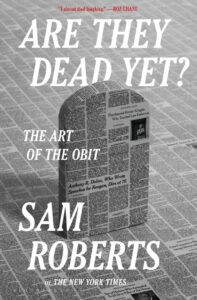
Are They Dead Yet? The Art of the Obit by Sam Roberts is available from Bloomsbury Publishing.